

Hydrochloric Acid HCl
HCl is hydrogen chloride as a pure molecular substance; when dissolved in water it forms hydrochloric acid, a strong-acid solution in which HCl is essentially converted to hydrated hydronium and chloride ions. Keeping the gas and the aqueous acid distinct resolves many common misconceptions.
What does HCl mean?
HCl contains one H atom and one Cl atom. In the gas phase it is a discrete polar covalent molecule. “Hydrochloric acid” refers to HCl dissolved in water, where the dominant acid chemistry is better represented with H₃O⁺ and Cl⁻ than with intact HCl molecules.
Once you can count every element correctly, the same formula becomes the basis for formula mass and molar mass.
What kind of chemical substance is it?
Hydrogen chloride is a polar diatomic covalent molecule. Chlorine attracts bonding electron density more strongly than hydrogen, giving Hδ+–Clδ−. In water, proton transfer to solvent is essentially complete under ordinary general-chemistry conditions, producing hydrated hydronium and chloride ions.
Why does Hydrochloric Acid behave this way?
The key chain is phase/solvent dependent: gas-phase HCl is a neutral polar molecule → water stabilizes separated charge extremely well → proton transfer produces H₃O⁺ and Cl⁻ → the aqueous solution behaves as a strong acid. This is why “HCl molecule” and “hydrochloric-acid solution” should not be treated as identical microscopic pictures.
What is the difference between hydrogen chloride and hydrochloric acid?
Hydrogen chloride is the molecular compound HCl, commonly discussed as a gas. Hydrochloric acid is its aqueous solution. In water, proton transfer is essentially complete, so H₃O⁺ and Cl⁻ are the dominant acid/base species.
Is HCl ionic or covalent?
An isolated HCl molecule is polar covalent. In aqueous hydrochloric acid, the chemistry is dominated by hydrated ions H₃O⁺ and Cl⁻. The answer therefore depends on whether you are asking about the molecule or the solution.
Why is hydrochloric acid a strong acid?
“Strong” means its proton-transfer reaction with water is essentially complete at ordinary dilute-solution conditions. It does not mean every HCl solution is highly concentrated.
Does a strong acid always have a very low pH?
Not necessarily. pH depends on concentration and activity as well as acid strength. A very dilute solution of a strong acid can have a much higher pH than a concentrated solution.
Is chloride ion a strong base because it has a negative charge?
No. Cl⁻ is the conjugate base of the strong acid HCl and is an extremely weak proton acceptor in water. A negative charge alone does not tell you base strength.
Why can concentrated hydrochloric acid fume?
Hydrogen chloride is volatile, and concentrated aqueous HCl can release HCl-rich vapor that interacts with atmospheric moisture, producing visible acidic mist. This is a hazard context, not a demonstration recommendation.
Does hydrochloric acid “contain H⁺ ions”?
Free bare protons are not a realistic picture in water. Introductory equations often write H⁺(aq) as shorthand; hydronium H₃O⁺ and larger hydrated-proton structures are better molecular descriptions.
Key properties and classification
Why this compound matters: Hydrochloric acid is a model strong acid used throughout stoichiometry, pH, titration and reaction classification. It also provides a powerful lesson in solvent effects: a neutral polar gas becomes an ion-rich aqueous solution because water stabilizes proton transfer products.
Where does Hydrochloric Acid appear in chemical equations?
These equations are included to connect the compound to chemistry concepts and stoichiometry. They are not laboratory procedures.
Essentially complete proton transfer under ordinary dilute aqueous conditions.
The net ionic core is H₃O⁺ + OH⁻ → 2 H₂O.
Links hydrochloric acid to the calcium-carbonate page and acid–carbonate stoichiometry.
Safety depends on form, concentration and situation
Hydrogen chloride gas and hydrochloric-acid solutions are corrosive and irritating; concentrated solutions can release acidic HCl-rich vapor. The hazard depends strongly on concentration, temperature, ventilation and exposure route. This page is chemistry education, not a handling or dilution guide.
Study the chemistry, not just the topic names
Hydrochloric acid becomes conceptually richer when the page separates molecular HCl from aqueous proton-transfer chemistry. The modules below connect bond polarity, solvent stabilization, strong-acid behavior, pH/activity and chloride chemistry.
Core chemistry HCl gas vs hydrochloric acid — molecule on one side, hydrated ions on the other The same HCl formula represents a molecular gas and, after dissolution, a strong-acid aqueous system.
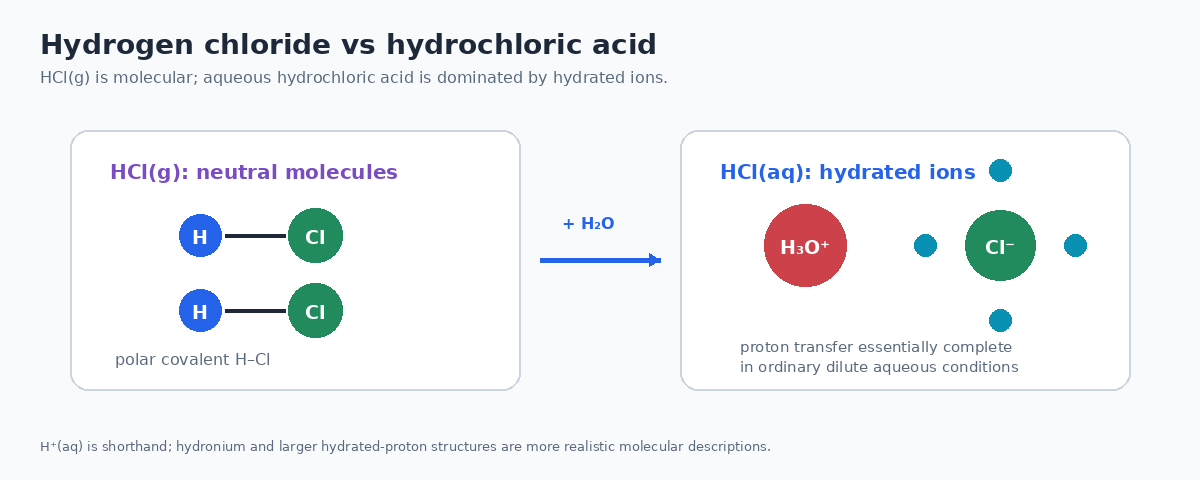
Gas-phase hydrogen chloride consists of polar H–Cl molecules. In water, the reaction HCl + H₂O → H₃O⁺ + Cl⁻ is essentially complete. Water strongly stabilizes the separated charges through ion–dipole interactions and hydrogen-bonded solvation.
This is why drawing only intact HCl molecules inside an aqueous hydrochloric-acid beaker gives the wrong microscopic picture.
Core → university Bond polarity is not the same as acid strength HCl is polar before it reaches water, but strong-acid behavior is a solvent-dependent proton-transfer result.
The H–Cl bond is polar because chlorine is more electronegative than hydrogen. But “polar bond” alone does not prove that every molecule is a strong acid in every solvent. Acid strength describes the thermodynamics of proton transfer relative to a base/solvent system.
In water, HCl proton transfer is so favorable that general chemistry treats it as complete. Comparing HCl with HF is a useful reminder that bond strength, hydration and conjugate-base stabilization all matter.
Solution chemistry pH, concentration and activity — why strong does not mean one fixed pH For simple dilute problems [H₃O⁺] tracks analytical HCl concentration, but concentrated solutions require activity-based thinking.

For a dilute idealized solution, complete ionization lets us estimate [H₃O⁺] ≈ c(HCl) and then pH = −log₁₀[H₃O⁺]. At higher ionic strength, the thermodynamic definition of pH uses hydrogen-ion activity rather than concentration alone.
This is why “the pH of hydrochloric acid” has no single answer unless concentration, temperature and measurement convention are stated.
Source: OpenStax Chemistry — pH and strong-acid calculations
Core → university Neutralization strips away spectator ions HCl/NaOH is a clean example of molecular, complete-ionic and net-ionic descriptions of the same reaction.
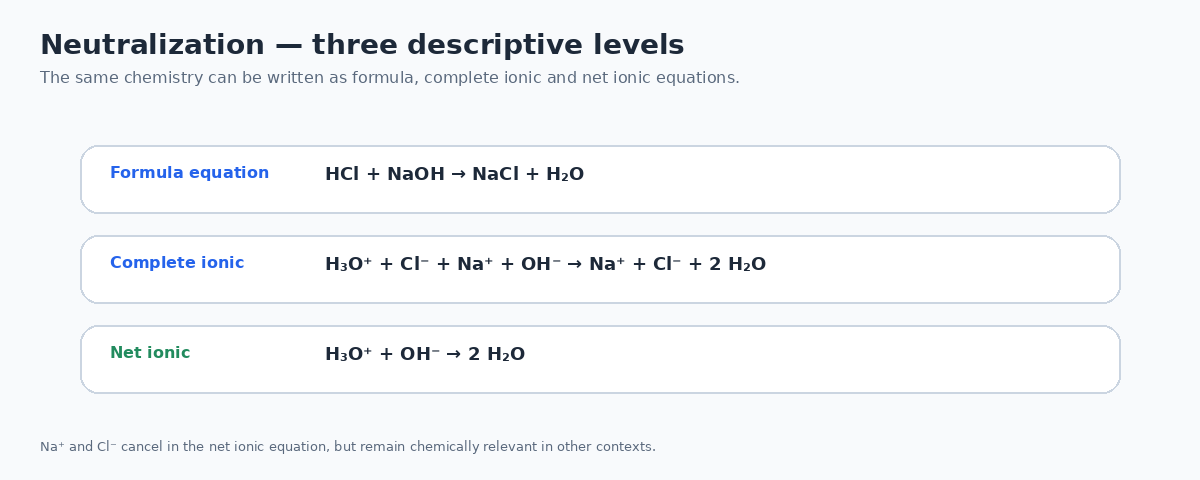
At the formula level: HCl + NaOH → NaCl + H₂O. In aqueous ionic form, Na⁺ and Cl⁻ appear on both sides and cancel. The net proton-transfer chemistry is H₃O⁺ + OH⁻ → 2 H₂O.
This shows why chemical equations can be written at different descriptive levels, and why “spectator ion” does not mean “unimportant in every chemical context.”
Source: OpenStax Chemistry — hydrolysis/neutralization examples
University / engineering Chloride chemistry matters beyond pH Cl⁻ is a weak base but a chemically important ion in solubility, complexation, electrochemistry and corrosion.
Chloride is often a spectator ion in simple acid–base equations, but it is not universally inert. It influences ionic strength, can form complexes with some metal ions, participates in electrochemical systems and is important in materials-corrosion environments.
Industrial hydrochloric-acid service therefore depends on both acidity and chloride chemistry, along with concentration, temperature and materials selection.
Source: PubChem — Hydrochloric Acid
Worked examples
HCl is treated as completely ionized → [H₃O⁺] ≈ 0.0100 mol/L; pH = −log₁₀(0.0100) = 2.00
This is a dilute idealized calculation. Thermodynamic pH is defined using activity.
HCl + NaOH → NaCl + H₂O is 1:1 → 0.125 mol NaOH
Stoichiometric equivalence does not prescribe how corrosive solutions should be handled.
Related compounds
Sources & evidence Reference sources Open the evidence and reference list used for this compound page.
Compound pages separate formula interpretation from reference data and from contextual explanation. Check the linked source when a value or condition matters to your work.
- PubChem — Hydrochloric Acid — Identity, formula, hydrogen-chloride/aqueous context and hazard data.
- NIST Chemistry WebBook — Hydrogen chloride — Gas-phase, phase, spectroscopic and thermochemical reference data.
- OpenStax Chemistry — strong-acid HCl reaction with water — Strong-acid classification and essentially complete ionization.
- OpenStax Chemistry — pH and pOH — pH definitions and strong-acid calculations.
Found an error, something unclear, or a missing topic?
Tell us what you noticed. Feedback goes to a private review queue and is never published automatically.