

Sodium Chloride NaCl
Sodium chloride is the ionic compound NaCl. In an ordinary crystal there are no separate NaCl molecules: NaCl gives the simplest 1:1 ratio of sodium ions (Na⁺) to chloride ions (Cl⁻) in an extended lattice. That distinction explains its crystal structure, conductivity, dissolution and electrochemistry.
What does NaCl mean?
NaCl is a formula-unit ratio. One Na⁺ balances one Cl⁻, so the lowest whole-number ratio is 1:1 and the crystal is electrically neutral overall. The formula does not imply an isolated two-atom NaCl molecule in the solid.
Once you can count every element correctly, the same formula becomes the basis for formula mass and molar mass.
What kind of chemical substance is it?
Solid sodium chloride is an extended ionic crystal. Na⁺ and Cl⁻ ions are held by electrostatic attraction throughout a three-dimensional rock-salt lattice. In the common structure each ion has six nearest neighbors of the opposite charge. When the solid melts or dissolves, the ions can become mobile; that change in mobility is central to conductivity and electrolysis.
Why does Sodium Chloride behave this way?
The same Na⁺ and Cl⁻ ions behave differently depending on their environment. In the solid lattice they occupy fixed positions; in molten NaCl they can move; in water they become solvated by polar water molecules. That change from fixed to mobile charge carriers connects crystal structure to conductivity, dissolution and electrochemistry.
Is NaCl a molecule?
Not in the usual description of crystalline sodium chloride. NaCl is an ionic solid with an extended lattice; the written formula is a formula unit giving the simplest 1:1 ratio of Na⁺ to Cl⁻ ions.
Why is the formula NaCl rather than Na₂Cl₂?
Ionic formulas are written in the lowest whole-number ratio that gives electrical neutrality. Na⁺ has charge +1 and Cl⁻ has charge −1, so one of each balances the charge and the empirical formula is NaCl.
Why does solid sodium chloride not conduct electricity, but molten or dissolved NaCl can?
Conductivity requires mobile charge carriers. In solid NaCl, Na⁺ and Cl⁻ are held at lattice sites. In molten NaCl or aqueous solution, the ions can move and transport charge.
What does “six-coordinate” mean in the NaCl crystal?
In the ordinary rock-salt structure, each Na⁺ has six nearest Cl⁻ neighbors and each Cl⁻ has six nearest Na⁺ neighbors. The coordination number is therefore 6:6. This is a three-dimensional lattice property, not six discrete Na–Cl molecules around one ion.
Why does sodium chloride dissolve in water?
Water is polar. The oxygen end of water stabilizes Na⁺ while the hydrogen ends stabilize Cl⁻. Dissolution occurs when the overall free-energy change—including disruption of the ionic lattice, hydration of the ions and entropy—is favorable. It is more accurate than saying water simply “breaks ionic bonds.”
Does dissolved NaCl still exist as NaCl molecules?
In dilute aqueous solution, sodium chloride is treated primarily as separated hydrated Na⁺ and Cl⁻ ions rather than intact NaCl molecules. At higher concentrations, ion–ion interactions become more important, so ideal independent-ion pictures become less accurate.
Is table salt exactly pure sodium chloride?
Sodium chloride is the chemical compound NaCl. Commercial table salt is mostly NaCl but may contain iodine compounds, anti-caking agents or other permitted additives. Halite is the natural mineral form of sodium chloride.
Why does salt water affect corrosion?
Dissolved ions increase electrical conductivity and can support electrochemical current through the solution. Chloride ions can also destabilize protective films on some metals, so saline environments are important in corrosion engineering. The exact effect depends on material, concentration, oxygen, temperature and other conditions.
Go deeper on the questions students search
These lessons expand one important question without duplicating the compound reference page.
Key properties and classification
Why this compound matters: Sodium chloride is one of the best compounds for connecting introductory chemistry to deeper physical and industrial chemistry. It links charge neutrality and formula units to crystal structure, lattice energy, hydration, electrolytes, ionic strength, electrolysis, biological ion balance, corrosion and the chlor-alkali industry.
Where does Sodium Chloride appear in chemical equations?
These equations are included to connect the compound to chemistry concepts and stoichiometry. They are not laboratory procedures.
Represents dissociation into hydrated ions in water; the solvent and energy balance are part of the real process.
Shows ion exchange and formation of sparingly soluble silver chloride.
High-level stoichiometry for industrial molten-salt electrolysis; not an operating procedure.
Shows why aqueous electrolysis differs from molten NaCl: water participates at the cathode.
Safety depends on form, concentration and situation
Ordinary sodium chloride is widely encountered, but concentration and context matter. Large exposures or highly concentrated solutions can be harmful, and industrial brine electrolysis involves hazardous products such as chlorine gas, hydrogen and caustic solutions. Chloride-containing solutions can also be corrosive to many engineering materials.
Study the chemistry, not just the topic names
Sodium chloride becomes much more interesting once the formula is connected to the three-dimensional lattice, ion mobility and solvent interactions. The modules below move from crystal structure to solution thermodynamics, non-ideal ionic behavior and industrial electrochemistry.
Core chemistry Formula unit and rock-salt lattice — why NaCl is not a molecule The 1:1 formula gives stoichiometry; the crystal itself is a repeating three-dimensional ionic lattice.
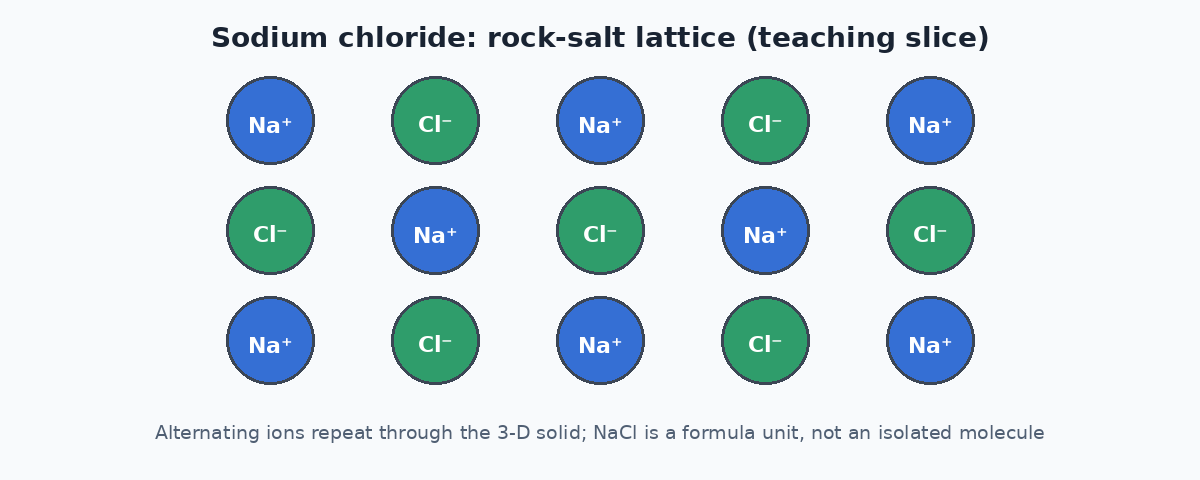
NaCl is best described as an ionic formula unit, not a discrete molecule. The solid extends in three dimensions. In the common rock-salt structure, chloride ions can be viewed as forming a face-centered-cubic arrangement with sodium ions occupying octahedral sites. Each Na⁺ has six nearest Cl⁻ neighbors, and each Cl⁻ has six nearest Na⁺ neighbors.
The formula NaCl therefore answers a composition question—what is the lowest whole-number ratio of ions?—while the crystal structure answers a spatial question—how are those ions arranged through the solid?
Source: OpenStax Chemistry 2e — Lattice Structures in Crystalline Solids
Core chemistry Conductivity — the ions are present in every state, but mobility changes Solid NaCl is a poor conductor; molten NaCl and NaCl(aq) conduct because ions become mobile.
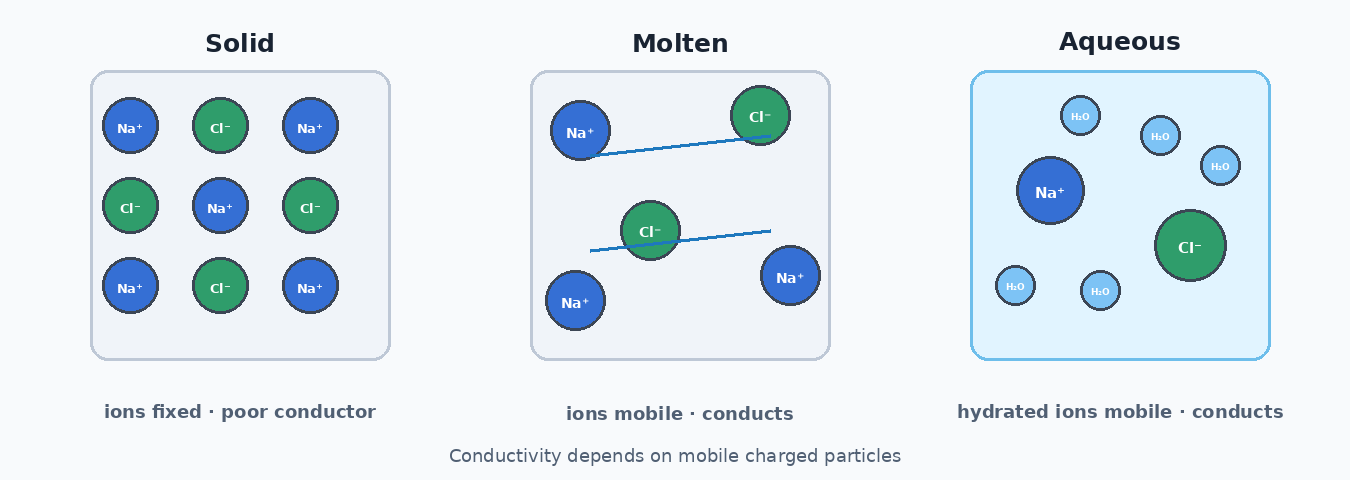
An ionic solid can contain charged particles and still fail to conduct electricity. In solid NaCl, the ions are held at lattice positions, so there are no freely moving charge carriers. Melting destroys the long-range solid lattice and allows Na⁺ and Cl⁻ to migrate. Dissolving NaCl in water also creates mobile hydrated ions.
This is a useful general rule: charge must be mobile to carry current. Merely “having ions” is not enough.
Core → university Dissolution and hydration — water stabilizes ions, but the energy balance decides Water molecules orient around Na⁺ and Cl⁻, producing hydration shells and competing with lattice attractions.
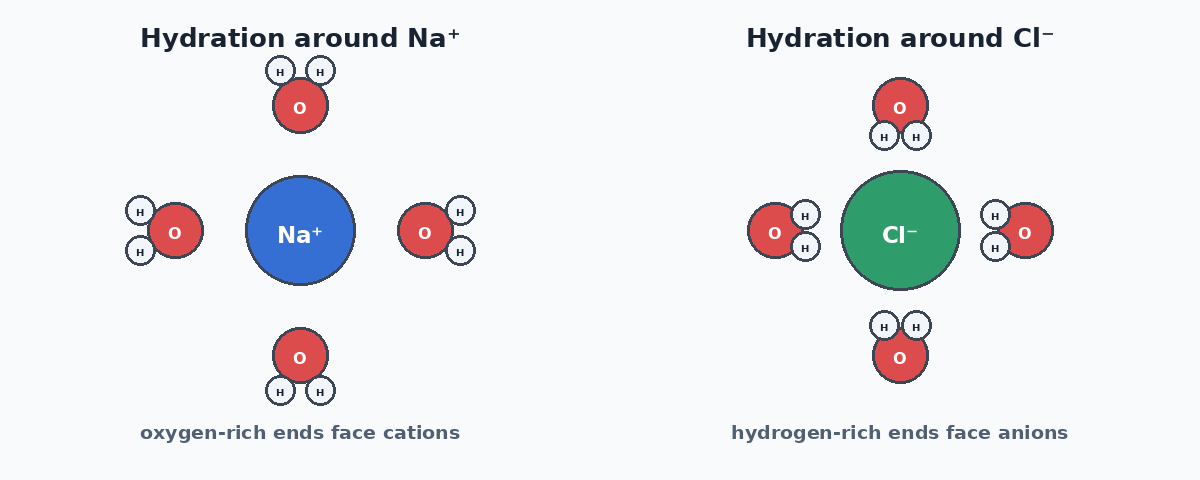
Water is polar, so its oxygen-rich end is attracted toward Na⁺ while its hydrogen-rich ends are oriented toward Cl⁻. These ion–dipole interactions form hydration shells around the separated ions.
Dissolution is not explained completely by saying that “water breaks the ionic bond.” The lattice must be disrupted, hydration releases stabilizing energy, and entropy also changes. The relevant thermodynamic question is whether the total Gibbs free-energy change for dissolution is favorable under the stated conditions.
Source: Chemistry LibreTexts — Electrolytes and Electrolytic Solutions
University Lattice energy and the Born–Haber viewpoint The strong electrostatic lattice helps explain high melting temperature, but lattice strength alone cannot predict solubility.
Separating an ionic lattice into gaseous ions requires substantial energy because each ion interacts electrostatically with many ions in the crystal. Lattice-energy models and Born–Haber cycles organize this energetic bookkeeping by connecting measurable thermochemical steps.
A common mistake is to assume that a large lattice energy automatically means “insoluble.” Solubility depends on the competition between lattice disruption, solvation/hydration and entropy. Different salts can therefore behave differently even when all are ionic solids.
Source: OpenStax University Physics — Bonding in Crystalline Solids
University Ionic strength and activity — why concentrated salt solutions are not ideal At higher concentration, ions interact with one another and concentration is no longer the whole thermodynamic story.
For an idealized dilute 1:1 electrolyte such as NaCl, complete dissociation gives approximately equal concentrations of Na⁺ and Cl⁻. Ionic strength is defined as I = ½ Σ cᵢzᵢ². For 0.10 mol·L⁻¹ NaCl treated ideally, I ≈ 0.10 mol·L⁻¹ because both ions have |z| = 1.
Real ionic solutions are non-ideal. Electrostatic ion–ion interactions mean chemical potential is described more accurately using activity rather than concentration alone. This becomes important in equilibrium calculations, electrochemistry, analytical chemistry and concentrated brines.
Source: IUPAC Gold Book — ionic strength
University → engineering Electrolysis — molten NaCl and aqueous brine do not give the same cathode product Molten NaCl can yield sodium metal; in aqueous brine, water is reduced instead and hydrogen is produced.
In molten NaCl, the mobile species are Na⁺ and Cl⁻. Sodium ions can be reduced at the cathode while chloride ions are oxidized at the anode. In aqueous NaCl, water is also present and competes in the electrode reactions; under ordinary brine electrolysis, water is reduced at the cathode to hydrogen and hydroxide rather than depositing sodium metal.
This distinction underpins major industrial chemistry. Brine electrolysis is part of the chlor-alkali process used to produce chlorine and sodium hydroxide, while molten-salt electrolysis is used for sodium metal. Electrode materials, concentration, overpotential, membrane design and operating conditions matter in real cells.
Applied / engineering Brine, biology and corrosion — the same ions in different systems Na⁺ and Cl⁻ are ordinary biological ions, major seawater ions and important engineering species in saline environments.
Sodium and chloride ions are major dissolved ions in natural waters and biological fluids. In engineering systems, chloride-rich water matters because ionic conductivity supports electrochemical currents and chloride can accelerate localized corrosion of susceptible alloys by interfering with passive films.
Context is essential: “salt water is corrosive” is not a complete design rule. Corrosion behavior depends on alloy, chloride concentration, dissolved oxygen, temperature, pH, flow, deposits and electrochemical conditions. ElementLookup should explain those dependencies without replacing engineering standards or material-selection practice.
Source: PubChem — Sodium Chloride
Worked examples
n = m ÷ M = 5.844 g ÷ 58.44 g·mol⁻¹ = 0.1000 mol
That amount corresponds to 0.1000 mol of NaCl formula units and, in the ideal complete-dissociation picture, 0.1000 mol Na⁺ plus 0.1000 mol Cl⁻.
I = ½[(0.10)(+1)² + (0.10)(−1)²] = 0.10 mol·L⁻¹
This is an idealized concentration-based calculation; real activities deviate increasingly as solutions become more concentrated.
Related compounds
Sources & evidence Reference sources Open the evidence and reference list used for this compound page.
Compound pages separate formula interpretation from reference data and from contextual explanation. Check the linked source when a value or condition matters to your work.
- PubChem — Sodium Chloride — Identity, 1:1 ion ratio, formula weight and experimental reference data.
- OpenStax Chemistry: Atoms First 2e — Ionic and Molecular Compounds — Ionic-solid properties and conductivity of solid versus molten NaCl.
- OpenStax Chemistry 2e — Lattice Structures in Crystalline Solids — Rock-salt lattice, FCC description and 1:1 stoichiometry.
- Chemistry LibreTexts — Electrolytes and Electrolytic Solutions — Ion mobility and the active role of water in stabilizing dissolved ions.
- OpenStax Chemistry — Electrolysis — Molten and aqueous sodium chloride electrolysis and industrial context.
- IUPAC Gold Book — Ionic strength — Definition used for the advanced solution-chemistry section.
Found an error, something unclear, or a missing topic?
Tell us what you noticed. Feedback goes to a private review queue and is never published automatically.