

Sulfuric Acid H2SO4
Sulfuric acid is H₂SO₄, a diprotic oxoacid with two ionizable hydrogens. In water, the first proton transfer is essentially complete, while hydrogen sulfate (HSO₄⁻) has a distinct second ionization equilibrium. Concentrated sulfuric acid is also a very different chemical environment from a dilute aqueous solution.
What does H2SO4 mean?
H₂SO₄ contains two H, one S and four O atoms per written molecular formula. The formula alone does not show connectivity: the acidic hydrogens are bonded to oxygen in the conventional structural representation, commonly written HO–S(=O)₂–OH.
Once you can count every element correctly, the same formula becomes the basis for formula mass and molar mass.
What kind of chemical substance is it?
Sulfuric acid is a covalent molecular oxoacid. A common classroom Lewis representation is HO–S(=O)₂–OH, with four S–O connections arranged approximately tetrahedrally around sulfur. That Lewis picture is useful for counting and identifying the two O–H groups, but advanced bonding descriptions should not be reduced to two perfectly localized S=O double bonds.
Why does Sulfuric Acid behave this way?
The key learning chain is structural: two O–H groups make H₂SO₄ diprotic → the first proton is transferred much more readily than the second → solutions can contain H₃O⁺, HSO₄⁻ and SO₄²⁻ in different proportions → one mole of H₂SO₄ can supply up to two acid equivalents in complete neutralization. Concentration then adds another layer: “strong acid” and “concentrated acid” describe different ideas.
Is sulfuric acid a strong acid?
Yes, but the two proton-transfer steps are not equally strong. The first ionization of H₂SO₄ in water is essentially complete under ordinary general-chemistry conditions. The second ionization, HSO₄⁻ ⇌ H⁺ + SO₄²⁻, has a finite equilibrium constant and must be treated separately when quantitative accuracy matters.
Why is sulfuric acid called diprotic?
Because one H₂SO₄ molecule contains two hydrogens that can be donated as protons in acid–base chemistry. The first gives HSO₄⁻; the second gives SO₄²⁻.
Does “strong sulfuric acid” mean the same thing as “concentrated sulfuric acid”?
No. Strength describes the extent of acid ionization in a solvent; concentration describes how much acid is present per amount of solution. A strong acid can be dilute, and a concentrated acid has a very different solvent/speciation environment from a dilute solution.
What is the difference between sulfate and hydrogen sulfate?
Hydrogen sulfate, HSO₄⁻, still contains one ionizable hydrogen and has a −1 charge. Sulfate, SO₄²⁻, has lost both acidic hydrogens and carries a −2 charge.
Why does mixing sulfuric acid with water release so much heat?
Hydration and ionization of sulfuric-acid species are strongly exothermic. The temperature rise depends on concentration and mixing conditions, which is why this chemistry belongs in a safety-aware thermodynamics discussion rather than a simple “dissolves in water” statement.
Is the familiar HO–S(=O)₂–OH drawing the whole bonding story?
No. It is a very useful Lewis bookkeeping representation. Real electron density and S–O bonding are better described with delocalized/ionic contributions than with a picture of two permanently localized S=O bonds.
Why is sulfuric acid so important industrially?
Its acid–base chemistry, sulfate formation, dehydrating/oxidizing behavior at high concentration and role in fertilizer, metals, petroleum and other chemical processes make it a major industrial reagent. Industrial importance does not make concentrated acid a routine handling material.
Key properties and classification
Why this compound matters: Sulfuric acid connects Lewis structures, polyprotic-acid equilibria, neutralization stoichiometry, sulfate chemistry, thermochemistry and industrial chemical processing. It is also an excellent example of why acid strength, concentration and solution speciation must not be treated as synonyms.
Where does Sulfuric Acid appear in chemical equations?
These equations are included to connect the compound to chemistry concepts and stoichiometry. They are not laboratory procedures.
The first proton transfer is treated as essentially complete in ordinary general-chemistry solutions.
This is a distinct equilibrium; it is not identical to the first proton transfer.
Shows the two-acid-equivalent stoichiometry of a diprotic acid when neutralization is complete.
Safety depends on form, concentration and situation
Sulfuric acid is highly corrosive, and dilution of concentrated acid is strongly exothermic. Concentrated acid also has dehydrating and oxidizing behavior that dilute-acid intuition does not capture. This page explains chemistry and industrial context; it is not a preparation, dilution or handling procedure.
Study the chemistry, not just the topic names
Sulfuric acid is most useful educationally when the page keeps three ideas separate: molecular structure, stepwise acid–base equilibria, and concentration-dependent solution behavior. The modules below connect those ideas to sulfate chemistry and industrial production without turning the page into an operating manual.
Core chemistry Lewis structure and the two acidic O–H groups The formula H₂SO₄ hides connectivity; the conventional structure makes the two proton-donating groups visible.
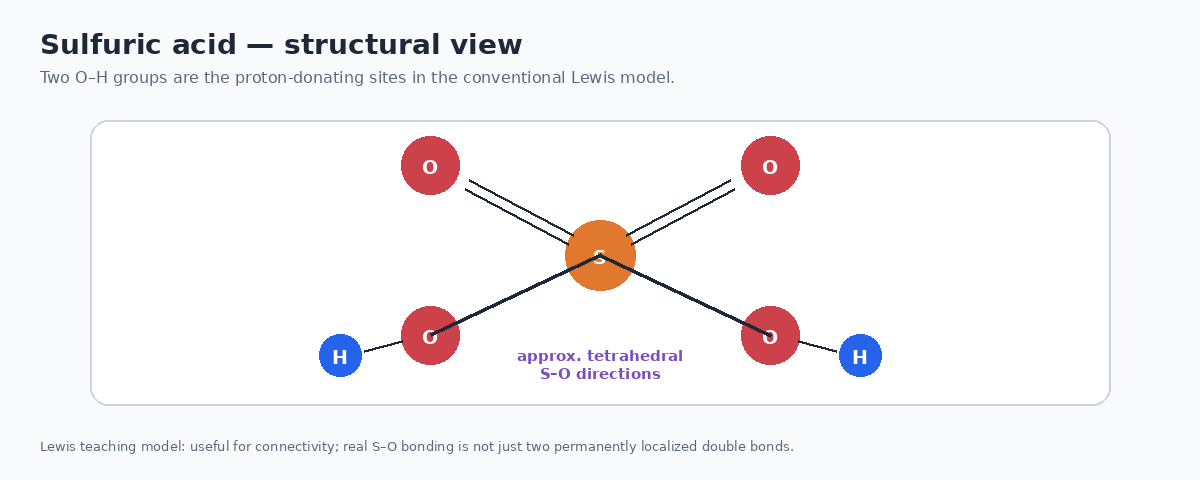
H₂SO₄ has 32 valence electrons. In the common minimized-formal-charge classroom drawing, sulfur is connected to four oxygens; two are –OH groups and two are drawn as S=O. Four S–O directions give an approximately tetrahedral arrangement around sulfur.
The drawing is a model, not a literal map of two permanently localized double bonds. In advanced bonding descriptions, charge separation and delocalization contribute to the S–O bonding picture.
Source: PubChem — Sulfuric Acid
Core → university Diprotic ionization — the first and second protons are chemically different First ionization is essentially complete; HSO₄⁻ has its own second equilibrium.
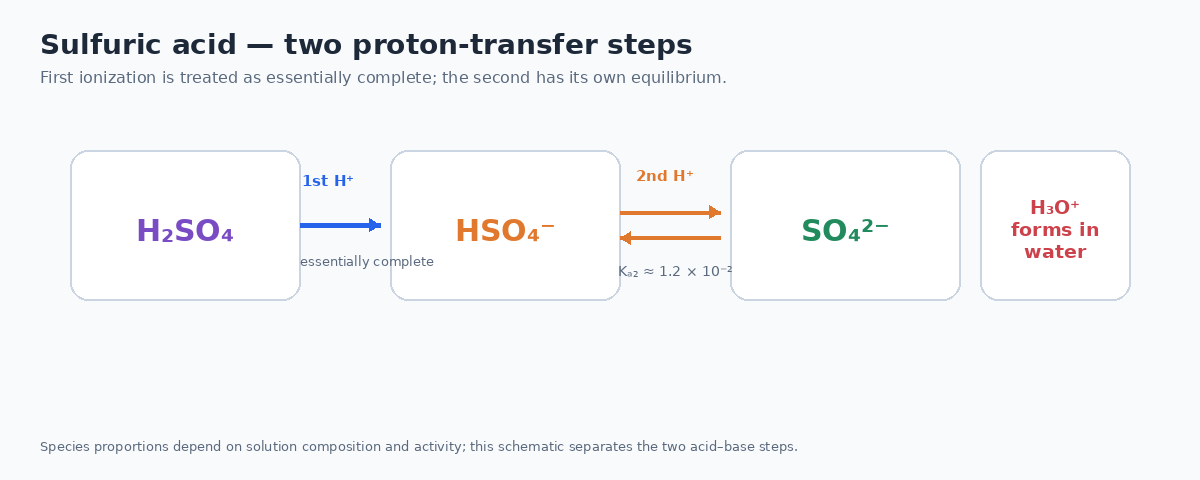
Ionization occurs in stages. The first transfer forms HSO₄⁻ and H₃O⁺ and is treated as complete in standard general-chemistry problems. The second transfer is:
HSO₄⁻ + H₂O ⇌ H₃O⁺ + SO₄²⁻
OpenStax gives a teaching value of Ka2 = 1.2 × 10⁻². This is large enough that the second step matters, but small enough that assuming “two completely free protons per molecule at every concentration” can give inaccurate quantitative answers.
Solution chemistry Strong vs concentrated — two different axes Acid strength describes ionization; concentration describes composition of the solution.

A dilute sulfuric-acid solution can still contain a strong acid, while concentrated sulfuric acid is a low-water, highly non-ideal medium in which simple dilute-solution intuition becomes incomplete. As water content changes, so do activities, speciation, heat of mixing and physical properties.
This distinction is important for pH calculations, thermodynamics and safety. “Strong” is not a synonym for “high molarity.”
University chemistry Sulfate and hydrogen sulfate connect acid–base chemistry to salts and solubility The two conjugate bases participate in different salts and equilibria.
Complete removal of both acidic hydrogens gives sulfate, SO₄²⁻; partial neutralization can give hydrogen sulfate salts containing HSO₄⁻. Sulfate solubility is highly cation-dependent: many sulfates are soluble, while salts such as BaSO₄ are notably sparingly soluble.
This makes sulfuric-acid chemistry a bridge from proton-transfer equilibria into precipitation, ionic strength and analytical chemistry.
University / engineering Contact-process chemistry — equilibrium, catalyst and absorption as one process story Industrial production links sulfur oxidation, a reversible SO₂/SO₃ equilibrium and controlled absorption chemistry.

A high-level Contact-process pathway is: sulfur-containing feed → SO₂ → catalytic oxidation to SO₃ → absorption into sulfuric-acid media → product acid. The central oxidation is 2 SO₂ + O₂ ⇌ 2 SO₃, an exothermic equilibrium. Industry must balance equilibrium, rate, catalyst performance, heat management, gas cleanup and mass transfer.
This is a process-chemistry overview only. It intentionally omits operating instructions and equipment specifications.
Source: OpenStax Chemistry 2e — sulfuric-acid production context
Worked examples
H₂SO₄ + 2 NaOH → Na₂SO₄ + 2 H₂O; 0.250 mol H₂SO₄ × 2 = 0.500 mol NaOH
This is stoichiometric bookkeeping for complete neutralization, not a mixing procedure.
m = nM = 0.100 mol × 98.079 g/mol = 9.81 g
Molar mass converts amount of pure H₂SO₄ to mass; solution concentration requires additional composition information.
Related compounds
Sources & evidence Reference sources Open the evidence and reference list used for this compound page.
Compound pages separate formula interpretation from reference data and from contextual explanation. Check the linked source when a value or condition matters to your work.
- PubChem — Sulfuric Acid — Identity, molecular formula, molecular weight, properties and hazard context.
- OpenStax Chemistry — Polyprotic Acids — Stepwise H₂SO₄/HSO₄⁻ ionization and Ka₂ teaching value.
- OpenStax Chemistry 2e — Compounds of Oxygen — Sulfuric-acid chemistry, sulfate context and industrial overview.
- NIST Chemistry WebBook — Sulfuric Acid — Evaluated thermochemistry/reference data.
Found an error, something unclear, or a missing topic?
Tell us what you noticed. Feedback goes to a private review queue and is never published automatically.