

Water H2O
Water is the molecular compound H₂O: each molecule contains two hydrogen atoms covalently bonded to one oxygen atom. The molecule is bent and polar, with two lone pairs on oxygen; that simple structure connects to hydrogen bonding, solvent behavior, acid–base chemistry and water’s unusual phase properties.
What does H2O mean?
The subscript 2 applies only to H. No subscript after O means one oxygen atom per H₂O molecule. H₂O describes one neutral water molecule; changing the subscript changes the substance.
Once you can count every element correctly, the same formula becomes the basis for formula mass and molar mass.
What kind of chemical substance is it?
H₂O is a discrete covalent molecule. Oxygen forms two O–H single bonds and retains two lone pairs. In the introductory VSEPR model, those four electron domains have an approximately tetrahedral arrangement, while the positions of the atoms give a bent molecular shape. The O–H bonds are polar and, because the molecule is bent, their dipoles do not cancel.
Why does Water behave this way?
Water is useful because the explanation can be followed as a chain: oxygen’s valence electrons → two O–H bonds plus two lone pairs → bent geometry → a permanent molecular dipole → hydrogen bonding between molecules → unusual solvent and phase behavior. Each arrow needs its own explanation; none of the later properties should be treated as magic caused by the formula alone.
Why is H₂O bent instead of linear?
Around oxygen there are four electron domains: two O–H bonding regions and two lone pairs. The electron-domain arrangement is approximately tetrahedral, but molecular shape names only the atom positions, so H₂O is bent. The H–O–H angle is about 104.5° rather than the ideal tetrahedral angle.
Does a water molecule have an ionic charge?
No. A normal H₂O molecule has net charge zero, and the preferred Lewis structure gives formal charge zero on each atom. Water is nevertheless polar: oxygen carries partial negative character and the hydrogens partial positive character because the bonding electrons are shared unequally. Net charge, formal charge and partial charge are different ideas.
Are the O–H bonds ionic or covalent?
They are polar covalent bonds. Hydrogen and oxygen share electron pairs, but oxygen attracts the shared electrons more strongly. This unequal sharing creates bond dipoles without turning the atoms into H⁺ and O²⁻ ions inside an ordinary water molecule.
Are hydrogen bonds the same as the O–H bonds inside water?
No. The O–H bonds inside one H₂O molecule are covalent bonds. Hydrogen bonds are weaker intermolecular attractions involving the partially positive H of one molecule and an electron-rich region, commonly a lone pair, on another molecule.
Is pure water always pH 7?
No. Pure water is approximately pH 7 at 25 °C because Kw is about 1.0 × 10⁻¹⁴ under that condition. Kw changes with temperature, so the numerical pH of a neutral solution also changes. Neutrality means [H₃O⁺] = [OH⁻], not “pH must always equal 7.”
Does pure water conduct electricity?
Pure water has very low conductivity because it contains very few mobile ions. Real tap, river and seawater contain dissolved ions and therefore conduct much better. The important distinction is between molecular water itself and the charged species present in the sample.
Why does ice float on liquid water?
Hydrogen bonding organizes ordinary ice into a comparatively open crystal structure. In liquid water the hydrogen-bond network is constantly rearranging and molecules can pack more closely on average, so ordinary ice is less dense than liquid water and floats.
Does water dissolve everything because it is called the universal solvent?
No. Water dissolves many ions and polar substances well, but many nonpolar substances have poor solubility. Dissolution depends on the balance among solute–solute, water–water and solute–water interactions plus entropy; polarity alone is not a universal solubility rule.
Key properties and classification
Why this compound matters: Water is the reference solvent and reaction medium for much of aqueous chemistry, biology and environmental chemistry. It also connects introductory bonding to acid–base equilibria, electrochemistry, phase behavior, thermodynamics, corrosion, separations and industrial steam/water systems.
Where does Water appear in chemical equations?
These equations are included to connect the compound to chemistry concepts and stoichiometry. They are not laboratory procedures.
A balanced composition and stoichiometry example; actual combustion conditions and safety matter.
Only a very small fraction is ionized at any instant, but the equilibrium is central to aqueous acid–base chemistry.
Shows decomposition stoichiometry; this is not an operating procedure.
Safety depends on form, concentration and situation
Ordinary water is not treated as a hazardous chemical, but context matters. Hot water and steam can cause severe burns, pressurized water/steam systems store substantial energy, and water reacts dangerously with some reactive chemicals and materials. “Safe substance” never means every chemical situation involving it is safe.
Study the chemistry, not just the topic names
Deeper chemistry should explain the mechanism, equation or model—not merely name a topic. Open the sections below to follow water from electron counting through acid–base equilibrium and finally to the thermodynamic models used for real water/steam systems.
Core chemistry Lewis structure, formal charge and VSEPR — step by step Count the eight valence electrons, place two lone pairs on oxygen, then distinguish electron-domain geometry from molecular shape.
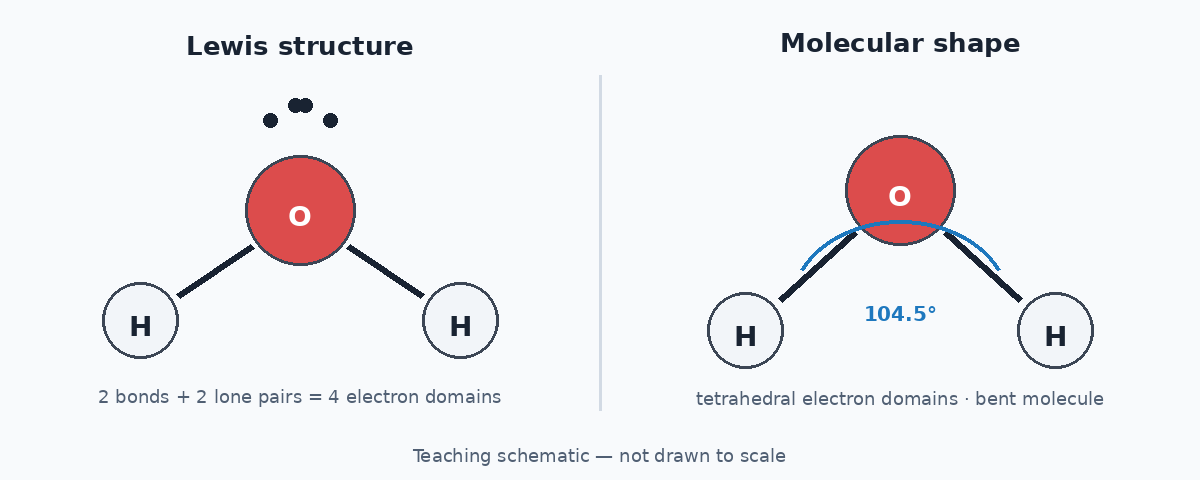
- Count valence electrons: oxygen contributes 6 and two hydrogens contribute 2 more, giving 8 electrons.
- Connect H–O–H: two O–H single bonds use 4 electrons.
- Place the remaining 4 electrons: they become two lone pairs on oxygen. Each H has a duet; O has an octet.
- Check formal charge: in the preferred structure, O and both H atoms have formal charge 0.
- Apply VSEPR: oxygen has four electron domains (two bonding, two nonbonding), so the electron-domain arrangement is tetrahedral. Because only atom positions define molecular geometry, the molecular shape is bent, with an H–O–H angle of about 104.5°.
Model limit: “sp³ hybridization” is a useful introductory localization model for four electron domains, but it is not the final quantum-mechanical description of water’s orbitals.
Core → university Net charge, formal charge, partial charge and polarity are not the same thing Water is neutral overall even though its electron density is unevenly distributed.
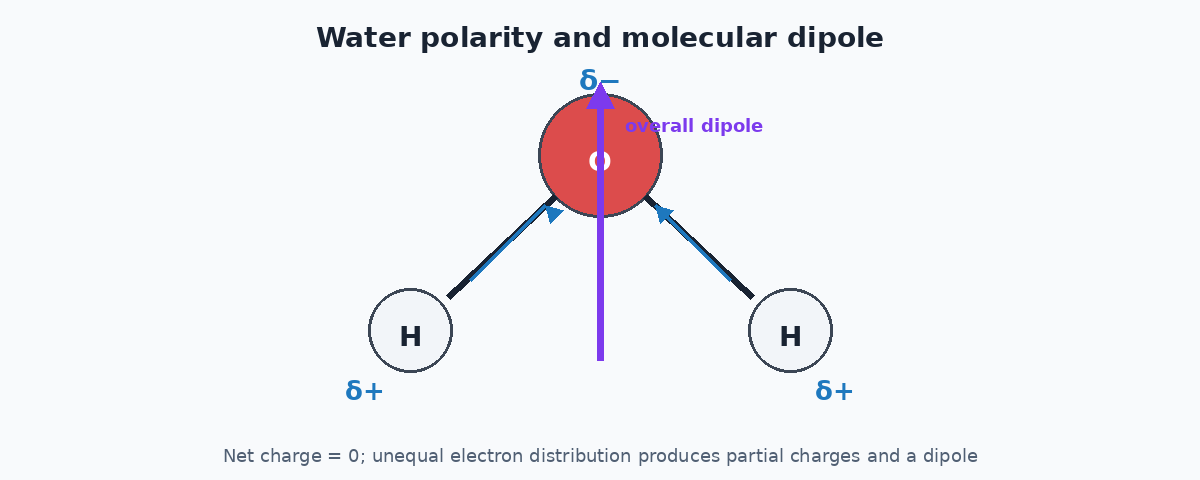
A normal water molecule has net charge 0. In its preferred Lewis structure, each atom also has formal charge 0. Yet the O–H bonds are polar because oxygen attracts the bonding electrons more strongly than hydrogen. We represent that unequal electron density with partial charges: oxygen is δ− and the hydrogen side is δ+.
Because H₂O is bent, the two bond-dipole vectors do not cancel. The molecule therefore has a permanent dipole. This is why “neutral” does not mean “nonpolar,” and why partial-charge symbols must not be mistaken for full ionic charges.
Core → university Hydrogen bonding and solvent chemistry — from polarity to hydration shells Explain why water interacts strongly with ions and polar molecules without calling it a literal universal solvent.
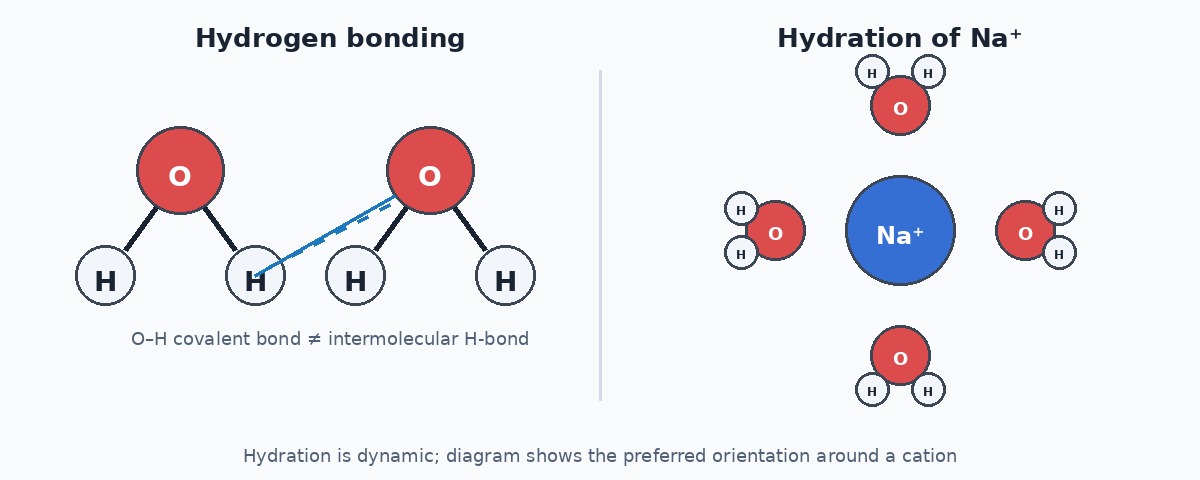
Water molecules attract one another through hydrogen bonding: a partially positive H on one molecule interacts with an electron-rich region on another. These are intermolecular attractions, not extra O–H covalent bonds.
When an ionic solid dissolves, water molecules orient around separated ions. The oxygen side of H₂O is attracted toward cations; the hydrogen side is attracted toward anions. The resulting hydration shells help stabilize dispersed ions. But dissolution is an energy-and-entropy balance: strong crystal lattices can resist separation, and nonpolar solutes often interact poorly with water. So “polar dissolves polar” is a useful starting heuristic, not a complete thermodynamic law.
University acid–base chemistry Autoionization, K₍w₎, neutral pH and the pKa-of-water controversy Water can both donate and accept protons; neutrality depends on equal hydronium and hydroxide activities, not a permanently fixed pH of 7.
Water is amphiprotic: depending on its reaction partner it can donate a proton or accept one. Even pure liquid water undergoes slight autoionization:
2 H₂O(l) ⇌ H₃O⁺(aq) + OH⁻(aq)
The ion-product relation is commonly written Kw = [H₃O⁺][OH⁻]. At 25 °C, introductory aqueous chemistry uses Kw ≈ 1.0 × 10⁻¹⁴, so neutral pure water has [H₃O⁺] = [OH⁻] ≈ 1.0 × 10⁻⁷ M and pH ≈ 7.00. Because Kw depends on temperature, neutral pH is not always 7; neutrality means the hydronium and hydroxide concentrations/activities are equal.
Why do some books list water pKa as 15.7? General-chemistry treatments commonly use 14.0 at 25 °C, while 15.7 has appeared in organic-chemistry tables. Journal of Chemical Education discussions trace the disagreement to inconsistent standard-state/concentration treatment and argue for the thermodynamically consistent aqueous value of 14.0. This is a good example of why advanced chemistry must state definitions and standard states rather than present a naked number.
Source: OpenStax pH/pOH + Journal of Chemical Education discussion
Physical chemistry Why ice floats — a structure–density problem, not a memorized exception Hydrogen bonding favors an open solid network; liquid water can partially collapse that network and pack more densely.
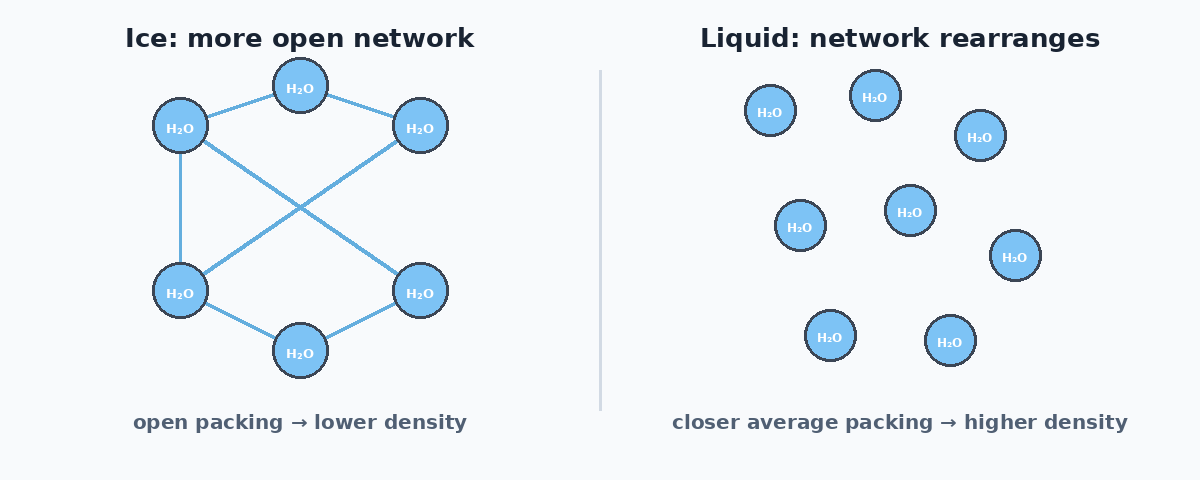
Ordinary ice is less dense than liquid water because freezing organizes H₂O molecules into an open hydrogen-bonded crystal network. In liquid water, hydrogen bonds continually form, break and distort, allowing molecules to occupy space more efficiently on average. The solid therefore floats on its own liquid.
The deeper lesson is that density is a structural property. “Solids are denser than liquids” is only a trend, not a law. Water also has a density maximum near 4 °C, showing that hydrogen-bond-driven structural effects compete with ordinary thermal expansion even within the liquid phase.
University → engineering Phase equilibrium, boiling, steam and engineering property models Boiling temperature depends on pressure; engineering work requires validated thermodynamic property formulations rather than one “boiling point.”
Water boils when its equilibrium vapor pressure is able to match the surrounding pressure closely enough for vapor bubbles to persist. Therefore 100 °C is the normal boiling temperature near 101,325 Pa, not a pressure-independent constant. At lower pressure the boiling temperature is lower; at higher pressure it is higher.
For university thermodynamics, this leads naturally to phase diagrams, saturation states, enthalpy of vaporization, entropy, heat capacity and vapor–liquid equilibrium. For engineering calculations, water and steam properties are not taken from a few textbook constants. The International Association for the Properties of Water and Steam (IAPWS) maintains reference formulations: IAPWS-95 for general/scientific thermodynamic properties and IAPWS-IF97 as an industrial formulation widely used for water/steam calculations, particularly in power applications.
ElementLookup should teach how to interpret these ideas; equipment sizing, pressure-system design and safety calculations belong to validated engineering tools, standards and qualified practice.
Applied chemistry Conductivity: why “water conducts electricity” needs qualification Charge transport in ordinary water samples is dominated by dissolved ions; highly purified water conducts very poorly.
Electrical current in an aqueous solution is carried mainly by mobile ions. Highly purified water contains very few ions and therefore has very low conductivity. Tap water, seawater and laboratory solutions contain dissolved ionic species, so they conduct much more strongly.
This matters in analytical chemistry, water treatment, corrosion and industrial systems because conductivity can serve as a practical indicator of dissolved ionic material. It also illustrates a recurring ElementLookup rule: always distinguish the pure compound from a real-world sample containing other species.
Worked examples
n = m ÷ M = 36.03 g ÷ 18.015 g·mol⁻¹ = 2.000 mol
The formula determines molar mass; the amount calculation then uses n = m/M.
[H₃O⁺]² = K₍w₎ → [H₃O⁺] = 1.0 × 10⁻⁷ M → pH = 7.00
This result is condition-dependent. At other temperatures K₍w₎ changes, so neutral pH changes too.
Related compounds
Sources & evidence Reference sources Open the evidence and reference list used for this compound page.
Compound pages separate formula interpretation from reference data and from contextual explanation. Check the linked source when a value or condition matters to your work.
- PubChem — Water — Identity, formula, molecular weight and reference information.
- NIST Chemistry WebBook — Water — Reference thermochemical, spectral and phase/property data.
- University of Sheffield — VSEPR calculation for H₂O — Electron-domain count, bent geometry and approximately 104.5° bond angle.
- OpenStax Chemistry — Molecular Structure and Polarity — Molecular geometry and dipole reasoning.
- OpenStax Biology 2e — Water — Hydrogen bonding, solvent behavior and ice/liquid density explanation.
- OpenStax Chemistry: Atoms First 2e — pH and pOH — K₍w₎, neutral pH at 25 °C and temperature dependence.
- Journal of Chemical Education — What Is the Real pKa of Water? — Advanced discussion of the 14.0 versus 15.7 pKa convention/standard-state issue.
- USGS — Conductivity and Water — Role of dissolved ions in water conductivity.
- IAPWS-95 — Reference thermodynamic formulation for ordinary water.
- IAPWS-IF97 — Industrial formulation for water and steam thermodynamic properties.
Found an error, something unclear, or a missing topic?
Tell us what you noticed. Feedback goes to a private review queue and is never published automatically.