

Calcium Carbonate CaCO3
Calcium carbonate is CaCO₃, an ionic solid made from Ca²⁺ and CO₃²⁻ in a 1:1 formula-unit ratio. The carbonate ion is internally covalent and resonance-stabilized, while calcium and carbonate ions form the crystal lattice. That layered bonding picture connects directly to polymorphs, acid fizzing, scale and lime/cement chemistry.
What does CaCO3 mean?
CaCO₃ has one Ca, one C and three O atoms per formula unit. Charge balance is 1 × Ca²⁺ with 1 × CO₃²⁻, giving net charge zero. The subscript 3 belongs to oxygen inside the carbonate ion.
Once you can count every element correctly, the same formula becomes the basis for formula mass and molar mass.
What kind of chemical substance is it?
CaCO₃ is classified overall as an ionic solid because Ca²⁺ and CO₃²⁻ are arranged in a crystal lattice. Inside each carbonate ion, carbon and oxygen are covalently bonded and the π electron density is delocalized across three equivalent C–O positions in the resonance description.
Why does Calcium Carbonate behave this way?
At the formula level, Ca²⁺ balances CO₃²⁻. Inside carbonate, covalent resonance distributes electron density over three C–O bonds. In the solid, whole ions pack into a crystal whose structure can be calcite, aragonite or vaterite. In water or on heating, equilibria decide whether CaCO₃ dissolves, precipitates or decomposes.
Is CaCO₃ ionic or covalent?
Overall, calcium carbonate is an ionic compound made from Ca²⁺ and CO₃²⁻ ions. The C–O bonds within each carbonate ion are covalent and resonance-delocalized, so “ionic” and “covalent” apply at different structural levels.
Is CaCO₃ a molecule or a formula unit?
For a crystalline ionic solid, CaCO₃ is best described by a formula unit: one Ca²⁺ for each CO₃²⁻ in the lowest electrically neutral ratio.
Why are there three resonance structures for CO₃²⁻?
A single Lewis drawing can place one C=O bond on any of the three oxygens. The three contributors are equivalent; the real carbonate ion is a resonance hybrid with delocalized electron density rather than a structure that flips among three fixed bonds.
What are calcite, aragonite and vaterite?
They are polymorphs of CaCO₃: the same overall composition arranged in different crystal structures. Different packing changes stability, density, solubility and material behavior.
Why does calcium carbonate fizz with acid?
Acid supplies H⁺, which protonates carbonate/bicarbonate species and ultimately forms CO₂ and H₂O. Escaping CO₂ gas helps drive the visible bubbling. The overall reaction with HCl is CaCO₃ + 2HCl → CaCl₂ + CO₂ + H₂O.
Why does hard-water scale often contain CaCO₃?
Water chemistry can carry calcium mainly with bicarbonate/carbonate species. Heating, CO₂ loss, pH shifts or concentration changes can move the carbonate equilibrium toward CaCO₃ precipitation, creating mineral scale on surfaces.
Does calcium carbonate always decompose at one fixed temperature?
No. CaCO₃ ⇌ CaO + CO₂ is an equilibrium whose position depends strongly on temperature and the CO₂ partial pressure. A single “decomposition temperature” hides that dependence as well as kinetic and heat-transfer effects.
Are limestone, chalk and marble pure CaCO₃?
They are natural materials commonly rich in calcium carbonate, but natural rocks can contain other minerals and impurities. Their textures and geological histories also differ, so the material name is not a guarantee of chemical purity.
Go deeper on the questions students search
These lessons expand one important question without duplicating the compound reference page.
Key properties and classification
Why this compound matters: Calcium carbonate is central to limestone, marble, chalk, shells, hard-water scale, soil/mineral chemistry, cement/lime production and carbonate equilibria. It is an unusually rich bridge among Lewis resonance, crystallography, aqueous equilibrium, geology and industrial materials chemistry.
Where does Calcium Carbonate appear in chemical equations?
These equations are included to connect the compound to chemistry concepts and stoichiometry. They are not laboratory procedures.
A classic carbonate–acid reaction; visible bubbling comes from CO₂ formation and escape.
Reversible equilibrium; the required temperature depends on CO₂ partial pressure as well as kinetics and heat transfer.
Connects calcination to the lime cycle.
Returns calcium to carbonate and connects to lime/cement materials and CO₂ mineralization concepts.
Safety depends on form, concentration and situation
Calcium carbonate itself is widely used, but fine dust can irritate the respiratory tract and industrial processing may involve kilns, hot solids, caustic CaO/Ca(OH)₂, CO₂-rich atmospheres and heavy mineral handling. Safety depends on the actual material form and process.
Study the chemistry, not just the topic names
CaCO₃ is a strong gold-standard compound because a simple formula opens into resonance, crystallography, acid–base equilibria, solubility, phase stability and industrial calcination. The modules below keep those levels separate so “ionic or covalent?” does not become the end of the explanation.
Core → university Carbonate resonance: 24 valence electrons and three equivalent contributors Ca²⁺ balances CO₃²⁻, while the carbonate ion itself needs a resonance description rather than one fixed C=O bond.

For CO₃²⁻, carbon contributes 4 valence electrons, three oxygens contribute 18, and the 2− charge adds 2 more: 24 valence electrons.
A valid Lewis contributor contains one C=O and two C–O⁻ positions, but any of the three oxygens can occupy the double-bond position. The three contributors are equivalent. The real ion is a resonance hybrid; it does not physically oscillate among three localized structures.
Calcium is represented as Ca²⁺ outside that covalent polyatomic ion. Thus CaCO₃ combines an ionic lattice with resonance-delocalized covalent bonding inside carbonate.
Source: Chemistry LibreTexts — Carbonate resonance structures
Solid-state chemistry One formula, several polymorphs: calcite, aragonite and vaterite Crystal arrangement changes even when the CaCO₃ composition does not, so physical behavior can change without changing formula.
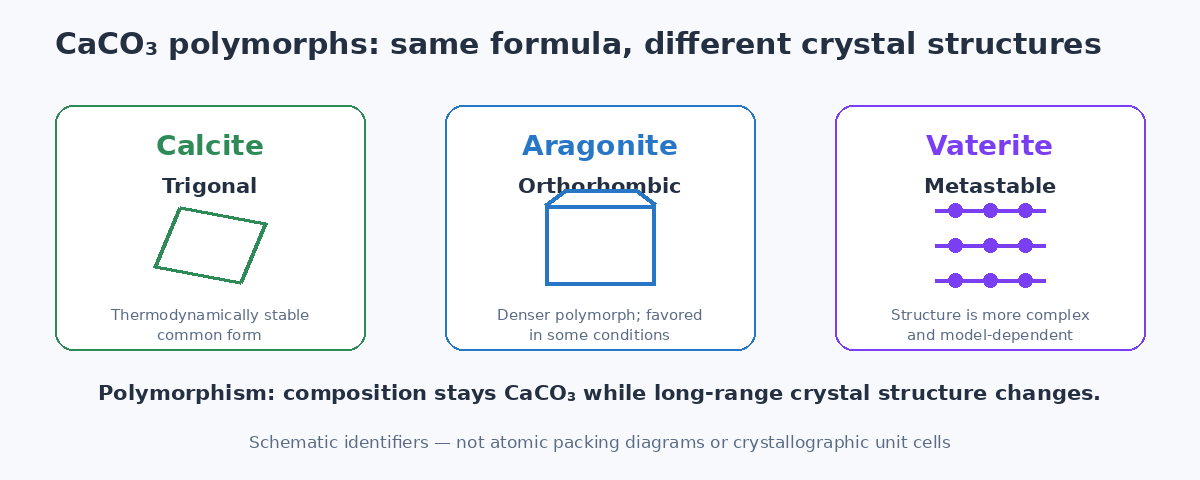
Calcite, aragonite and vaterite are all calcium carbonate, but their ions are arranged differently in the solid. This is polymorphism: one chemical composition can adopt more than one crystal structure.
Different structures have different thermodynamic stabilities and solubilities. USGS measurements of the CaCO₃–CO₂–H₂O system show distinct equilibrium constants for calcite, aragonite and vaterite. This is why a property value cannot always be assigned to “CaCO₃” without also asking which solid form is present.
Source: USGS — solubilities of calcite, aragonite and vaterite
Aqueous / acid–base chemistry Acid fizzing and solubility are part of the same carbonate equilibrium network Removing carbonate through protonation and CO₂ formation can pull CaCO₃ dissolution forward.
A minimal dissolution equilibrium is CaCO₃(s) ⇌ Ca²⁺ + CO₃²⁻. But open water systems also contain CO₂(aq), H₂CO₃, HCO₃⁻ and H⁺. When acid is added, carbonate accepts protons and carbon ultimately leaves as CO₂ + H₂O. That lowers free carbonate activity and allows more solid to dissolve.
This is why carbonate solubility in natural water cannot be understood from a single Ksp expression alone; CO₂ pressure, pH, temperature, complexation and solid polymorph can all matter.
Physical / industrial chemistry Calcination has no single universal “decomposition temperature” CaCO₃ ⇌ CaO + CO₂ depends on both temperature and CO₂ partial pressure, while real kilns add heat- and mass-transfer limits.
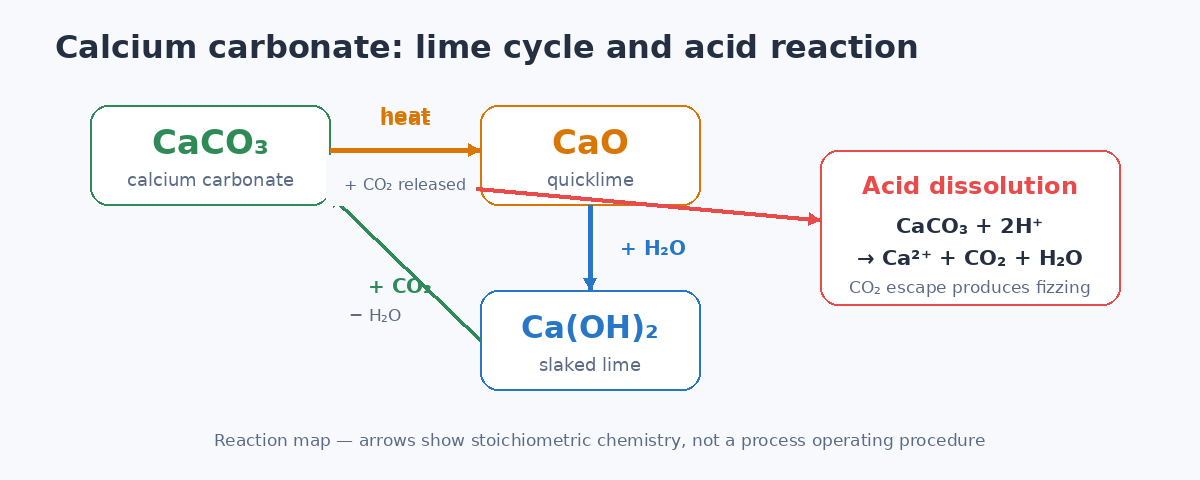
The calcination equilibrium is CaCO₃(s) ⇌ CaO(s) + CO₂(g). Because the solids have unit activity in a simple equilibrium treatment, the equilibrium condition is closely related to the CO₂ pressure at a given temperature.
Raising temperature favors decomposition, while raising the surrounding CO₂ partial pressure opposes it. This is why statements such as “calcium carbonate decomposes at 825 °C” are only rough context. Literature on lime calcination shows that practical temperatures depend on gas composition, desired rate, particle size, heat transfer and kinetics.
Source: Journal of Cleaner Production — CaCO₃ calcination equilibrium discussion
Water / engineering chemistry Hard-water scale is a precipitation problem controlled by chemistry and operating conditions Heating, CO₂ loss and concentration changes can push calcium–carbonate water toward CaCO₃ precipitation on surfaces.
In many natural and process waters, calcium and dissolved inorganic carbon are carried in solution. When temperature rises, CO₂ is lost, pH changes or water becomes concentrated, the equilibrium can shift toward precipitation of CaCO₃. The result can be scale on heat-transfer surfaces, pipework or equipment.
Scale formation is not simply “calcium carbonate becoming less soluble.” It depends on speciation, saturation state, nucleation, surface conditions, flow and kinetics. That makes CaCO₃ a useful bridge from school equilibrium chemistry to real water-treatment and process-engineering problems.
Source: USGS — CaCO₃ polymorph solubility in CO₂–H₂O systems
Materials / engineering The lime cycle connects limestone, quicklime, slaked lime and carbonation A sequence of reversible/related reactions connects geology, mortars, cement chemistry and CO₂ mineralization concepts.
Heating limestone-rich material can produce CaO (quicklime) and CO₂. Adding water to CaO forms Ca(OH)₂ (slaked lime), and reaction of Ca(OH)₂ with CO₂ can reform CaCO₃. These transformations form the familiar lime cycle.
In real cementitious systems, many additional phases and kinetics are involved, so the simple cycle is a conceptual backbone rather than a complete cement model.
Worked examples
10.0 g / 100.09 g/mol = 0.09991 mol CaCO₃ → 0.09991 mol CO₂ × 44.0095 g/mol ≈ 4.40 g CO₂
The overall reaction gives a 1:1 mole ratio between CaCO₃ and CO₂.
1.000 mol CaCO₃ → 1.000 mol CaO + 1.000 mol CO₂ ≈ 56.08 g CaO + 44.01 g CO₂
Real limestone may contain impurities, and actual conversion depends on equilibrium and kinetics.
Related compounds
Sources & evidence Reference sources Open the evidence and reference list used for this compound page.
Compound pages separate formula interpretation from reference data and from contextual explanation. Check the linked source when a value or condition matters to your work.
- PubChem — Calcium Carbonate — Identity, formula, formula weight and reference information.
- Chemistry LibreTexts — Carbonate resonance structures — Three equivalent carbonate resonance contributors and delocalized bonding.
- OpenStax Chemistry — Occurrence, Preparation and Properties of Carbonates — Carbonate basicity, acid reaction and carbonate chemistry.
- USGS — Calcite, aragonite and vaterite solubility — Measured/evaluated CaCO₃ polymorph equilibria in CO₂–H₂O systems.
- NIST Chemistry WebBook — Calcium carbonate — Reference thermochemical information.
Found an error, something unclear, or a missing topic?
Tell us what you noticed. Feedback goes to a private review queue and is never published automatically.