

Why Does Calcium Carbonate React with Acids?
The familiar fizz of calcium carbonate in acid is a compact lesson in acid–base chemistry, gas evolution, solubility equilibrium and coupled equilibria.
Start simple, then go as deep as you need
The levels are cumulative: Deep dive keeps the earlier explanation visible and adds the more technical layer, caveats, comparisons, retrieval practice and scientific sources.
Why Does Calcium Carbonate React with Acids? in one minute
Acid supplies H⁺/H₃O⁺ that protonates carbonate. Carbonate is converted through bicarbonate/carbonic-acid chemistry to CO₂ and H₂O, while Ca²⁺ enters solution. Removing carbonate species from solution pulls more CaCO₃ toward dissolution, so the solid is consumed and CO₂ bubbles appear.
The fizz is CO₂. Acid does more than “attack the solid”: protonation removes carbonate from the dissolution equilibrium and couples acid–base chemistry to solubility.
What you will understand before you leave
Learning outcomes
- Write and interpret the molecular and net ionic equations for CaCO₃ reacting with strong acid.
- Explain why CO₂ gas evolves.
- Connect protonation of CO₃²⁻ to bicarbonate and carbonic-acid chemistry.
- Explain how acid shifts a sparingly soluble carbonate toward dissolution.
- Connect the chemistry to antacids, limestone/marble weathering and carbonate scale.
Ideas to know first
CO₃²⁻ is a polyatomic base that can accept protons.
Solid CaCO₃ can exist in equilibrium with small amounts of Ca²⁺ and CO₃²⁻ in water.
A reaction can be driven by formation/removal of a gaseous product such as CO₂.
See how the idea connects
These are explanatory steps, not buttons. Read from left to right to follow the cause-and-effect chain.
Only a small amount is present as free Ca²⁺ and CO₃²⁻ in neutral water.
CO₃²⁻ becomes HCO₃⁻ and then carbonic-acid-like species.
Carbonic acid is linked to dissolved CO₂ and water; CO₂ can escape as gas.
Removing carbonate from solution allows additional CaCO₃ to dissolve and react.
What is the reaction pathway?
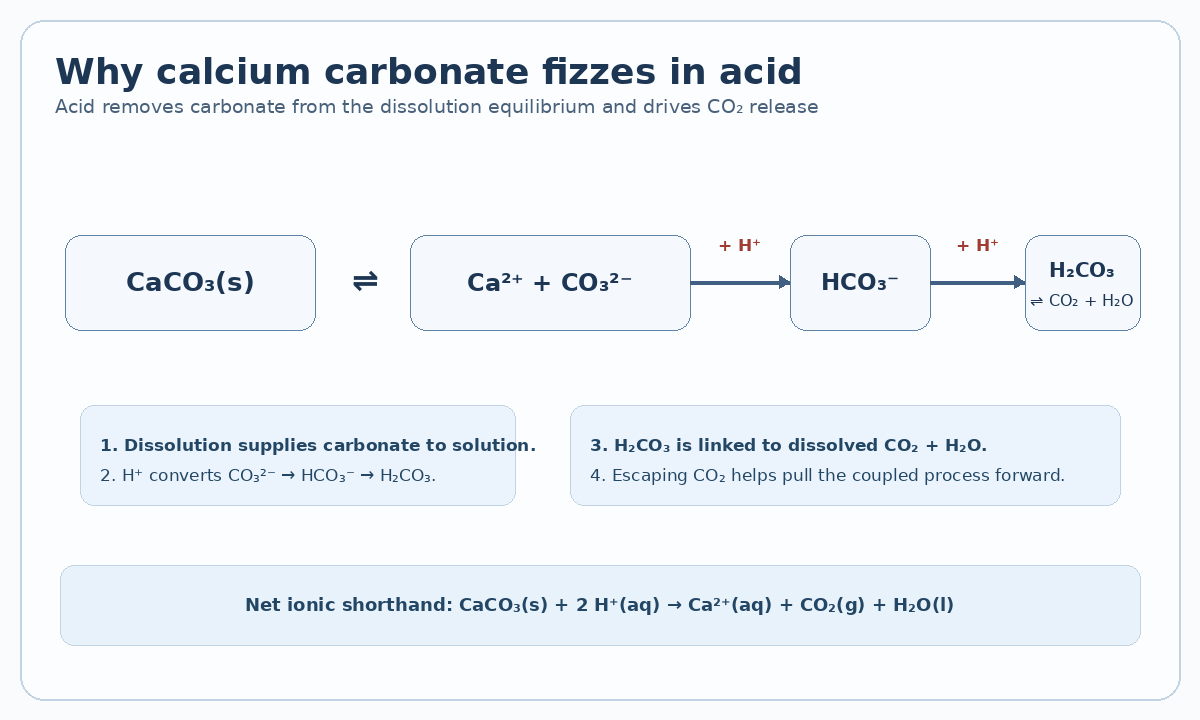
With hydrochloric acid, the familiar overall equation is:
Because chloride is a spectator ion in this example, the net ionic shorthand is:
In water, H₃O⁺ notation is often more realistic than a free H⁺ symbol, but both conventions are used for stoichiometric teaching.
Why does the reaction fizz?
Carbonate accepts protons. A useful conceptual sequence is CO₃²⁻ → HCO₃⁻ → H₂CO₃ → CO₂ + H₂O. The visible bubbles are carbon dioxide leaving the liquid phase.
Gas evolution helps pull the chemistry forward because one of the products is removed from the local solution as CO₂ escapes. The rate of visible fizzing also depends on kinetics—surface area, acid concentration, mixing and temperature—not just the balanced equation.
How does acid change CaCO₃ solubility?
Calcium carbonate has a dissolution equilibrium:
Acid consumes CO₃²⁻ by protonating it. Lowering the free carbonate concentration shifts the dissolution equilibrium toward the right, allowing more solid CaCO₃ to enter solution. This is a classic example of coupled equilibria: acid–base chemistry and solubility are linked.
Why the same chemistry appears in antacids, limestone and scale
Calcium carbonate is used in some antacids because carbonate consumes acid. Limestone and marble are attacked by acidic environments through related carbonate protonation/dissolution chemistry. In water systems, carbonate equilibria also influence mineral scale formation and removal.
The same balanced formula can therefore represent very different contexts. The surrounding pH, CO₂ partial pressure, dissolved-ion composition and surface condition determine what actually happens in a real system.
Worked stoichiometry: acid requirement and CO₂ formed
This is equation stoichiometry, not an experimental instruction. Real reaction completion and gas recovery depend on conditions and mass transfer.
What students often mix up
Do not say the bubbles are hydrogen gas; carbonate + acid releases CO₂.
Do not treat the net ionic equation as a full microscopic mechanism.
Do not confuse reaction rate with equilibrium/stoichiometric driving force.
Do not assume limestone, chalk and marble behave identically in every physical setting merely because CaCO₃ is a major component.
Check your understanding
Answer before opening the explanation. The aim is understanding, not speed.
1What gas causes the fizz?
Carbon dioxide, CO₂.
2How many moles of H⁺ are required per mole of CaCO₃ in the net stoichiometric equation?
Two.
3Why can acid increase CaCO₃ dissolution?
It consumes carbonate species by protonation, lowering free CO₃²⁻ and pulling the dissolution equilibrium toward more dissolved material.
4Is the visible fizz itself proof that the reaction is at equilibrium?
No. Fizzing is a kinetic observation of gas evolution; equilibrium and rate are different ideas.
Sources and terminology
Definitions and reference claims are anchored to authoritative scientific organizations and peer-reviewed literature where needed. Element Lookup adds teaching explanation, examples and visual structure; it does not treat AI as the source of scientific definitions or numbers.
Found an error, something unclear, or a missing topic?
Tell us what you noticed. Feedback goes to a private review queue and is never published automatically.