

Carbon Dioxide CO2
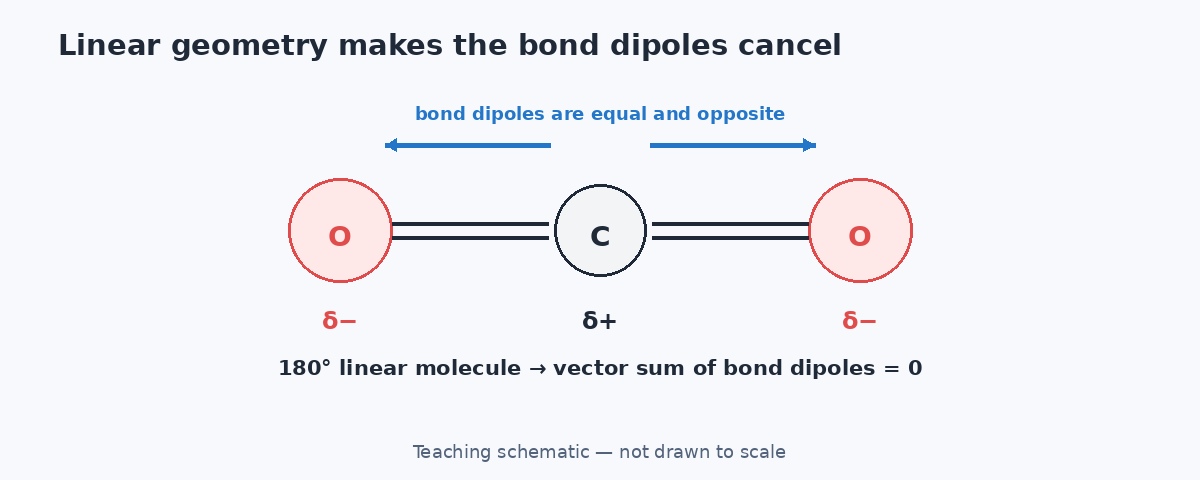
Carbon dioxide is CO₂, a molecular compound containing one carbon atom and two oxygen atoms per molecule. The equilibrium molecule is linear: each C=O bond is polar, but the two bond dipoles point in opposite directions and cancel, so CO₂ has no permanent molecular dipole.
What does CO2 mean?
CO₂ contains one C and two O atoms. CO and CO₂ are different compounds: changing a subscript changes composition, electron count, bonding and chemical behavior.
Once you can count every element correctly, the same formula becomes the basis for formula mass and molar mass.
What kind of chemical substance is it?
CO₂ is a discrete covalent molecule commonly represented as O=C=O. Carbon has two bonding directions and no lone pair in the usual Lewis structure, giving a linear 180° geometry. The C=O bonds are polar, but molecular symmetry cancels their dipoles.
Why does Carbon Dioxide behave this way?
A one-line answer says “CO₂ is nonpolar.” The useful explanation is the chain behind it: polar C=O bonds → linear 180° geometry → equal and opposite bond dipoles → no permanent molecular dipole. The same molecule then connects to aqueous acid–base equilibria, dry-ice phase behavior, infrared spectroscopy and the carbon cycle.
Why is CO₂ nonpolar if its C=O bonds are polar?
The molecule is linear and symmetric. The two C=O bond dipoles have equal magnitude and opposite direction, so their vector sum is zero. “Polar bonds” and “polar molecule” are therefore different statements.
Why is CO₂ linear?
In the introductory VSEPR model, carbon has two electron domains in CO₂ and no lone pairs. Two domains arrange 180° apart, giving the O=C=O molecule a linear geometry.
Does nonpolar mean CO₂ cannot interact with electric fields or absorb infrared radiation?
No. “Nonpolar” means there is no permanent molecular dipole in the equilibrium geometry. The electron cloud is still polarizable, and molecular vibrations that change the dipole moment can absorb infrared radiation.
Is dissolved CO₂ the same thing as carbonic acid?
No. CO₂ can dissolve as molecular CO₂(aq), and only a fraction is hydrated to carbonic acid, H₂CO₃. Carbonic acid, bicarbonate and carbonate are connected through equilibria whose proportions depend strongly on pH and other conditions.
Why does dry ice sublime instead of melt at ordinary atmospheric pressure?
The CO₂ triple-point pressure is above normal atmospheric pressure. At about 1 bar there is no stable liquid-CO₂ region, so heating solid CO₂ crosses the solid–gas boundary and it sublimes.
Are carbon monoxide (CO) and carbon dioxide (CO₂) basically the same?
No. Changing the oxygen count changes the compound. CO and CO₂ have different electron structures, bonding, toxicology, combustion roles and physical properties; a subscript is part of chemical identity, not decoration.
Why does a fizzy drink lose carbonation after opening?
Opening lowers the CO₂ partial pressure above the liquid. Dissolved CO₂ then leaves the solution, shifting gas–liquid and acid–base equilibria. The escaping bubbles are a visible consequence of that new equilibrium condition.
Go deeper on the questions students search
These lessons expand one important question without duplicating the compound reference page.
Key properties and classification
Why this compound matters: CO₂ connects molecular geometry to combustion, respiration, photosynthesis, carbonate chemistry, ocean chemistry, atmospheric science, refrigeration/phase behavior, fire suppression and industrial gas handling. It is an unusually useful bridge from a simple Lewis structure to physical chemistry and environmental chemistry.
Where does Carbon Dioxide appear in chemical equations?
These equations are included to connect the compound to chemistry concepts and stoichiometry. They are not laboratory procedures.
Shows CO₂ as a common carbon-containing combustion product and gives a direct stoichiometric link to methane.
A simplified aqueous sequence; actual speciation depends on pH, temperature, ionic composition and gas partial pressure.
Connects CO₂ with calcium carbonate and the lime/carbonate cycle.
Safety depends on form, concentration and situation
CO₂ is not flammable, but elevated concentrations can displace oxygen and create a serious asphyxiation hazard. Solid CO₂ can cause cold injury, and sealed systems can become highly pressurized as CO₂ warms or vaporizes. Safety depends on concentration, ventilation, phase and equipment.
Study the chemistry, not just the topic names
CO₂ looks simple on paper, but its deeper chemistry spans symmetry, solution equilibria, phase thermodynamics, spectroscopy and process chemistry. Open the modules below to follow those connections without confusing the molecular formula with the behavior of a bulk system.
Core chemistry Lewis structure, linear geometry and dipole cancellation Two polar C=O bonds can still produce a nonpolar molecule when the geometry is perfectly symmetric.
- Count valence electrons: carbon contributes 4 and two oxygens contribute 12, giving 16 total.
- Build the Lewis structure: the familiar lowest-formal-charge representation is O=C=O, with two lone pairs on each oxygen.
- Apply VSEPR: the central carbon has two electron domains, so the molecule is linear at 180°.
- Add bond dipoles: each C=O bond is polar toward oxygen.
- Add them as vectors: equal dipoles in opposite directions cancel, so the equilibrium molecule has no permanent dipole moment.
This comparison is especially useful beside bent H₂O, where the bond dipoles do not cancel.
Source: OpenStax Chemistry 2e — Molecular Structure and Polarity
University chemistry Dissolved CO₂ is an equilibrium network, not one species Gas dissolution, hydration, bicarbonate and carbonate are coupled through gas–liquid and acid–base equilibria.

When CO₂ contacts water, it first dissolves as molecular CO₂(aq). A fraction hydrates to carbonic acid, H₂CO₃, which is connected by proton-transfer equilibria to bicarbonate and carbonate. A useful simplified map is:
CO₂(g) ⇌ CO₂(aq); CO₂(aq) + H₂O ⇌ H₂CO₃; H₂CO₃ ⇌ H⁺ + HCO₃⁻; HCO₃⁻ ⇌ H⁺ + CO₃²⁻.
The proportions are condition-dependent. Pressure changes how much gas dissolves; pH changes the balance among dissolved carbon species; temperature and ionic composition also matter. This is why “CO₂ makes carbonic acid” is true as an overview but incomplete as a quantitative description.
Physical chemistry The phase diagram explains dry ice, liquid CO₂ and supercritical CO₂ At 1 bar solid CO₂ cannot melt to a stable liquid; above the critical point liquid and gas are no longer distinct phases.
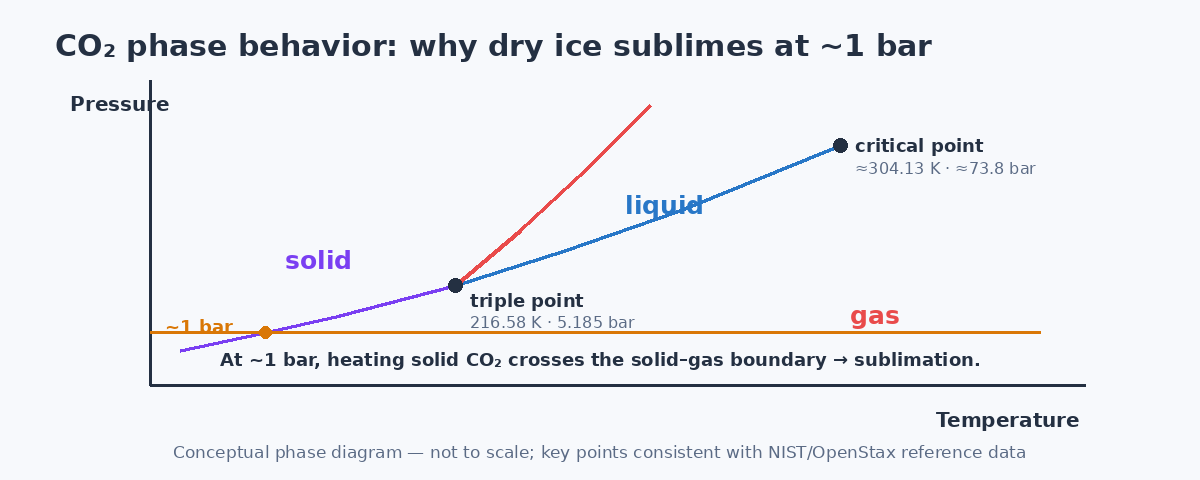
NIST reference data place the CO₂ triple point at about 216.58 K and 5.185 bar. Because ordinary atmospheric pressure is below the triple-point pressure, a path near 1 bar does not cross a stable liquid region: dry ice warms and sublimes directly to gas.
The critical point is near 304.18 K and 73.8 bar. Above the critical temperature and pressure, the familiar liquid–gas phase boundary ends; CO₂ is then described as a supercritical fluid rather than as an ordinary liquid or gas.
These are equilibrium boundaries, not instructions for handling pressurized CO₂. Real equipment requires pressure-rated design and specialist safety controls.
University spectroscopy A nonpolar molecule can still absorb infrared radiation IR activity depends on whether a vibration changes the molecular dipole, not simply on whether the equilibrium molecule is polar.
CO₂ has no permanent dipole at its equilibrium linear geometry, but the atoms vibrate. During some vibrational modes—particularly the asymmetric stretch and bending motions—the instantaneous charge distribution changes so that the vibration can interact with infrared radiation. A perfectly symmetric stretch does not create the same changing dipole.
This is a useful correction to the misconception “nonpolar molecules cannot absorb IR.” Spectroscopy depends on the symmetry and dipole change of a particular vibration.
Environmental chemistry Carbon dioxide links the atmosphere, oceans and carbonate minerals The same CO₂ molecule participates in a carbon cycle that includes gas exchange, acid–base speciation and calcium carbonate formation/dissolution.
Atmospheric CO₂ can dissolve into surface waters. Added dissolved CO₂ shifts the carbonate system toward more H⁺ and bicarbonate, which lowers pH and can reduce the fraction of dissolved inorganic carbon present as carbonate ion. That matters because carbonate is a building block for CaCO₃ minerals and biological shells.
On land and in industry, CO₂ also appears in combustion, calcination, carbonation and gas-processing systems. The chemistry page should separate these molecular/equilibrium facts from policy or emissions-accounting debates.
Source: US EPA — Understanding Ocean and Coastal Acidification
Worked examples
1.00 mol CH₄ × (1 mol CO₂ / 1 mol CH₄) × 44.0095 g/mol = 44.01 g CO₂
The balanced equation gives a 1:1 mole ratio between CH₄ and CO₂.
1 bar < CO₂ triple-point pressure (5.185 bar) → the 1-bar path does not enter the stable liquid region
The phase diagram determines which phase transitions are thermodynamically available.
Related compounds
Sources & evidence Reference sources Open the evidence and reference list used for this compound page.
Compound pages separate formula interpretation from reference data and from contextual explanation. Check the linked source when a value or condition matters to your work.
- NIST Chemistry WebBook — Carbon dioxide — Identity, phase-change data and IR spectrum links.
- PubChem — Carbon Dioxide — Identity, formula, molecular weight and safety/reference links.
- OpenStax Chemistry 2e — Molecular Structure and Polarity — Linear geometry, bond dipoles and molecular polarity.
- OpenStax Chemistry — Chemical Equilibria — CO₂/water/carbonic-acid equilibrium example.
- NOAA Ocean Acidification Program — Seawater carbonate chemistry and CO₂ uptake context.
- US EPA — Overview of Greenhouse Gases — Atmospheric and emissions context.
Found an error, something unclear, or a missing topic?
Tell us what you noticed. Feedback goes to a private review queue and is never published automatically.