

Sodium Hydroxide NaOH
Sodium hydroxide, NaOH, is an ionic solid made from Na⁺ and OH⁻ ions. When it dissolves in water it dissociates essentially completely, so it is classified as a strong base. “Strong base” describes this dissociation/acid–base behavior; it does not tell you the concentration of a particular solution.
Also called: caustic soda · lye · sodium hydrate
What does NaOH mean?
NaOH gives a 1:1 ratio of Na⁺ to OH⁻. Solid sodium hydroxide is an ionic lattice, not a collection of discrete Na–O–H molecules. In water the relevant particles are hydrated Na⁺ and OH⁻ ions.
Once you can count every element correctly, the same formula becomes the basis for formula mass and molar mass.
What kind of chemical substance is it?
Solid NaOH is ionic. Sodium exists as Na⁺ and hydroxide as OH⁻; the O–H bond inside hydroxide is covalent, while electrostatic interactions organize the ions in the solid. Dissolution separates and hydrates the ions.
Why does Sodium Hydroxide behave this way?
The useful chain is: ionic solid → hydration/dissociation to Na⁺ and OH⁻ → hydroxide accepts protons → strong acid–base neutralization → heat release and salt formation. Industrially, NaOH is closely tied to sodium chloride through chlor-alkali electrolysis, linking this page directly to the NaCl gold-standard page.
Is sodium hydroxide an acid or a base?
It is a strong base in water because dissolved NaOH provides OH⁻ ions essentially completely.
Is NaOH a molecule?
Not in the ordinary solid. Sodium hydroxide is an ionic compound composed of Na⁺ and OH⁻ in a crystal lattice. NaOH is a formula unit showing the 1:1 ionic ratio.
Is lye the same as sodium hydroxide?
“Lye” commonly refers to sodium hydroxide in many contexts, but the word can also be used more broadly for strongly alkaline hydroxide products. Chemical identity and concentration should be checked rather than inferred from a common name alone.
Why does sodium hydroxide get hot when dissolved in water?
Breaking the ionic lattice requires energy, but hydration of Na⁺ and especially OH⁻ releases substantial energy. Under ordinary conditions the net dissolution enthalpy is exothermic, so solution temperature can rise.
Does strong base mean concentrated base?
No. Strong describes essentially complete dissociation; concentrated describes amount per volume/mass of solution. A dilute NaOH solution is still a solution of a strong base.
What is the pH of sodium hydroxide?
There is no single pH for “sodium hydroxide.” pH depends on concentration, temperature and activity. A solution label or molarity must be stated before a pH calculation is meaningful.
Why does NaOH neutralize acids?
The hydroxide ion accepts a proton. In strong-acid/strong-base neutralization, the essential net ionic reaction is H₃O⁺ + OH⁻ → 2 H₂O.
Separate 'strong base' from 'high pH' and concentration
NaOH dissociates essentially completely in ordinary aqueous chemistry, but that does not mean every NaOH solution has the same pH or behaves ideally at all concentrations.
Dissociation
NaOH provides Na⁺ and OH⁻ in water; 'strong' refers to near-complete dissociation.
Concentration
The amount of OH⁻ per volume sets the first approximation to pOH.
Real solution
Temperature, activity and very high ionic strength can matter when high precision is required.
Check your reasoning A strong base must always be concentrated. Click to reveal the explanation Explanation revealed
Common wrong reasoning: Strength and concentration are the same idea.
Better answer: A strong base can be very dilute; 'strong' describes dissociation, while concentration describes how much solute is present.
Common misconceptions and exam traps
It is an ionic compound that dissociates into hydrated ions.
Many substances can make solutions alkaline; NaOH is only one strong base.
Spectator ions remain even when H⁺ and OH⁻ form water.
Key properties and classification
Why this compound matters: NaOH is one of the clearest compounds for connecting ionic structure to solution chemistry. It appears in pH, titration, neutralization, hydrolysis, organic reactions, materials processing and chlor-alkali electrochemistry.
Where does Sodium Hydroxide appear in chemical equations?
These equations are included to connect the compound to chemistry concepts and stoichiometry. They are not laboratory procedures.
Essentially complete dissociation for dissolved NaOH under ordinary conditions.
The net ionic core is hydronium plus hydroxide forming water.
Shows the 2:1 base-to-acid stoichiometry for complete neutralization of diprotic H₂SO₄.
Safety depends on form, concentration and situation
Sodium hydroxide is strongly corrosive, and dissolving or neutralizing it can release substantial heat. Concentrated solutions can cause severe chemical burns. This page does not provide mixing, preparation or handling procedures.
Study the chemistry, not just the topic names
Sodium hydroxide is best understood by keeping structure, dissociation, concentration and thermochemistry separate. The modules below move from ionic solid to hydrated ions, then into pH, neutralization and chlor-alkali process chemistry.
Core chemistry NaOH is an ionic formula unit, not a discrete Na–O–H molecule
The solid contains Na⁺ and OH⁻; water separates and hydrates those ions.
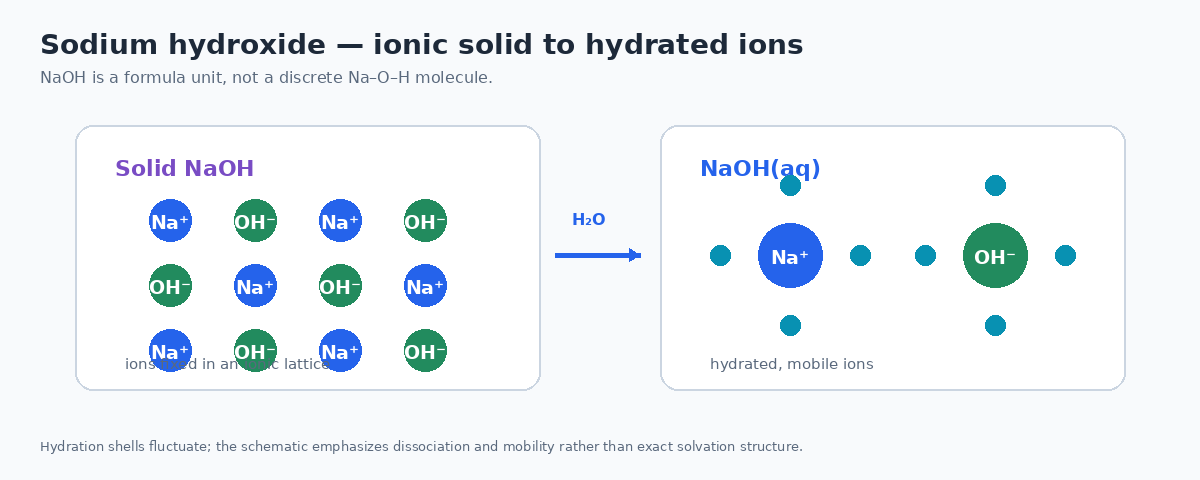
In solid sodium hydroxide, Na⁺ and OH⁻ occupy an ionic crystal structure. The covalent O–H bond belongs inside the hydroxide ion; the interaction between Na⁺ and OH⁻ is ionic. When NaOH dissolves, the lattice is disrupted and water hydrates the ions.
This is why a simple linear Na–O–H molecular drawing is not a good structural model of the bulk solid.
Source: PubChem — Sodium Hydroxide
Core → university Strong base vs concentration — why NaOH has no single pH
Near-complete dissociation tells you base strength; molarity/amount tells you concentration.

OpenStax classifies NaOH as a strong base because dissolved ionic NaOH dissociates essentially completely into Na⁺ and OH⁻. For ideal dilute solutions, this allows [OH⁻] ≈ c(NaOH). But pH depends on the actual concentration and, at higher ionic strengths, activity.
A statement such as “sodium hydroxide has pH 14” is therefore incomplete unless a concentration and temperature are specified.
Thermochemistry Why dissolution and neutralization can heat the solution
Lattice disruption costs energy; hydration and proton-transfer processes release energy.
Dissolving NaOH requires separating ions from the solid lattice, but hydration of Na⁺ and OH⁻ is strongly favorable. The net dissolution is exothermic under ordinary conditions. Strong-acid/strong-base neutralization also releases heat as hydronium and hydroxide form water.
Heat release is a thermodynamic fact, not a cue for an experiment; concentration and heat removal strongly affect real systems.
Core → university Net ionic neutralization exposes the chemistry beneath spectator ions
Na⁺ and many counterions can cancel from a complete ionic equation, leaving proton transfer.
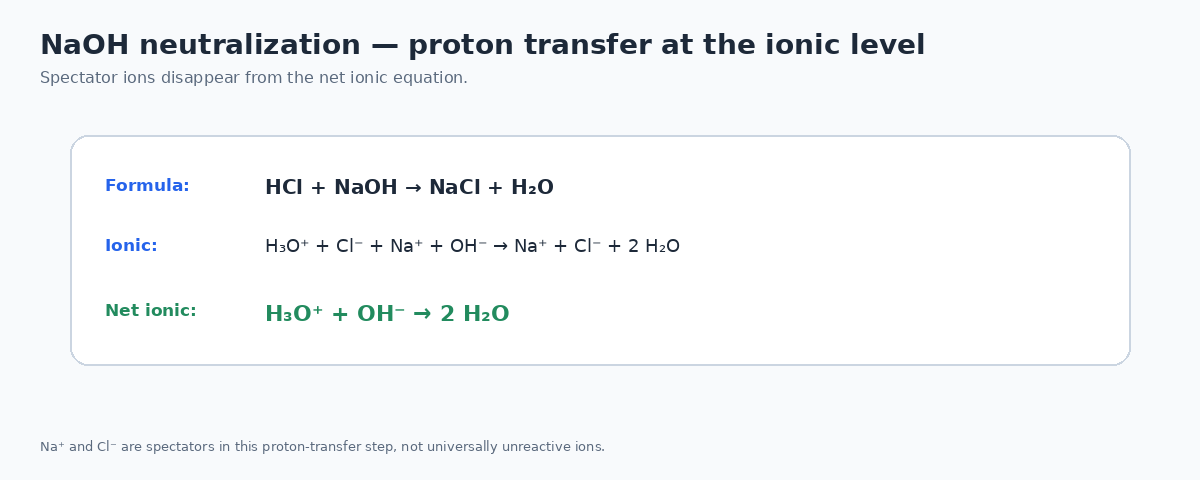
For HCl + NaOH, the complete ionic picture contains Na⁺, Cl⁻, H₃O⁺ and OH⁻. Na⁺ and Cl⁻ are unchanged spectators, leaving H₃O⁺ + OH⁻ → 2 H₂O.
That same idea generalizes to titrations and acid–base stoichiometry, while reminding us that spectator ions can still matter for ionic strength or other chemistry.
Source: OpenStax Chemistry — salt hydrolysis / neutralization
University / engineering Chlor-alkali chemistry links NaOH directly to sodium chloride
Industrial electrolysis of brine co-produces NaOH, chlorine and hydrogen in separated cell chemistry.
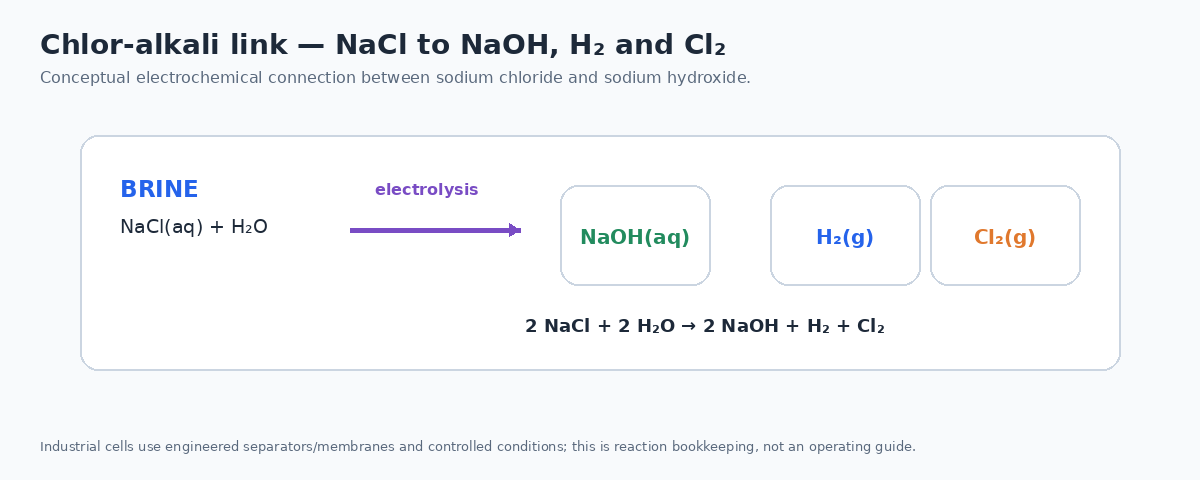
Modern sodium-hydroxide production is closely connected to brine electrolysis. A high-level overall equation is 2 NaCl + 2 H₂O → 2 NaOH + Cl₂ + H₂. Real chlor-alkali cells use engineered separation so chlorine, hydrogen and caustic solution do not simply remix.
The page keeps this at process-chemistry level; cell design, operating conditions and handling belong to industrial safety/engineering standards.
Source: OpenStax Chemistry 2e — sodium hydroxide / chlor-alkali context
Worked examples
[OH⁻] ≈ 1.0 × 10⁻³ M → pOH = 3.00 → pH = 14.00 − 3.00 = 11.00
Uses the 25 °C pKw ≈ 14.00 approximation and ideal dilute behavior.
H₂SO₄ + 2 NaOH → Na₂SO₄ + 2 H₂O → 0.0750 × 2 = 0.150 mol NaOH
Stoichiometric calculation only; not a mixing instruction.
Related compounds
Sources & evidence Reference sources Open the evidence and reference list used for this compound page.
Compound pages separate formula interpretation from reference data and from contextual explanation. Check the linked source when a value or condition matters to your work.
- PubChem — Sodium Hydroxide — Identity, formula, ionic representation, properties and hazard context.
- OpenStax Chemistry — NaOH as a strong base — Dissociation and strong-base classification.
- OpenStax Chemistry 2e — NaOH / chlor-alkali — Solubility, exothermic dissolution and industrial production context.
- NIST Chemistry WebBook — Sodium Hydroxide — Reference identity and thermochemical data.
Found an error, something unclear, or a missing topic?
Tell us what you noticed. Feedback goes to a private review queue and is never published automatically.