

Sodium Bicarbonate NaHCO3
Sodium bicarbonate is NaHCO₃, an ionic solid made from Na⁺ and HCO₃⁻ ions in a 1:1 ratio. The bicarbonate ion is amphiprotic: it can accept a proton to move toward carbonic acid or donate one to form carbonate. This is the chemistry behind its buffering and acid-reactive behavior.
What does NaHCO3 mean?
NaHCO₃ represents one Na⁺ ion for one HCO₃⁻ ion in an electrically neutral formula unit. It is not best pictured as a discrete covalent Na–O–H–C–O₃ molecule. Covalent bonding occurs inside the bicarbonate ion; sodium belongs to the ionic solid.
Once you can count every element correctly, the same formula becomes the basis for formula mass and molar mass.
What kind of chemical substance is it?
Sodium bicarbonate is an ionic solid built from Na⁺ and HCO₃⁻. Inside HCO₃⁻, carbon and oxygen are covalently bonded and the negative charge is delocalized over the two non-protonated oxygens. The O–H group is chemically important because bicarbonate lies between carbonic acid and carbonate in the acid–base sequence.
Why does Sodium Bicarbonate behave this way?
NaHCO₃ first separates conceptually into Na⁺ and HCO₃⁻. The bicarbonate ion can accept H⁺ or donate H⁺, so pH controls which carbonate-system species are favored. Adding acid drives HCO₃⁻ toward CO₂/H₂O, while heating can convert solid bicarbonate to carbonate with release of CO₂ and H₂O.
Is sodium bicarbonate the same as baking soda?
In ordinary chemical naming, baking soda is sodium bicarbonate, NaHCO₃. Baking powder is different: it is a formulated mixture containing bicarbonate plus one or more acidic ingredients and other components.
Is sodium bicarbonate ionic or covalent?
The solid is ionic overall: Na⁺ and HCO₃⁻ form the formula unit. Within HCO₃⁻, the C–O and O–H bonds are covalent.
Is bicarbonate an acid or a base?
It can act as either. HCO₃⁻ can accept H⁺ to move toward H₂CO₃/CO₂(aq), or donate H⁺ to form CO₃²⁻. This is called amphiprotic behavior.
Why does sodium bicarbonate fizz with acids?
Acid protonates bicarbonate, leading to carbon dioxide and water. Gas formation makes the reaction visibly effervescent.
What happens when sodium bicarbonate is heated?
It decomposes to sodium carbonate, carbon dioxide and water: 2 NaHCO₃ → Na₂CO₃ + CO₂ + H₂O. The rate depends strongly on temperature and conditions.
What is the molar mass of NaHCO₃?
The formula mass is about 84.0066 g/mol.
Does sodium bicarbonate make every solution neutral?
No. “Buffering” means resisting pH change within a chemical system, not forcing every solution to pH 7. Bicarbonate speciation depends on pH, dissolved CO₂ and other acid/base components.
Key properties and classification
Why this compound matters: Sodium bicarbonate connects ionic formula units, polyatomic-ion resonance, acid–base equilibria, gas evolution, buffers and decomposition reactions. It is also a strong example of why familiar household names should still be taught with rigorous chemical distinctions.
Where does Sodium Bicarbonate appear in chemical equations?
These equations are included to connect the compound to chemistry concepts and stoichiometry. They are not laboratory procedures.
Simplified net reaction showing why acid produces effervescence.
Balanced overall decomposition; actual rate depends on temperature and material conditions.
Shown as two explicit proton-transfer steps; in real aqueous CO₂ systems, dissolved CO₂/H₂CO₃ bookkeeping depends on the convention used.
Safety depends on form, concentration and situation
Sodium bicarbonate is widely used in foods, laboratories and formulated products, but concentrated dust, ingestion amounts and medical use are separate safety/health contexts. This page explains chemistry and does not provide dosing or treatment advice.
Study the chemistry, not just the topic names
The important chemistry is not “baking soda reacts with acid”; it is the position of HCO₃⁻ inside a coupled carbonic-acid/carbonate system. That one idea explains buffering, pH dependence, CO₂ release and many environmental/biological carbonate equilibria.
Core chemistry NaHCO₃ is Na⁺ + HCO₃⁻, and bicarbonate is resonance-stabilized Ionic bonding joins Na⁺ and HCO₃⁻; covalent/resonance bonding lives inside the anion.
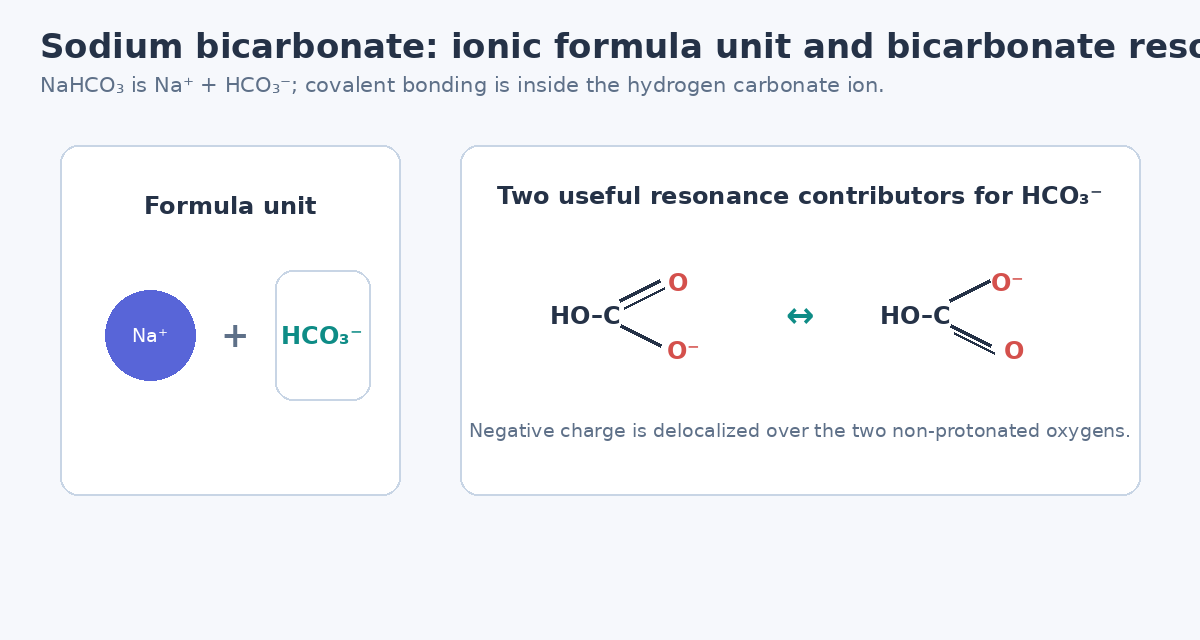
The charges balance 1:1: Na⁺ + HCO₃⁻ → NaHCO₃. Within HCO₃⁻, one oxygen bears H while the two non-protonated oxygens share delocalized negative charge through resonance.
This is why drawing sodium covalently bonded to one oxygen is a poor molecular model for the solid.
Acid–base chemistry Bicarbonate is amphiprotic — it sits between carbonic acid and carbonate HCO₃⁻ can both accept and donate H⁺.
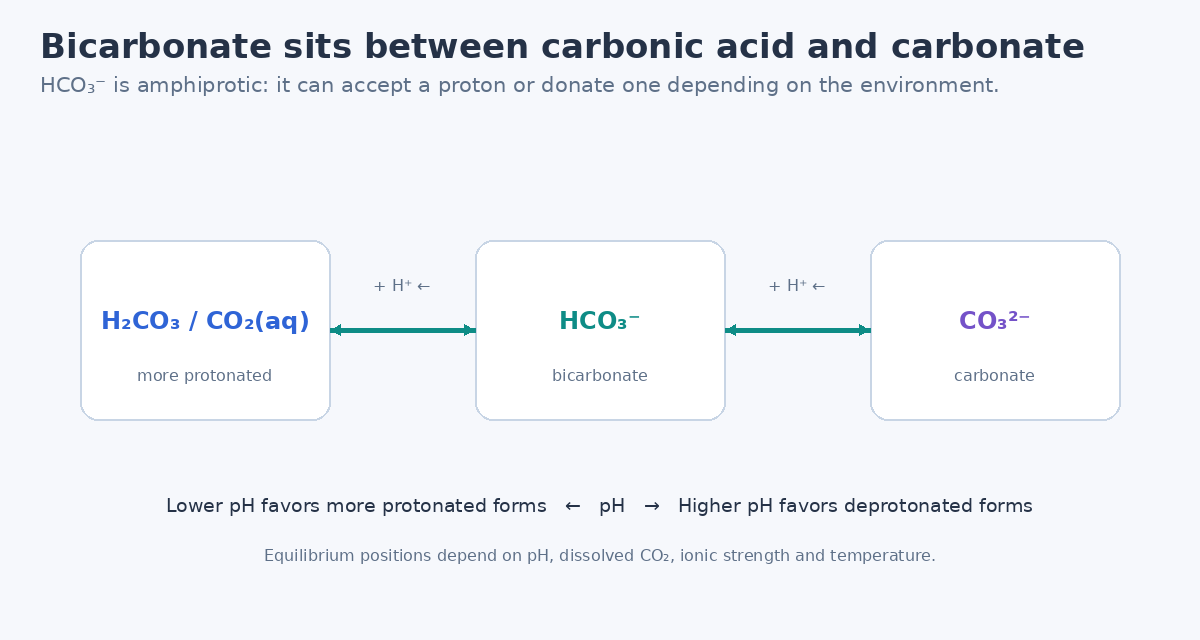
Carbonic-acid chemistry is diprotic. The two proton-transfer steps are H₂CO₃ ⇌ H⁺ + HCO₃⁻ and HCO₃⁻ ⇌ H⁺ + CO₃²⁻. Thus bicarbonate is both the conjugate base of carbonic acid and the conjugate acid of carbonate.
In the common aqueous CO₂(aq)/H₂CO₃ teaching convention, an apparent first pKₐ near 6.35 and a second pKₐ near 10.33 are often used around 25 °C. The first number depends on how dissolved CO₂ and true H₂CO₃ are grouped, so conventions and conditions matter in advanced carbonate-system work.
Core → applied Why acid causes fizzing and why heating releases CO₂ Both behaviors follow from the instability of protonated bicarbonate and from the solid’s decomposition pathway.
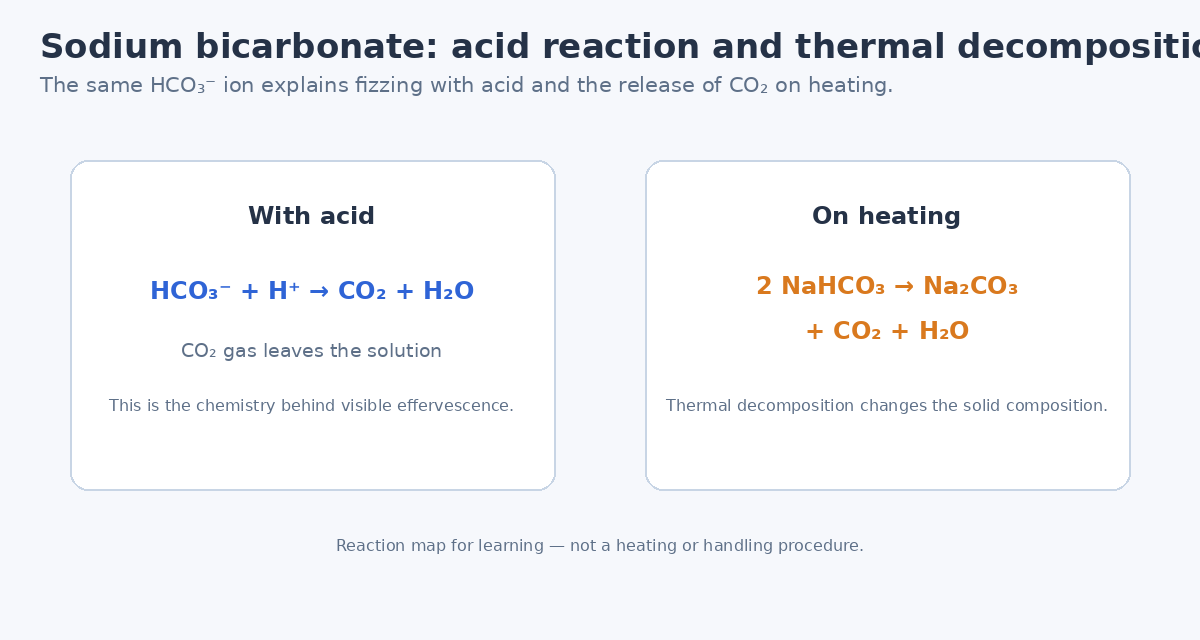
Adding a stronger acid consumes HCO₃⁻ and ultimately gives dissolved/escaping CO₂ plus H₂O. In the solid state, heating can produce sodium carbonate while CO₂ and H₂O leave.
The equations explain the chemistry; they are not instructions for generating gas in a closed vessel.
Source: PubChem — Sodium Bicarbonate
Solution chemistry A buffer resists pH change; it does not automatically produce pH 7 Buffer performance depends on conjugate-pair ratios and total concentration.
A buffer works because an acid/base pair can consume added H⁺ or OH⁻. The carbonic-acid/bicarbonate pair is one example. Henderson–Hasselbalch relationships connect pH to the ratio of conjugate-base and acid forms.
Dissolved CO₂ adds a gas–liquid equilibrium, so open and closed systems can behave differently.
Source: OpenStax Chemistry — Buffers
University / engineering Bicarbonate links alkalinity, water chemistry and CO₂ control In natural and engineered waters, carbonate-system species move together as pH and dissolved CO₂ change.
Bicarbonate often contributes strongly to alkalinity and therefore to a water’s capacity to neutralize added acid. The relevant species are not independent: CO₂(aq), H₂CO₃, HCO₃⁻ and CO₃²⁻ are coupled through equilibria.
Engineering calculations therefore use pH, inorganic-carbon concentration, temperature and activity corrections rather than treating “bicarbonate concentration” as a complete description of the system.
Worked examples
Na + H + C + 3O ≈ 22.99 + 1.008 + 12.01 + 48.00 = 84.01 g/mol
Small differences depend on the atomic-weight values/rounding used.
2 NaHCO₃ → Na₂CO₃ + CO₂ + H₂O; 0.250 × (1/2) = 0.125 mol CO₂
Theoretical stoichiometry only.
Related compounds
Sources & evidence Reference sources Open the evidence and reference list used for this compound page.
Compound pages separate formula interpretation from reference data and from contextual explanation. Check the linked source when a value or condition matters to your work.
- PubChem — Sodium Bicarbonate — Identity, physical properties, decomposition and safety data.
- NIST Chemistry WebBook — Sodium Bicarbonate — Reference identity and spectroscopy record.
- OpenStax Chemistry — Polyprotic Acids — Carbonic-acid/bicarbonate/carbonate equilibria.
- OpenStax Chemistry 2e — Buffers — Buffer chemistry and carbonate-system context.
Found an error, something unclear, or a missing topic?
Tell us what you noticed. Feedback goes to a private review queue and is never published automatically.