

Carbon Monoxide vs Carbon Dioxide (CO vs CO₂)
CO and CO₂ differ by one oxygen atom, but that changes carbon oxidation state, molecular structure, combustion meaning and biological hazard. Learn why the names are similar but the chemistry is not.
Start simple, then go as deep as you need
The levels are cumulative: Deep dive keeps the earlier explanation visible and adds the more technical layer, caveats, comparisons, retrieval practice and scientific sources.
Carbon Monoxide vs Carbon Dioxide (CO vs CO₂) in one minute
Carbon monoxide is CO; carbon dioxide is CO₂. CO contains carbon in oxidation state +2 and is a toxic gas that binds strongly to heme proteins. CO₂ contains carbon in oxidation state +4, is linear, and is the normal fully oxidized carbon product of complete combustion. Both are colorless gases, but they are chemically and physiologically very different.
The extra oxygen in CO₂ is not a minor naming change. It changes oxidation state, bonding, combustion interpretation and hazard mechanism.
What you will understand before you leave
Learning outcomes
- Distinguish CO and CO₂ by formula and carbon oxidation state.
- Explain why complete combustion tends toward CO₂ while oxygen-limited combustion can generate CO.
- Compare their molecular structures and polarity at an introductory level.
- Understand why CO toxicity is not the same phenomenon as elevated CO₂ exposure.
- Avoid common naming and combustion misconceptions.
Ideas to know first
Oxygen is commonly assigned −2 in these oxides; use charge balance to obtain carbon’s oxidation state.
The products depend on reactants and oxygen availability; a balanced equation alone does not describe every real flame.
See how the idea connects
These are explanatory steps, not buttons. Read from left to right to follow the cause-and-effect chain.
CO has one O per C; CO₂ has two.
The extra oxygen corresponds to a more oxidized carbon atom in CO₂.
Oxygen-limited combustion can produce CO; more complete oxidation tends toward CO₂.
CO interferes with oxygen transport through heme binding; high CO₂ affects respiration/acid–base balance and can displace oxygen.
How do CO and CO₂ differ structurally?
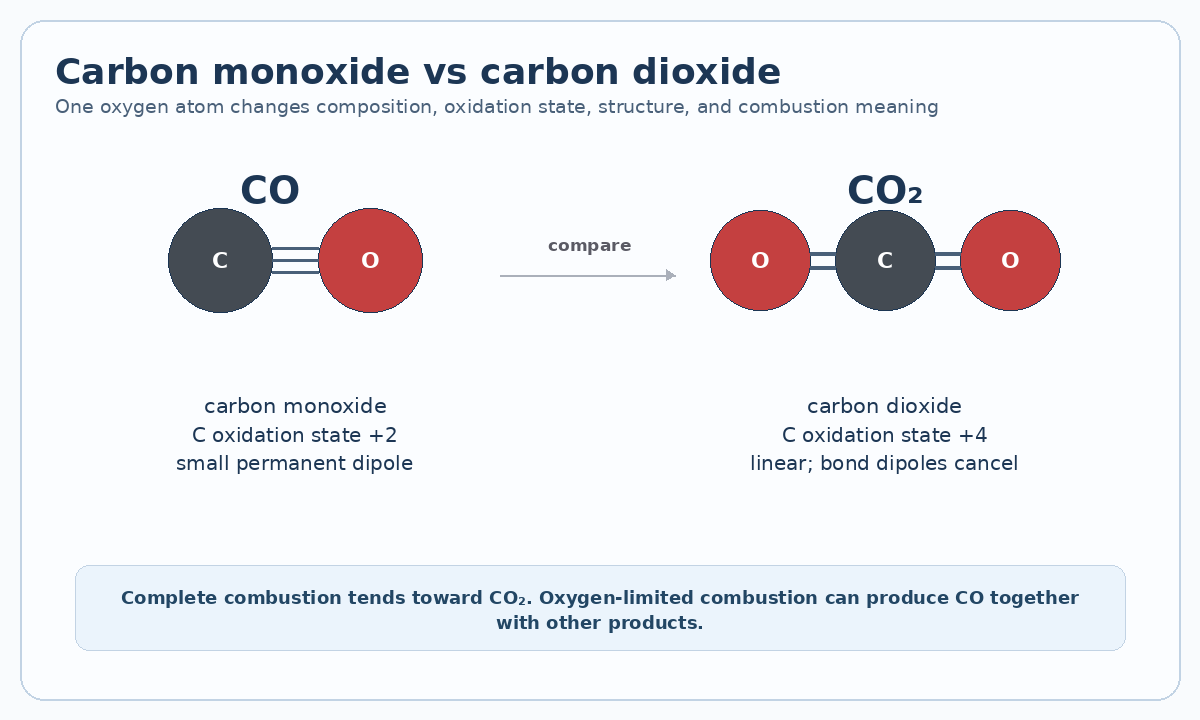
CO contains one carbon and one oxygen atom. A common Lewis description uses a strong multiple-bond interaction and formal charges to satisfy octets; advanced bonding is better described with molecular orbitals. CO is a heteronuclear diatomic molecule and has a small permanent dipole.
CO₂ is linear: O=C=O in the familiar Lewis model. Each C=O bond is polar, but the equal, opposite bond dipoles cancel in a symmetric linear molecule, so CO₂ has no permanent molecular dipole.
Why is carbon +2 in CO but +4 in CO₂?
Using the usual −2 oxidation state for oxygen:
CO can therefore be oxidized further to CO₂. This oxidation-state difference is one reason the two compounds play different roles in combustion and redox chemistry.
Why can oxygen-limited combustion produce CO?
For a hydrocarbon such as methane, complete combustion is often summarized as:
When oxygen availability, mixing, temperature or residence time is insufficient, oxidation may stop before all carbon reaches the +4 state. CO can then appear among the products. Real flames can contain mixtures of CO₂, CO, unburned hydrocarbons, soot and other species; “incomplete combustion = only CO” is an oversimplification.
Why are the health hazards different?
Carbon monoxide is poisonous because it binds strongly to heme proteins, including hemoglobin, interfering with oxygen transport and cellular respiration. It is dangerous even though it is colorless and odorless.
Carbon dioxide is not toxic by the same heme-binding mechanism. At elevated concentrations it can disturb respiratory acid–base physiology and displace oxygen. “CO is toxic, CO₂ is harmless” is therefore also too simple; the mechanisms and relevant concentration ranges are different.
This is educational context, not exposure guidance. Occupational and emergency limits should be taken from current health/safety authorities.
Side-by-side chemistry summary
| Feature | CO | CO₂ |
|---|---|---|
| Formula | CO | CO₂ |
| Carbon oxidation state | +2 | +4 |
| Molecular geometry | diatomic | linear |
| Permanent dipole | small, nonzero | zero for the symmetric molecule |
| Combustion meaning | partially oxidized carbon product | fully oxidized carbon product |
| Main hazard concept | heme binding / impaired oxygen transport | high-concentration respiratory/asphyxiation hazard |
What students often mix up
Do not confuse CO and CO₂ because both are carbon oxides.
Do not assume incomplete combustion produces only CO; real product mixtures depend on conditions.
Do not describe CO₂ as “safe” without concentration/context, and do not describe its hazard as the same as CO poisoning.
Do not infer molecular polarity from polar bonds alone; CO₂ bond dipoles cancel because the molecule is linear and symmetric.
Check your understanding
Answer before opening the explanation. The aim is understanding, not speed.
1Which compound has carbon in the higher oxidation state?
CO₂: carbon is +4, compared with +2 in CO.
2Why is CO₂ nonpolar overall even though C=O bonds are polar?
The molecule is linear and symmetric, so the two bond-dipole vectors cancel.
3Which gas is associated with strong heme binding?
Carbon monoxide, CO.
4Does oxygen-limited combustion always produce pure CO?
No. Real combustion can give a mixture of CO₂, CO, unburned species, soot and other products.
Sources and terminology
Definitions and reference claims are anchored to authoritative scientific organizations and peer-reviewed literature where needed. Element Lookup adds teaching explanation, examples and visual structure; it does not treat AI as the source of scientific definitions or numbers.
Found an error, something unclear, or a missing topic?
Tell us what you noticed. Feedback goes to a private review queue and is never published automatically.