

Sodium Carbonate Na2CO3
Sodium carbonate is Na₂CO₃, an ionic carbonate salt made from two Na⁺ ions for each CO₃²⁻ ion. The carbonate ion has delocalized bonding, and aqueous sodium carbonate is basic because CO₃²⁻ accepts a proton from water to form HCO₃⁻ and OH⁻.
What does Na2CO3 mean?
Na₂CO₃ is a formula unit, not a discrete “sodium carbonate molecule.” Charge balance is 2(+1) + (−2) = 0. Covalent bonding is inside carbonate; electrostatic interactions connect ions in the solid.
Once you can count every element correctly, the same formula becomes the basis for formula mass and molar mass.
What kind of chemical substance is it?
Solid sodium carbonate is ionic overall. Each carbonate ion is trigonal planar around carbon and is best represented as a resonance hybrid rather than as one permanently localized C=O bond plus two C–O bonds. In water the ions become solvated and carbonate participates in acid–base equilibria.
Why does Sodium Carbonate behave this way?
The basicity appears after dissolution because carbonate is the conjugate base of bicarbonate. It reacts with water to generate some hydroxide, so formula, dissolution and acid–base chemistry are separate layers.
What is the formula of sodium carbonate?
Na₂CO₃. Two Na⁺ ions balance one CO₃²⁻ ion.
Why is sodium carbonate a basic salt?
CO₃²⁻ accepts a proton from water: CO₃²⁻ + H₂O ⇌ HCO₃⁻ + OH⁻. The generated hydroxide makes the solution basic.
What is the molar mass of sodium carbonate?
The anhydrous compound is about 105.988 g/mol. Hydrates have larger formula masses.
Is sodium carbonate the same as sodium bicarbonate?
No. Sodium carbonate is Na₂CO₃; sodium bicarbonate is NaHCO₃. Their ions, acid–base behavior and molar masses differ.
What happens when sodium carbonate reacts with acid?
Carbonate is protonated through bicarbonate/carbonic-acid chemistry; with sufficient strong acid the overall products include CO₂, water and the corresponding salt.
Does sodium carbonate have resonance?
The carbonate ion does. Equivalent Lewis contributors represent one delocalized CO₃²⁻ structure.
What is washing soda?
Washing soda commonly means sodium carbonate decahydrate, Na₂CO₃·10H₂O.
Key properties and classification
Why this compound matters: Sodium carbonate connects ionic charge balance, polyatomic-ion resonance, conjugate acid–base pairs, carbonate equilibria and hydrate formulas. It also links naturally to sodium bicarbonate, calcium carbonate, carbon dioxide and water.
Where does Sodium Carbonate appear in chemical equations?
These equations are included to connect the compound to chemistry concepts and stoichiometry. They are not laboratory procedures.
Explains the basicity of sodium carbonate solutions.
Net ionic bookkeeping; real speciation passes through protonated carbonate species.
Connects carbonate, carbon dioxide and bicarbonate chemistry.
Safety depends on form, concentration and situation
Sodium carbonate is alkaline and can irritate eyes, skin or the respiratory tract, especially as dust or concentrated solution. This page explains chemistry, not handling or formulation procedures.
Study the chemistry, not just the topic names
The useful progression is formula unit → carbonate resonance → aqueous hydrolysis → carbonate/bicarbonate/CO₂ speciation → hydrate context.
Core chemistry Formula unit and carbonate resonance: ionic outside, covalent inside Two Na⁺ ions balance one CO₃²⁻; carbonate has delocalized C–O bonding.
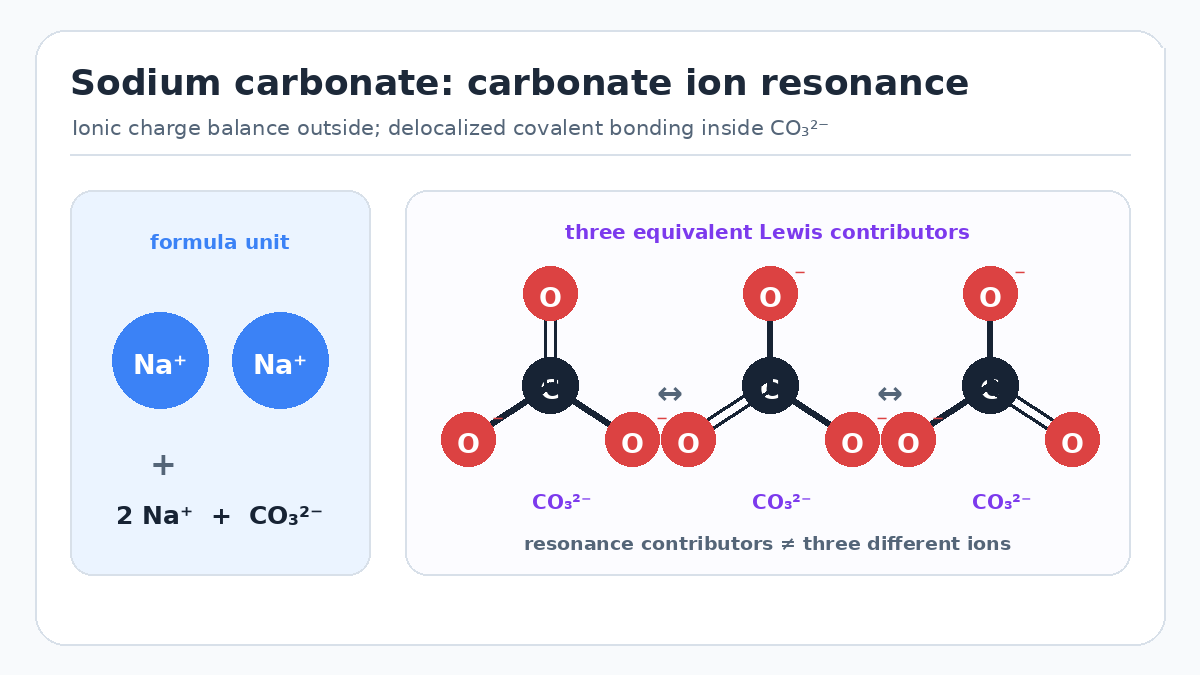
The formula follows from charge balance: 2 Na⁺ + CO₃²⁻ → Na₂CO₃. Sodium is not covalently attached to one oxygen in a discrete molecule.
Within CO₃²⁻, three equivalent Lewis contributors place the formal double bond in different positions. Resonance means one delocalized ion, not rapid switching.
Source: PubChem — Sodium Carbonate
Acid–base chemistry Why Na₂CO₃ solution is basic even though OH⁻ is absent from the formula Carbonate hydrolysis creates OH⁻ after dissolution.

The key equilibrium is CO₃²⁻ + H₂O ⇌ HCO₃⁻ + OH⁻. CO₃²⁻ is the conjugate base of HCO₃⁻; Na⁺ is a spectator in this step.
Equilibrium chemistry Carbonate, bicarbonate and dissolved CO₂ are one connected aqueous system pH and gas exchange control which inorganic-carbon species are favored.
Acid shifts carbonate toward bicarbonate and dissolved CO₂/carbonic-acid convention; base shifts speciation toward carbonate. In open systems atmospheric CO₂ can matter.
Composition depends on pH, total inorganic carbon, ionic strength, temperature and gas exchange.
Solid-state / quantitative Anhydrous sodium carbonate and washing soda are different formula-mass problems Crystal water belongs in the formula mass of a hydrate.
Anhydrous Na₂CO₃ has a molar mass near 105.988 g/mol. Na₂CO₃·10H₂O includes ten waters per formula unit, so hydration state must be checked in mass calculations.
Applied chemistry Soda ash links carbonate equilibria to bulk chemistry Its usefulness follows from alkalinity, acid reaction and precipitation chemistry.
Sodium carbonate is a major bulk chemical. It supplies carbonate alkalinity, reacts with acids and participates in precipitation and high-temperature process chemistry.
Industrial operating details are outside this reference page.
Source: PubChem — Sodium Carbonate
Worked examples
2(+1) + (−2) = 0, so two Na⁺ are required for each CO₃²⁻.
The subscripts encode the lowest neutral ionic ratio.
2(22.9898) + 12.011 + 3(15.999) ≈ 105.99 g/mol
For a hydrate, add the mass of its crystal water.
Related compounds
Sources & evidence Reference sources Open the evidence and reference list used for this compound page.
Compound pages separate formula interpretation from reference data and from contextual explanation. Check the linked source when a value or condition matters to your work.
- PubChem — Sodium Carbonate — Identity, formula, molecular weight and safety/property context.
- NIST Chemistry WebBook — sodium carbonate — Reference molecular weight and thermochemistry index.
- OpenStax Chemistry 2e — Carbonates — Carbonate basicity, acid reactions and bulk context.
Found an error, something unclear, or a missing topic?
Tell us what you noticed. Feedback goes to a private review queue and is never published automatically.