

Glucose C6H12O6
Glucose is C₆H₁₂O₆, a six-carbon monosaccharide and aldohexose. The molecular formula alone does not capture its stereochemistry. In water, D-glucose exists mainly as cyclic α- and β-D-glucopyranose forms that interconvert through a small amount of open-chain aldehyde.
What does C6H12O6 mean?
C₆H₁₂O₆ gives composition but not stereochemistry or ring form. Many different compounds share this molecular formula. Common D-glucose can be drawn as an open-chain Fischer projection or as cyclic Haworth/chair representations; these are different representations/forms of the same glucose stereoisomeric system.
Once you can count every element correctly, the same formula becomes the basis for formula mass and molar mass.
What kind of chemical substance is it?
Glucose is a covalent molecular compound with multiple O–H groups and, in its open-chain form, an aldehyde. Intramolecular addition of a hydroxyl group to the aldehyde produces a cyclic hemiacetal. Ring closure creates a new stereocenter, giving α and β anomers.
Why does Glucose behave this way?
Open-chain D-glucose can cyclize to a six-membered glucopyranose ring. Ring closure creates the anomeric carbon and α/β forms. Because the ring can reopen, the anomers interconvert in water (mutarotation), and the small open-chain aldehyde population explains reducing-sugar behavior.
What is the chemical formula of glucose?
C₆H₁₂O₆.
Is glucose a carbohydrate?
Yes. Glucose is a monosaccharide, specifically an aldohexose.
Is glucose usually open-chain or cyclic in water?
Mostly cyclic. OpenStax describes aqueous D-glucose as predominantly the six-membered glucopyranose forms, with only a small open-chain fraction.
What is the difference between α-glucose and β-glucose?
They are anomers that differ in configuration at the anomeric carbon created during ring closure. For D-glucopyranose, the anomeric OH is opposite the CH₂OH side in the α form and on the same side in the β form in the usual Haworth convention.
What is mutarotation?
It is the change in optical rotation that occurs as a pure α or β anomer in solution re-equilibrates through ring opening and reclosure to the same mixture of anomers.
Why is glucose a reducing sugar if it is mostly cyclic?
Its cyclic hemiacetal can reopen to an aldehyde form. That accessible open-chain form can be oxidized in classical reducing-sugar tests.
Is a Haworth hexagon the real 3-D shape of glucose?
No. Haworth projections are 2-D conventions. Six-membered glucopyranose rings adopt puckered chair-like conformations.
Key properties and classification
Why this compound matters: Glucose is a gateway from molecular formula to stereochemistry, functional groups, equilibria, optical activity and biological organic chemistry. Its high search demand is broad, but structure/anomer queries provide clear educational value beyond one-line answers.
Where does Glucose appear in chemical equations?
These equations are included to connect the compound to chemistry concepts and stoichiometry. They are not laboratory procedures.
Overall oxidation/combustion stoichiometry; biological oxidation proceeds through many enzyme-controlled steps.
Overall biochemical stoichiometry for alcoholic fermentation; real pathways are multistep and enzyme-mediated.
Generic aldehyde oxidation logic; glucose ring opening provides access to the aldehyde form.
Safety depends on form, concentration and situation
Glucose is a common biological nutrient and laboratory chemical. This page discusses molecular chemistry, not blood-glucose interpretation, diabetes management, nutrition targets or medical treatment. Those are health contexts requiring different evidence and individualized guidance.
Study the chemistry, not just the topic names
Glucose is where flat structural formulas stop being enough. The important learning path is Fischer stereochemistry → ring closure → anomers → chair conformations → mutarotation → reducing-sugar chemistry.
Core → organic Open-chain D-glucose cyclizes to α- and β-D-glucopyranose Intramolecular hemiacetal formation converts an aldehyde chain into a ring.
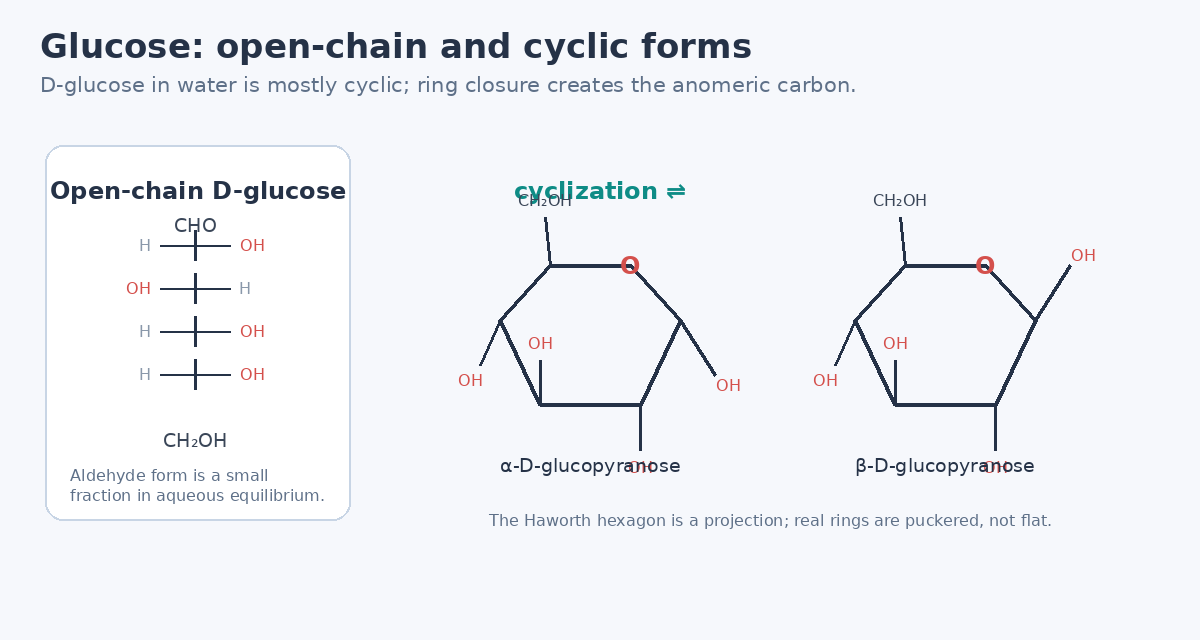
OpenStax explains that the C5 hydroxyl group of D-glucose can add intramolecularly to the C1 aldehyde, producing a six-membered pyranose hemiacetal.
Ring closure creates a new stereocenter at C1 — the anomeric carbon — and therefore creates α and β anomers.
Source: OpenStax Organic Chemistry — Cyclic Structures of Monosaccharides
Stereochemistry α and β are not different molecular formulas; they are anomers The anomers differ only at the newly created anomeric stereocenter.
In a conventional Haworth projection of D-glucopyranose, the C5 CH₂OH group is drawn up. The α anomer has the anomeric OH on the opposite side; the β anomer has it on the same side.
OpenStax notes that β-D-glucopyranose is especially stable because its substituents can occupy favorable equatorial positions in the chair conformation.
Physical organic chemistry Mutarotation proves that the ring structures communicate through an open-chain form Pure α or β glucose solutions converge to the same equilibrium optical rotation.
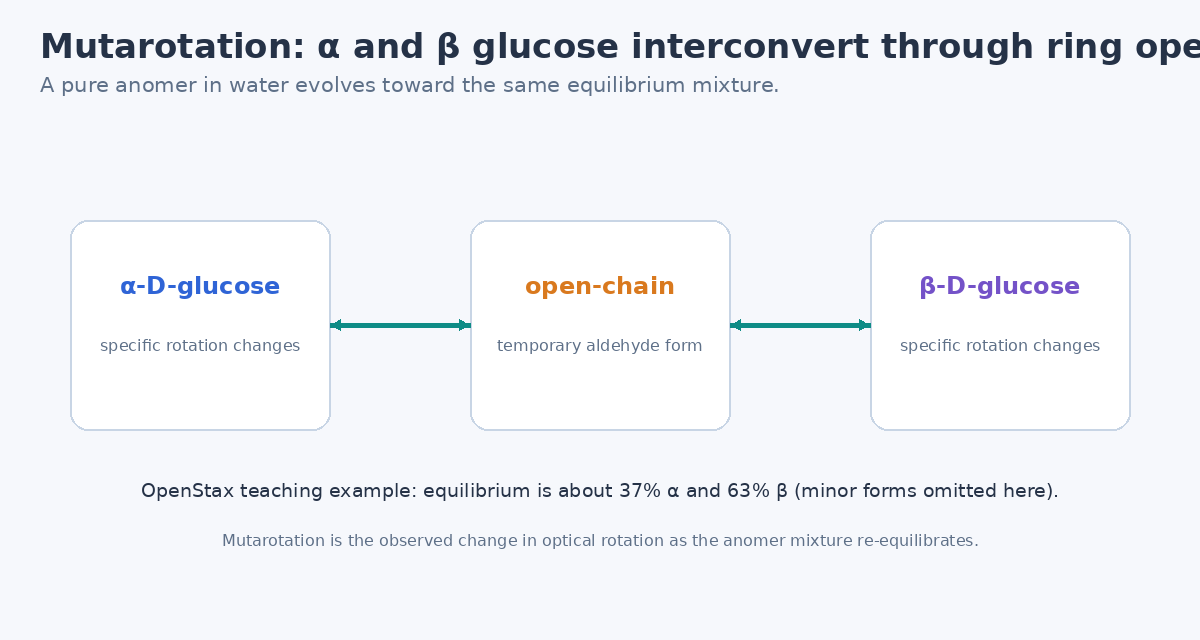
OpenStax describes an aqueous equilibrium of roughly 37% α and 63% β glucopyranose in its teaching example, with minor forms omitted. Pure α and pure β samples both evolve toward the same mixture.
The mechanism is reversible ring opening to the aldehyde followed by ring closure from either face, so optical rotation changes with time.
Organic redox Why glucose is a reducing sugar even though the ring form dominates The hemiacetal ring can reopen to an oxidizable aldehyde.
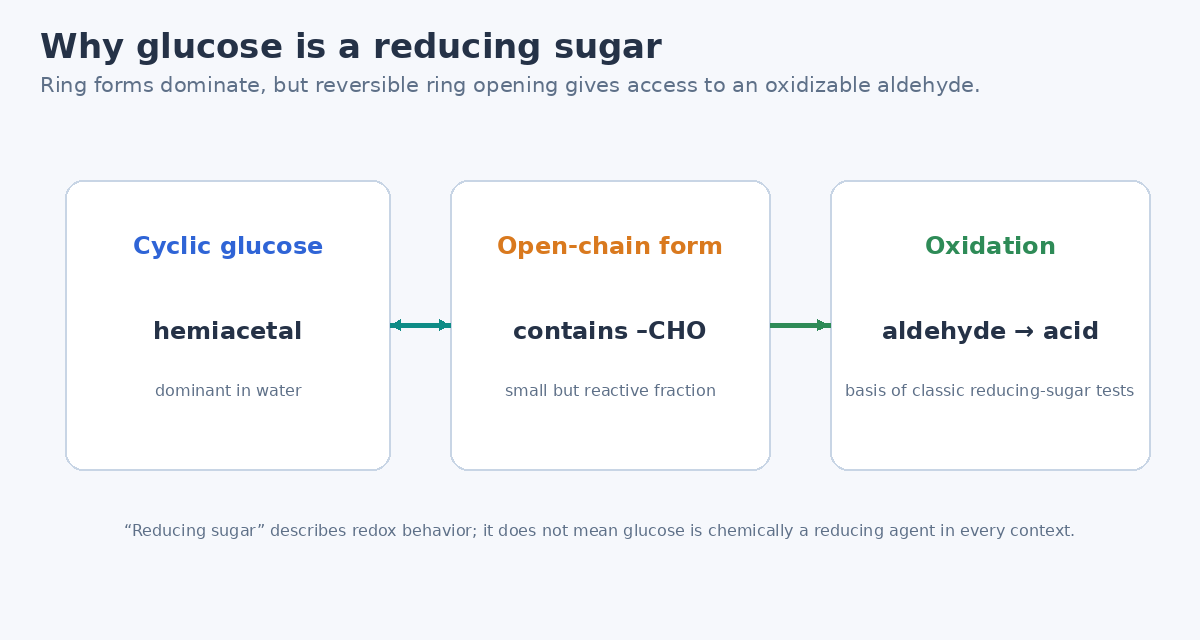
Glucose is classified as a reducing sugar because its free anomeric hemiacetal is in equilibrium with an open-chain aldehyde. Classical Ag⁺ or Cu²⁺ tests oxidize accessible aldose functionality while the metal oxidant is reduced.
This is a dynamic-equilibrium explanation, not a contradiction between “cyclic” and “aldehyde” descriptions.
Source: OpenStax Organic Chemistry — Reactions of Monosaccharides
Biochemical / materials chemistry Glucose becomes a building block through glycosidic bonds Linking the anomeric carbon to another alcohol group gives glycosides and larger carbohydrates.
Once the anomeric OH is converted to a glycosidic acetal, the ring is no longer free to open in the same way. Repeating glucose units with different α/β linkage patterns produces materials with very different properties, including starch/glycogen-type storage polymers and cellulose-type structural polymers.
The molecular formula of one monomer does not predict polymer architecture; stereochemistry and linkage position matter.
Worked examples
n = m/M = 18.0 g / 180.156 g/mol ≈ 0.0999 mol
About 0.100 mol with three significant figures.
C₆H₁₂O₆ + 6 O₂ → 6 CO₂ + 6 H₂O; 0.250 × 6 = 1.50 mol O₂
Overall theoretical stoichiometry, not a biological pathway description.
Related compounds
Sources & evidence Reference sources Open the evidence and reference list used for this compound page.
Compound pages separate formula interpretation from reference data and from contextual explanation. Check the linked source when a value or condition matters to your work.
- PubChem — D-Glucose — Identity, formula, structure and reference properties.
- OpenStax Organic Chemistry — Cyclic Structures of Monosaccharides — Cyclization, α/β anomers and mutarotation.
- OpenStax Organic Chemistry — Reactions of Monosaccharides — Reducing-sugar and oxidation chemistry.
- OpenStax Biology 2e — Carbohydrates — Monosaccharide classification and ring-form overview.
Found an error, something unclear, or a missing topic?
Tell us what you noticed. Feedback goes to a private review queue and is never published automatically.