

Ethanol C2H6O
Ethanol is the two-carbon alcohol CH₃CH₂OH, with molecular formula C₂H₆O. The structural formula matters because C₂H₆O can also describe the different compound dimethyl ether. Ethanol’s hydroxyl group makes it polar, hydrogen-bonding and much more water-compatible than a comparable hydrocarbon.
What does C2H6O mean?
C₂H₆O gives composition but not connectivity. Writing CH₃CH₂OH shows ethanol’s –OH functional group. The isomer dimethyl ether, CH₃OCH₃, has the same molecular formula but different connectivity and different properties.
Once you can count every element correctly, the same formula becomes the basis for formula mass and molar mass.
What kind of chemical substance is it?
Ethanol is a covalent molecular compound. Its O–H and C–O bonds are polar; the oxygen carries two lone pairs in a simple Lewis description. The hydroxyl group can both donate and accept hydrogen bonds, while the ethyl group contributes a nonpolar hydrocarbon region.
Why does Ethanol behave this way?
Compare ethane and ethanol: adding an –OH group introduces a strongly polar bond, lone pairs and hydrogen-bonding capability. Compare ethanol and dimethyl ether: the same C₂H₆O formula produces different properties because connectivity and functional group matter. This makes ethanol an ideal bridge from general chemistry into organic structure–property relationships.
What is the formula of ethanol: C₂H₆O or C₂H₅OH?
Both are useful. C₂H₆O is the molecular formula; C₂H₅OH or CH₃CH₂OH highlights the hydroxyl group and connectivity. The latter is more informative for chemistry.
Can two compounds have the same molecular formula C₂H₆O?
Yes. Ethanol and dimethyl ether are constitutional isomers: same molecular formula, different atom connectivity, different functional groups and different properties.
Is ethanol polar?
Yes. The C–O and O–H bonds are polar, and the molecule has a net dipole. It also contains a nonpolar ethyl region, so its behavior reflects both polar and nonpolar parts.
Why does ethanol mix with water?
The hydroxyl group can donate and accept hydrogen bonds with water. Because ethanol has only a two-carbon nonpolar group, hydrogen-bonding interactions remain strong enough for complete miscibility under ordinary conditions.
Why does ethanol have a higher boiling point than dimethyl ether?
Ethanol molecules can donate strong O–H···O hydrogen bonds to one another, while dimethyl ether lacks an O–H hydrogen-bond donor. Stronger intermolecular attraction generally raises the energy needed for vaporization.
What happens when ethanol is oxidized?
As a primary alcohol, ethanol can be oxidized first to ethanal (acetaldehyde) and then further to ethanoic/acetic acid under suitable oxidizing conditions. The exact product depends on reagent and conditions.
Is ethanol the same as “alcohol”?
Ethanol is one member of the alcohol functional-group family. In everyday speech “alcohol” often means ethanol, but chemistry includes many other alcohols such as methanol, propanol and glycerol.
Key properties and classification
Why this compound matters: Ethanol connects molecular formula to structural formula, constitutional isomerism, functional groups, hydrogen bonding, phase behavior and organic oxidation. It also links chemistry to fuels, solvents, fermentation and spectroscopy without reducing the topic to beverage/health queries.
Where does Ethanol appear in chemical equations?
These equations are included to connect the compound to chemistry concepts and stoichiometry. They are not laboratory procedures.
Balanced combustion stoichiometry for ethanol; actual combustion systems depend on mixing and conditions.
Primary-alcohol oxidation to ethanal shown as bookkeeping; reagent/conditions determine outcome.
Further oxidation gives ethanoic/acetic acid under suitable conditions.
Safety depends on form, concentration and situation
Ethanol is flammable, its vapor can form ignitable mixtures with air, and ingestion causes dose-dependent toxic effects. Denatured ethanol may contain deliberately added substances that make it unsuitable for consumption. Chemistry education should distinguish pure ethanol from beverages, fuels and formulated products.
Study the chemistry, not just the topic names
Ethanol is a compact introduction to organic structure–property relationships. The modules below use formula/connectivity, functional groups and intermolecular forces to explain why ethanol behaves differently from both hydrocarbons and its isomer dimethyl ether.
Core chemistry Molecular formula vs structural formula — C₂H₆O is not enough to identify ethanol Ethanol and dimethyl ether share C₂H₆O but differ in connectivity and functional group.

The molecular formula C₂H₆O counts atoms. The condensed structural formula CH₃CH₂OH reveals the alcohol functional group. Rearranging the same atoms as CH₃OCH₃ gives dimethyl ether, a different compound.
This is constitutional isomerism: molecular formula is necessary information, but not sufficient to determine molecular identity.
Source: PubChem — Ethanol
Core → university The hydroxyl group makes ethanol polar and hydrogen-bonding O–H and C–O are polar; the O–H group can donate and oxygen lone pairs can accept hydrogen bonds.

Ethanol has a polar hydroxyl end and a comparatively nonpolar ethyl end. Between ethanol molecules, O–H groups can donate hydrogen bonds to oxygen lone pairs. Ethanol can also hydrogen-bond strongly with water.
This explains why ethanol has a substantially higher boiling point than a similarly sized ether and why a two-carbon alcohol mixes so well with water.
Source: NIST Chemistry WebBook — Ethanol
Organic chemistry Primary-alcohol oxidation: ethanol → ethanal → ethanoic acid Oxidation state changes at the carbon bearing the –OH group while the carbon skeleton is retained.
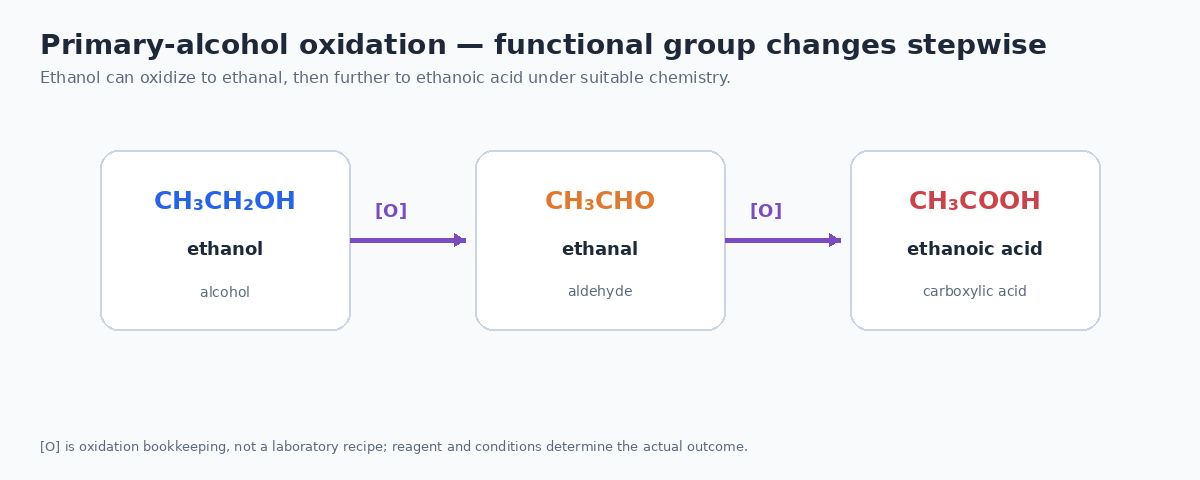
Ethanol is a primary alcohol. Organic-chemistry oxidation can convert the –CH₂OH carbon to an aldehyde (ethanal) and, under stronger/further oxidation, to a carboxylic acid (ethanoic/acetic acid).
The exact stopping point depends on oxidant and conditions. ElementLookup shows the transformation logic, not laboratory reagent recipes.
Thermochemistry Combustion connects functional-group chemistry to stoichiometry and energy One mole of ethanol requires three moles of O₂ for complete combustion and gives two CO₂ plus three H₂O.
The balanced equation is C₂H₅OH + 3 O₂ → 2 CO₂ + 3 H₂O. It is a useful stoichiometry problem because carbon, hydrogen and oxygen all have to balance simultaneously.
Real flames can produce incomplete-combustion products when oxygen supply/mixing is poor, so the balanced complete-combustion equation is an ideal reaction model, not a guarantee about every flame.
University / engineering Ethanol as solvent, fuel component and separation challenge Polarity, volatility and hydrogen bonding make ethanol useful but also make water–ethanol separation non-ideal.
Ethanol’s mixed polar/nonpolar character makes it a versatile solvent and blending component. Its volatility makes distillation useful for separation, but real ethanol–water vapor–liquid equilibrium is non-ideal and eventually limits simple distillation through azeotropic behavior.
Engineering calculations therefore use measured/validated phase-equilibrium data rather than assuming ideal Raoult-law behavior over the full composition range.
Source: NIST Chemistry WebBook — Ethanol phase and thermochemistry data
Worked examples
C₂H₅OH + 3 O₂ → 2 CO₂ + 3 H₂O; 0.500 × 3 = 1.50 mol O₂
Theoretical complete-combustion stoichiometry only.
n = m/M = 23.0 g / 46.068 g/mol ≈ 0.499 mol
Particle count can then be obtained using Avogadro’s constant.
Related compounds
Sources & evidence Reference sources Open the evidence and reference list used for this compound page.
Compound pages separate formula interpretation from reference data and from contextual explanation. Check the linked source when a value or condition matters to your work.
- PubChem — Ethanol — Identity, molecular/structural formula, properties and hazard context.
- NIST Chemistry WebBook — Ethanol — Phase, thermochemistry, spectroscopy and reference data.
- OpenStax Organic Chemistry — Oxidation of Alcohols — Primary-alcohol oxidation sequence and functional-group chemistry.
- OpenStax Organic Chemistry — Ethanol: Chemical, Drug, and Poison — Ethanol chemistry/oxidation context.
Found an error, something unclear, or a missing topic?
Tell us what you noticed. Feedback goes to a private review queue and is never published automatically.