

Silicon Dioxide SiO2
Silicon dioxide, SiO₂, is the composition of silica. In ordinary quartz and silica glass it is not a collection of discrete O=Si=O molecules: silicon and oxygen form an extended network in which Si is commonly tetrahedrally coordinated by O, and oxygens bridge between silicon centers.
What does SiO2 mean?
SiO₂ gives the overall 1:2 silicon-to-oxygen ratio. In ordinary condensed silica it is a network formula, not a molecular formula for isolated three-atom units. Locally, Si commonly has four O neighbors, but bridging oxygens are shared across the extended network, giving the global 1:2 composition.
Once you can count every element correctly, the same formula becomes the basis for formula mass and molar mass.
What kind of chemical substance is it?
Ordinary silica is a giant/network covalent solid. A useful local motif is a SiO₄ tetrahedron, but that tetrahedron is not an isolated SiO₄ molecule: each oxygen can bridge to another silicon center. Different ways of connecting those tetrahedra produce crystalline polymorphs or disordered glass networks.
Why does Silicon Dioxide behave this way?
CO₂ uses strong C=O multiple bonding to form small linear molecules. Silicon does not form the same stable multiple-bonded O=Si=O network under ordinary condensed conditions; instead silica forms extended Si–O–Si frameworks. That one structural difference explains why CO₂ is a molecular gas while SiO₂ is a hard, high-melting network solid.
Is SiO₂ a molecule?
Not in ordinary quartz, glass or most bulk silica. SiO₂ is best treated as an empirical/network formula for an extended covalent structure. Gas-phase molecular SiO₂ species can exist, but they are not the right model for ordinary silica solids.
Why does SiO₂ have the formula 1:2 if each Si is bonded to four O atoms?
Because the oxygen atoms bridge between neighboring silicon centers. Each bridging O is shared by two Si sites, so four local O neighbors per Si reduce to an overall Si:O ratio of 1:2 in the extended network.
What is the difference between quartz and silica glass?
Both can have SiO₂ composition. Quartz has long-range crystalline order; silica glass is amorphous, so its Si–O network lacks the same repeating long-range periodicity.
Why is SiO₂ so different from CO₂?
CO₂ consists of discrete linear molecules with C=O double bonds. Ordinary SiO₂ forms a continuous network of Si–O bonds. Melting or deforming the network therefore involves a completely different structural problem from separating CO₂ molecules.
Is silicon dioxide safe?
“Silicon dioxide” covers different forms and exposure situations. Food-grade amorphous silica has specific regulated uses, while inhalation of respirable crystalline silica dust is a serious occupational hazard. Bulk glass or a quartz crystal should not be discussed as though it were the same exposure as fine respirable dust.
Are quartz, cristobalite and tridymite different compounds?
They are polymorphs: different crystal structures with the same overall SiO₂ composition. Structure—not formula alone—distinguishes them.
Does SiO₂ have a Lewis structure like CO₂?
A simple O=Si=O drawing can represent a gas-phase molecule or electron-counting exercise, but it is misleading for ordinary condensed silica. The network structure is the chemically relevant model for quartz and glass.
Key properties and classification
Why this compound matters: Silicon dioxide is a foundational example in solid-state chemistry, geology and materials engineering. It teaches why formula does not uniquely determine structure, why local coordination differs from overall stoichiometry, and how crystal order versus amorphous networks changes material behavior.
Where does Silicon Dioxide appear in chemical equations?
These equations are included to connect the compound to chemistry concepts and stoichiometry. They are not laboratory procedures.
A stoichiometric composition equation; actual oxidation behavior depends on silicon surface and conditions.
Shows acidic-oxide behavior at the formula level; not an operating procedure.
A high-level reaction connection used to link silica and silicate chemistry.
Safety depends on form, concentration and situation
Safety depends strongly on physical form and exposure route. Bulk quartz or glass is not the same exposure as respirable crystalline-silica dust. OSHA and NIOSH identify inhalation of fine respirable crystalline silica as a serious occupational hazard associated with silicosis and other diseases. Food-grade amorphous silica is a separate regulated material context.
Study the chemistry, not just the topic names
Silicon dioxide is a gold-standard example of why “draw the formula” is not enough. The sections below move from local SiO₄ tetrahedra to network topology, polymorphism, glass disorder and materials/safety context.
Core chemistry Local tetrahedra, shared oxygens and the 1:2 formula Each Si can have four O neighbors even though the overall formula is SiO₂ because oxygens bridge between silicon centers.
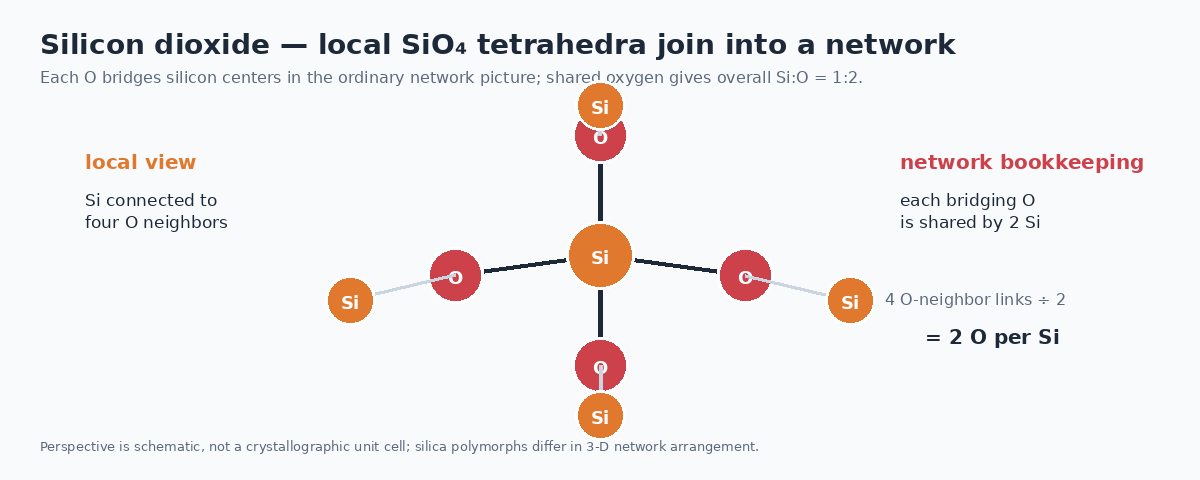
In quartz and silica glass, a useful local model places Si at the center of an approximately tetrahedral O environment. Each O can connect onward to another Si, creating Si–O–Si bridges. Because bridging O atoms are shared, the network averages to two O atoms per Si.
The SiO₄ tetrahedron is a local coordination motif, not a discrete SiO₄ molecule.
Source: Inorganic Chemistry for Chemical Engineers — metalloids / silica
Core → university Why CO₂ is molecular but SiO₂ is a network solid Same 1:2 formula pattern, radically different bonding topology.
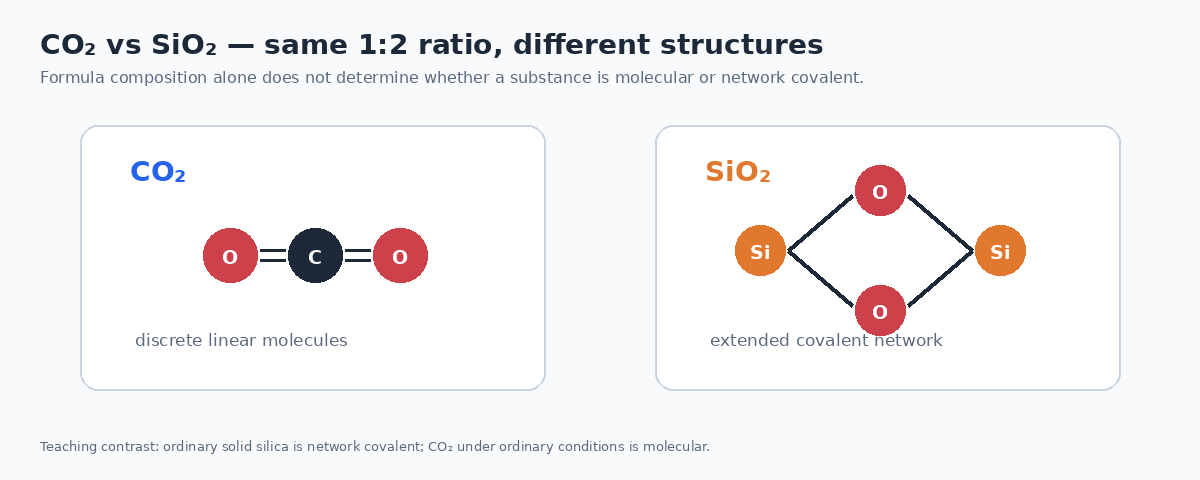
Carbon forms strong π bonds with oxygen, so CO₂ is well described as discrete O=C=O molecules. Silicon is larger and does not form the same strong localized π bonding with oxygen in ordinary bulk silica. Instead, Si–O single-bond frameworks extend through the solid.
This contrast explains the huge property difference: CO₂ is a molecular substance; silica is a giant covalent material.
Source: Inorganic Chemistry for Chemical Engineers — CO₂ vs SiO₂
Materials chemistry Quartz, cristobalite and glass — same composition, different order Polymorphism and amorphous structure show that composition alone does not determine material structure.
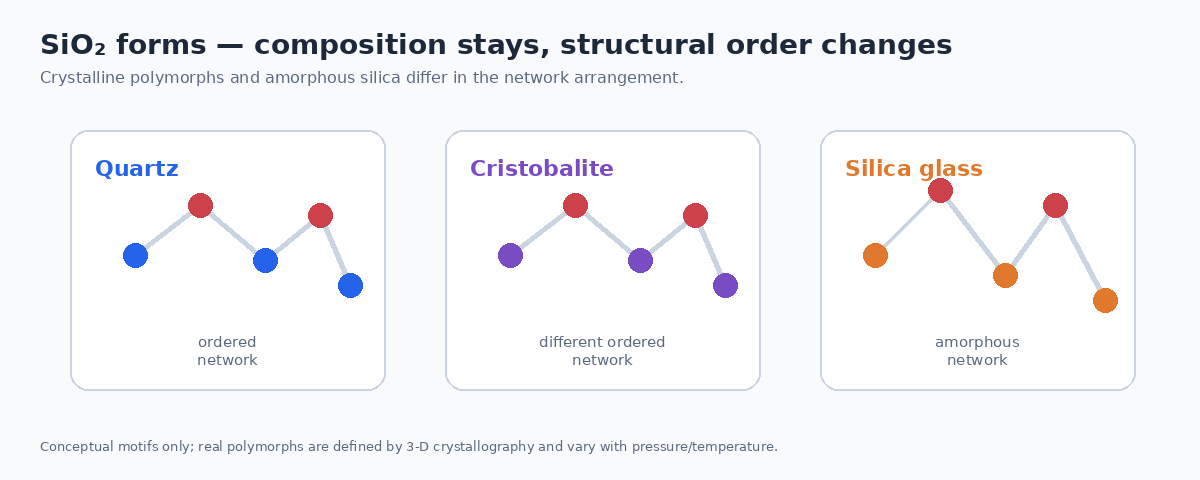
Quartz, cristobalite and tridymite are crystalline SiO₂ polymorphs with different long-range arrangements. Silica glass retains a connected Si–O network but lacks crystalline long-range periodic order.
At higher pressure, silica can adopt denser structures such as stishovite with different local coordination. This is a reminder that even the “SiO₄ tetrahedron everywhere” picture has limits outside its pressure/structure range.
Source: PubChem — Silica
University / engineering Why silica is a glass, ceramics and semiconductor-process material Network connectivity gives high thermal stability, optical transparency in suitable forms and chemically robust surfaces.
Fused silica and silica-rich glasses are valuable because their network structure produces useful thermal, optical and chemical properties. In microelectronics, thin SiO₂ layers have historically served as electrically insulating and surface-passivating materials on silicon.
Material properties depend on purity, hydroxyl content, defects, thermal history and whether the silica is crystalline or amorphous; “SiO₂ property” without form/condition can be too vague for engineering work.
Safety & evidence “Is silicon dioxide safe?” needs a form-and-exposure answer Respirable crystalline silica and food-grade amorphous silica are not interchangeable exposure categories.
OSHA identifies inhalation of respirable crystalline silica as a serious occupational hazard associated with silicosis, lung cancer and other disease. That risk concerns fine airborne crystalline particles generated in certain work processes.
By contrast, amorphous silicon dioxide has regulated food-additive uses in the United States. A scientifically responsible page therefore states the physical form, particle/exposure context and regulatory setting instead of giving one universal “safe/unsafe” label.
Worked examples
4 O-neighbor connections per Si ÷ 2 Si per bridging O = 2 O per Si → SiO₂
This is network-counting logic, not a claim that one isolated SiO₂ molecule is the structural unit.
28.085 / 60.084 × 100% ≈ 46.7% Si by mass
The remaining mass fraction is oxygen; actual materials may contain impurities or other network components.
Related compounds
Sources & evidence Reference sources Open the evidence and reference list used for this compound page.
Compound pages separate formula interpretation from reference data and from contextual explanation. Check the linked source when a value or condition matters to your work.
- PubChem — Silica / Silicon Dioxide — Identity, formula, polymorph/amorphous context and reference data.
- Inorganic Chemistry for Chemical Engineers — silica network — Network structure, SiO₄ tetrahedra and CO₂ comparison.
- OSHA — Crystalline Silica Health Effects — Respirable crystalline-silica occupational-health context.
- FDA — Silicon Dioxide food-substance listing — Regulated food-use context for silicon dioxide.
Found an error, something unclear, or a missing topic?
Tell us what you noticed. Feedback goes to a private review queue and is never published automatically.