

Phosphoric Acid H3PO4
Phosphoric acid is H₃PO₄, a phosphorus oxoacid with three ionizable O–H groups. It is triprotic: proton loss occurs stepwise through H₂PO₄⁻, HPO₄²⁻ and PO₄³⁻, with each successive deprotonation less favorable in water.
What does H3PO4 mean?
H₃PO₄ is commonly drawn with central phosphorus bonded to four oxygens, three bearing H as O–H groups. Localized Lewis drawings are useful for acid–base bookkeeping; phosphate-family bonding is more delocalized.
Once you can count every element correctly, the same formula becomes the basis for formula mass and molar mass.
What kind of chemical substance is it?
Phosphoric acid is a covalent molecular oxoacid. Its acid chemistry comes from O–H proton transfer, while conjugate bases redistribute negative charge over oxygen. “Triprotic” means up to three protons can be donated stepwise; it does not mean all three leave equally easily.
Why does Phosphoric Acid behave this way?
H₃PO₄ has three different acid-ionization equilibria. The first proton is easier to remove than the second, and the third is much less acidic still.
What is the formula of phosphoric acid?
H₃PO₄.
Is phosphoric acid a strong acid?
No. In general chemistry it is a weak, triprotic acid; it is not treated like fully dissociated HCl or HNO₃ in dilute water.
What are the conjugate bases of phosphoric acid?
H₂PO₄⁻, HPO₄²⁻ and PO₄³⁻.
What is the molar mass of H₃PO₄?
About 97.995 g/mol.
Why are there three pKa values?
Each pKa belongs to a different proton-transfer step, and successive deprotonations become less favorable as negative charge accumulates.
What is phosphorus’s oxidation state in H₃PO₄?
+5.
Is concentrated phosphoric acid a “strong acid”?
Concentration and acid strength are different properties; concentrated weak-acid solutions can still be corrosive.
Key properties and classification
Why this compound matters: Phosphoric acid is a compact gateway to polyprotic equilibria, buffer chemistry, conjugate-base speciation, oxidation states and phosphate chemistry, with strong search demand and a distinct teaching role beside HCl, HNO₃ and H₂SO₄.
Where does Phosphoric Acid appear in chemical equations?
These equations are included to connect the compound to chemistry concepts and stoichiometry. They are not laboratory procedures.
Most favorable of the three acid-ionization steps.
Important near the H₂PO₄⁻/HPO₄²⁻ buffer region.
Much weaker; appreciable PO₄³⁻ requires sufficiently basic conditions.
Safety depends on form, concentration and situation
Phosphoric acid solutions can be corrosive, especially at high concentration. This page explains acid–base chemistry and phosphate speciation, not dilution or handling procedures.
Study the chemistry, not just the topic names
Phosphoric acid is best learned as linked proton-transfer equilibria. “Phosphate” can refer to several protonation states unless formula and charge are stated.
Core chemistry Structure: three O–H groups are the three acidic sites The conventional structure makes the triprotic formula visible.
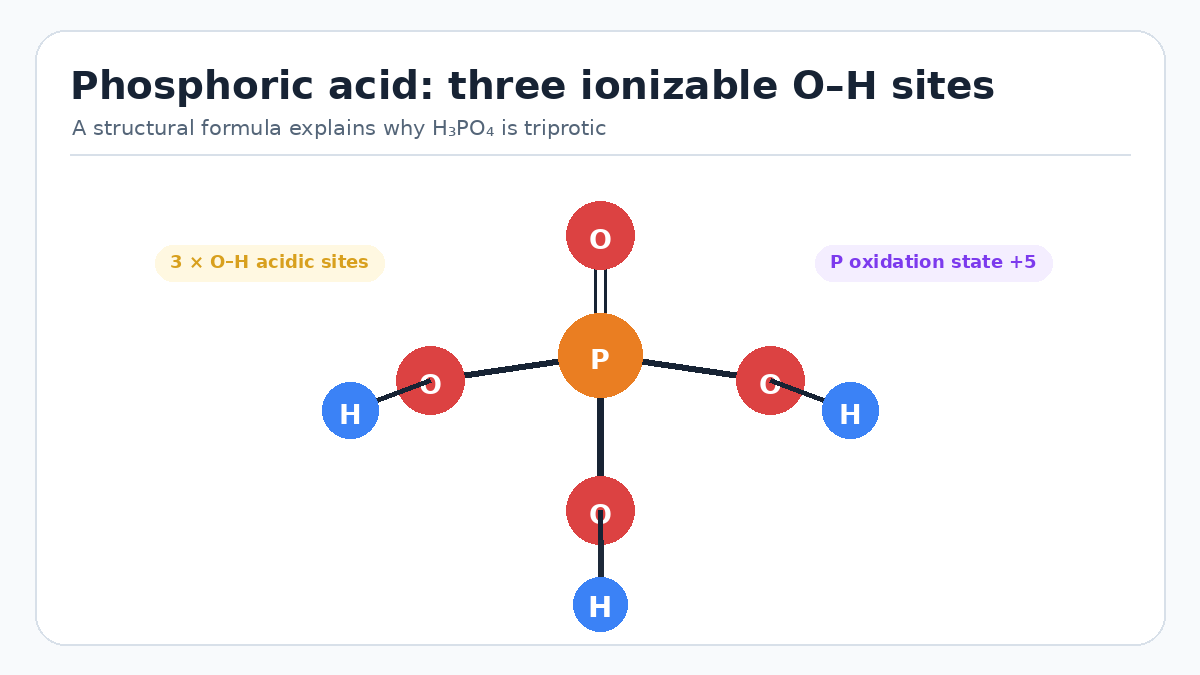
A useful structural formula places phosphorus at the center with four oxygens; three carry hydrogens as P–O–H. Those O–H sites are removed in acid–base reactions.
Source: PubChem — Phosphoric Acid
Acid–base chemistry Three ionizations create four major protonation states H₃PO₄, H₂PO₄⁻, HPO₄²⁻ and PO₄³⁻ form a stepwise ladder.
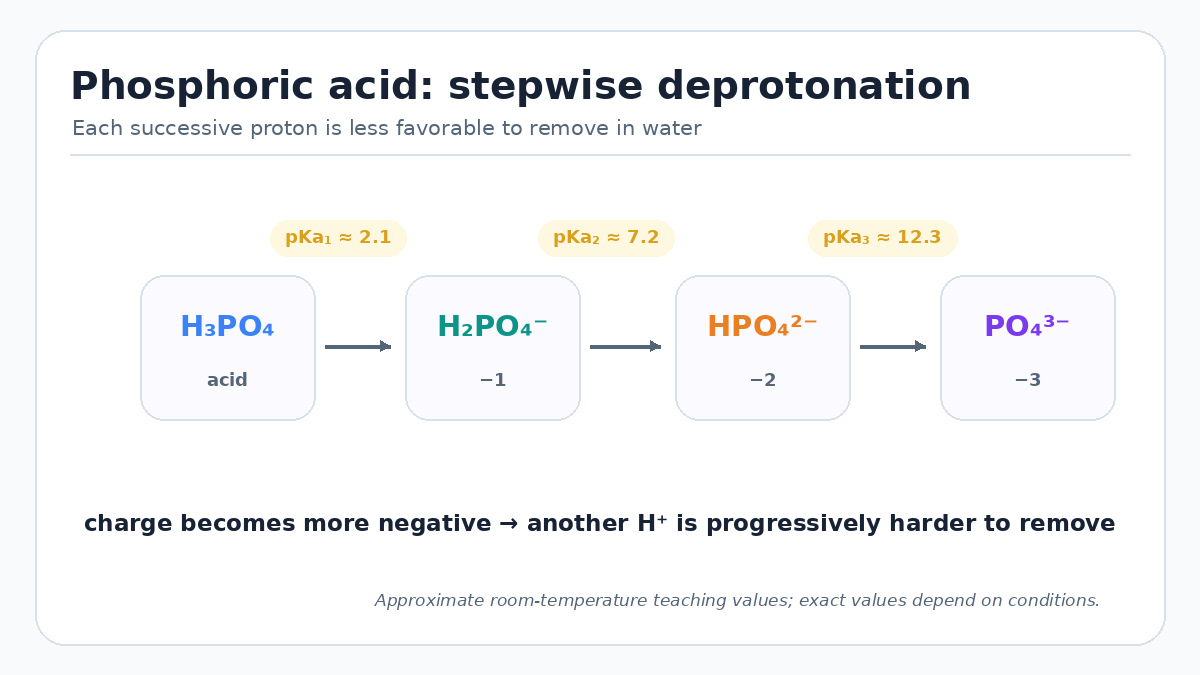
Approximate aqueous pKₐ values near room temperature are often quoted around 2.1, 7.2 and 12.3, with exact values depending on temperature and ionic conditions.
The wide separation explains why different phosphate species dominate in different pH regions.
Equilibrium / buffers Near pKa₂, H₂PO₄⁻ and HPO₄²⁻ form an important conjugate pair Buffer behavior comes from comparable acid/base amounts.
When pH is near the second pKₐ, both H₂PO₄⁻ and HPO₄²⁻ can be significant. Henderson–Hasselbalch can estimate their ratio when activity effects are modest.
Source: OpenStax Chemistry — Buffers
Oxidation-state reasoning Phosphorus is +5, but acid–base steps are not redox Proton transfer changes charge/protonation without changing P oxidation state.
3(+1) + P + 4(−2) = 0 gives P = +5. Removing H⁺ changes the species charge but not phosphorus oxidation state.
Source: PubChem — Phosphoric Acid
Applied chemistry “Phosphate” chemistry depends on protonation and counterions H₃PO₄, H₂PO₄⁻, HPO₄²⁻ and PO₄³⁻ are chemically distinct.
Fertilizer, food, biochemical and materials contexts often use different phosphate salts or protonation states. The formula carries information that the word “phosphate” alone does not.
Source: PubChem — Phosphoric Acid
Worked examples
3(+1) + P + 4(−2) = 0 → P = +5
Deprotonation does not change P(+5).
pH = pKa + log(base/acid), so log(base/acid) ≈ 0 and the ratio ≈ 1.
Idealized dilute-buffer estimate.
Related compounds
Sources & evidence Reference sources Open the evidence and reference list used for this compound page.
Compound pages separate formula interpretation from reference data and from contextual explanation. Check the linked source when a value or condition matters to your work.
- PubChem — Phosphoric Acid — Identity, formula, molecular weight, structure and safety context.
- OpenStax Chemistry 2e — Relative Strengths of Acids and Bases — Polyprotic-acid framework.
- OpenStax Chemistry 2e — Buffers — Buffer and Henderson–Hasselbalch context.
Found an error, something unclear, or a missing topic?
Tell us what you noticed. Feedback goes to a private review queue and is never published automatically.