

Calcium Hydroxide Ca(OH)2
Calcium hydroxide is Ca(OH)₂, an ionic solid containing Ca²⁺ and OH⁻ in a 1:2 ratio. It is a strong base in the sense that dissolved Ca(OH)₂ dissociates into ions, but it is only sparingly soluble, so strength and solubility must not be confused.
What does Ca(OH)2 mean?
One Ca²⁺ requires two OH⁻ for neutrality. Parentheses show that the OH group occurs twice. The solid is an extended ionic crystal, not an isolated O–Ca–O molecule.
Once you can count every element correctly, the same formula becomes the basis for formula mass and molar mass.
What kind of chemical substance is it?
Calcium hydroxide is ionic overall; O–H bonding inside hydroxide is covalent. Dissolved material produces hydrated Ca²⁺ and OH⁻ ions, but the amount dissolved is limited by solubility equilibrium.
Why does Calcium Hydroxide behave this way?
“Strong” describes dissociation of the dissolved portion; “solubility” describes how much solid enters solution. A saturated Ca(OH)₂ solution can therefore be strongly basic even though only a limited amount dissolves.
What is the formula of calcium hydroxide?
Ca(OH)₂.
Is calcium hydroxide a strong base?
Yes in the usual general-chemistry sense for the dissolved portion; limited solubility is a separate property.
What is its molar mass?
About 74.09 g/mol.
What is limewater?
A clear aqueous solution containing dissolved calcium hydroxide, often near saturation in classroom contexts.
Why does limewater turn cloudy with CO₂?
Ca²⁺/carbonate chemistry can form sparingly soluble CaCO₃ under suitable conditions.
What does Ksp mean for Ca(OH)₂?
It describes equilibrium among the solid and dissolved Ca²⁺/OH⁻ activities.
Does calcium hydroxide decompose when heated?
At sufficiently high temperature it decomposes to calcium oxide and water.
Key properties and classification
Why this compound matters: Calcium hydroxide separates ionic dissociation, base strength and solubility, then connects them to Ksp, precipitation, carbonate chemistry and the lime cycle.
Where does Calcium Hydroxide appear in chemical equations?
These equations are included to connect the compound to chemistry concepts and stoichiometry. They are not laboratory procedures.
Ksp relates ion activities at equilibrium.
Familiar limewater/carbonation reaction; aqueous pathways include carbonate speciation.
High-temperature decomposition.
Safety depends on form, concentration and situation
Calcium hydroxide is caustic/alkaline and can irritate or burn eyes, skin and respiratory tissues. This is not a construction, dental or handling procedure.
Study the chemistry, not just the topic names
Ca(OH)₂ is useful because strong-base behavior, limited solubility and carbonate precipitation can all be taught without conflating them.
Core chemistry Charge balance and parentheses in Ca(OH)₂ One Ca²⁺ balances two hydroxide ions.
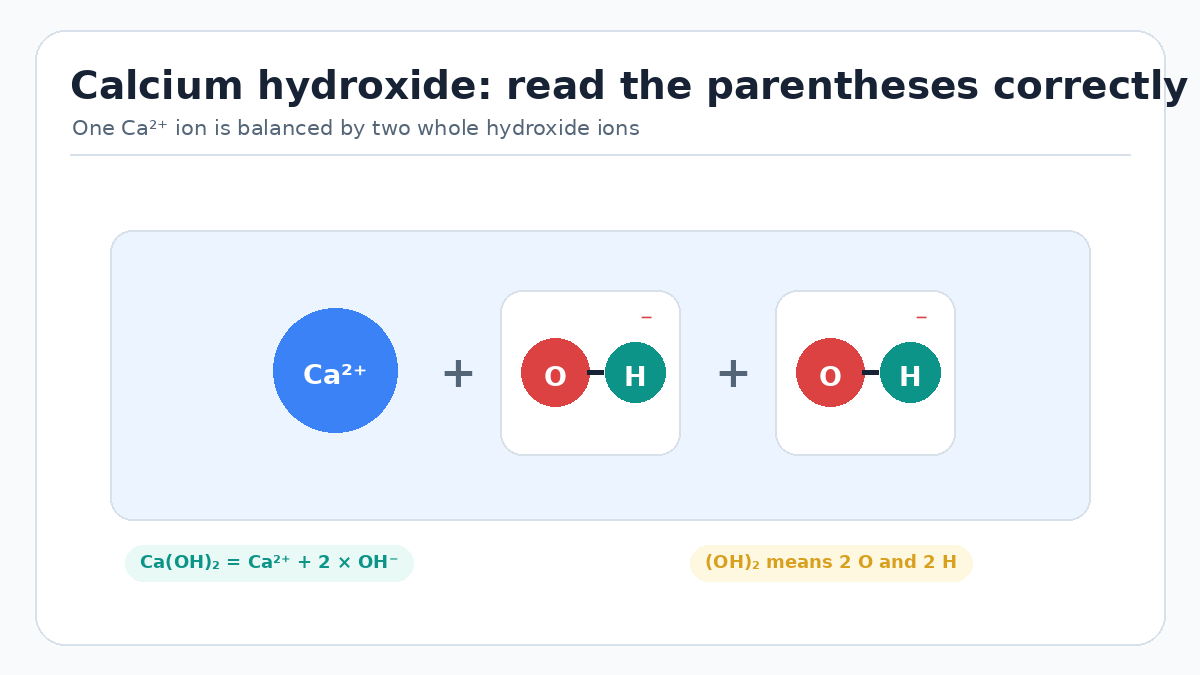
Calcium commonly forms Ca²⁺; hydroxide is OH⁻. Neutrality requires +2 + 2(−1) = 0.
The subscript 2 applies to the whole OH group.
Source: PubChem — Calcium Hydroxide
Equilibrium chemistry Ksp: limited solubility controls how much strong base reaches solution Dissolved Ca(OH)₂ dissociates, but dissolution itself is an equilibrium.
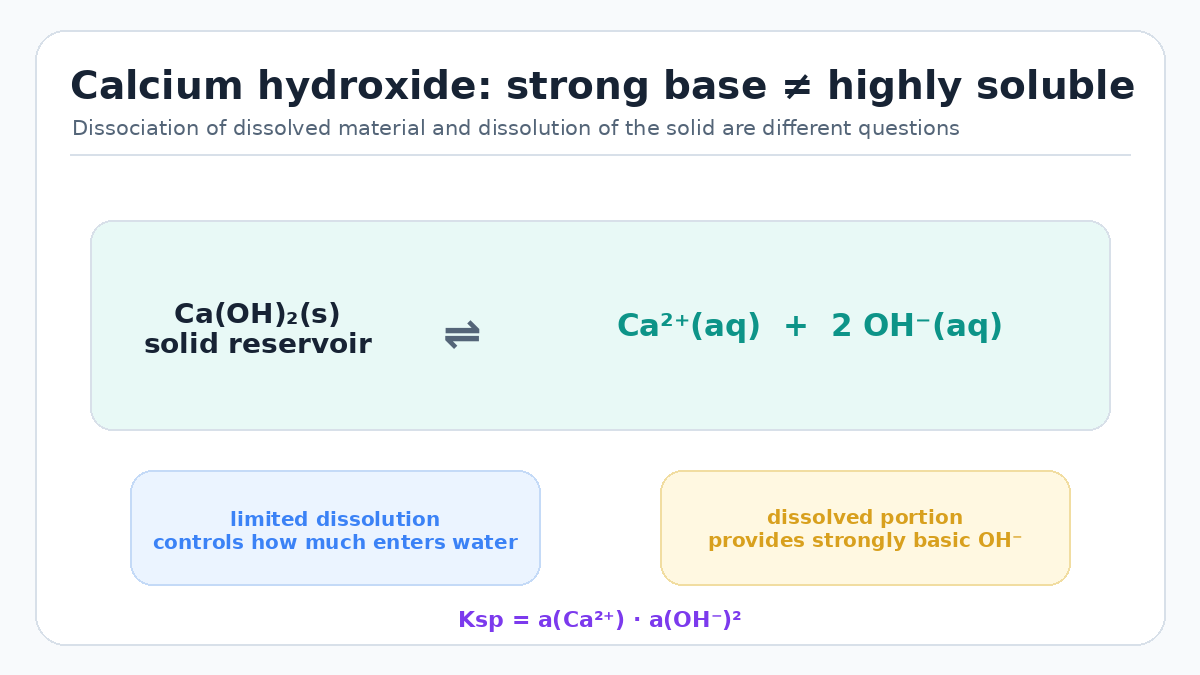
For Ca(OH)₂(s) ⇌ Ca²⁺ + 2OH⁻, Ksp = a(Ca²⁺)a(OH⁻)². In a simple dilute model, molar solubility s gives [Ca²⁺] ≈ s and [OH⁻] ≈ 2s.
Source: PubChem — Calcium Hydroxide
Acid–base chemistry Strong base does not mean unlimited concentration Base strength and solubility answer different questions.
Dissolved hydroxide reacts essentially stoichiometrically with strong acids in ordinary aqueous chemistry, but a saturated solution contains only as much dissolved solid as equilibrium permits.
Carbonate chemistry Why CO₂ can make limewater cloudy Carbonation can produce CaCO₃ precipitate.
Ca(OH)₂ + CO₂ → CaCO₃ + H₂O is a useful overall equation. Microscopically, dissolved inorganic-carbon speciation and Ca²⁺ precipitation are coupled equilibria.
With excess CO₂, bicarbonate-rich dissolved species can become important.
Source: OpenStax Chemistry — Carbonates
Thermal / materials chemistry The lime cycle links CaCO₃, CaO and Ca(OH)₂ Three calcium compounds interconvert under different conditions.
High-temperature CaCO₃ can form CaO + CO₂; CaO reacts with water to form Ca(OH)₂; Ca(OH)₂ can carbonate back toward CaCO₃.
This is a reaction map, not an industrial procedure.
Worked examples
Stoichiometry gives [OH⁻] ≈ 2s.
Assumes complete dissociation of dissolved material and neglects activity corrections.
40.078 + 2(15.999 + 1.008) ≈ 74.09 g/mol
Both O and H are doubled.
Related compounds
Sources & evidence Reference sources Open the evidence and reference list used for this compound page.
Compound pages separate formula interpretation from reference data and from contextual explanation. Check the linked source when a value or condition matters to your work.
- PubChem — Calcium Hydroxide — Formula, molecular weight, ionic components and safety/property context.
- NIOSH Pocket Guide — Calcium hydroxide — Occupational hazard and physical-property context.
- OpenStax Chemistry 2e — Carbonates — Carbonate/CO₂ chemistry.
Found an error, something unclear, or a missing topic?
Tell us what you noticed. Feedback goes to a private review queue and is never published automatically.