

Benzene C6H6
Benzene is C₆H₆, a planar six-carbon aromatic ring with six delocalized π electrons. It is not accurately described as a ring with three fixed single and three fixed double bonds: all six C–C bonds are equivalent in the real molecule.
What does C6H6 mean?
C₆H₆ has high unsaturation, but benzene’s unusual stability comes from cyclic π-electron delocalization. Alternating-bond hexagons are resonance contributors; a circle is shorthand for delocalization, not a literal extra bond.
Once you can count every element correctly, the same formula becomes the basis for formula mass and molar mass.
What kind of chemical substance is it?
Each carbon is approximately sp²-hybridized, forming a planar σ framework. One p orbital remains on each carbon; the six p orbitals overlap around the ring to form delocalized π molecular orbitals containing six π electrons.
Why does Benzene behave this way?
The two Kekulé drawings are representations of one molecule. Benzene does not alternate between structures; its six C–C bonds are equivalent and π electrons are delocalized.
What is benzene’s formula?
C₆H₆.
What is benzene’s structure?
A planar six-carbon ring with one hydrogen per carbon and a delocalized six-electron π system.
Does benzene have alternating single and double bonds?
Not as fixed physical bonds; alternating Kekulé drawings are resonance contributors.
Why is benzene aromatic?
It is cyclic, planar, conjugated and has six π electrons, satisfying 4n + 2 with n = 1.
What is its molar mass?
About 78.112 g/mol.
Why does benzene favor substitution over simple addition?
Many additions would destroy aromatic delocalization; substitution can restore the aromatic ring.
Is benzene dangerous?
Yes. It is flammable and a well-established human carcinogen.
Key properties and classification
Why this compound matters: Benzene is the foundational aromatic molecule, allowing formula/structure queries to progress into resonance, molecular orbitals, Hückel aromaticity and characteristic substitution chemistry.
Where does Benzene appear in chemical equations?
These equations are included to connect the compound to chemistry concepts and stoichiometry. They are not laboratory procedures.
Conceptual net pattern; no reagent/catalyst recipe is given.
Overall stoichiometry; actual reaction requires catalytic conditions.
Ideal stoichiometric equation, not an ignition instruction.
Safety depends on form, concentration and situation
Benzene is volatile, flammable, toxic and a known human carcinogen. This page is a structure/organic-chemistry reference, not a handling or preparation guide.
Study the chemistry, not just the topic names
The progression is σ framework → six p orbitals → delocalized π MOs → aromatic stabilization → characteristic substitution chemistry.
Core organic chemistry Two Kekulé structures, one real benzene molecule Resonance contributors do not represent flipping molecules.
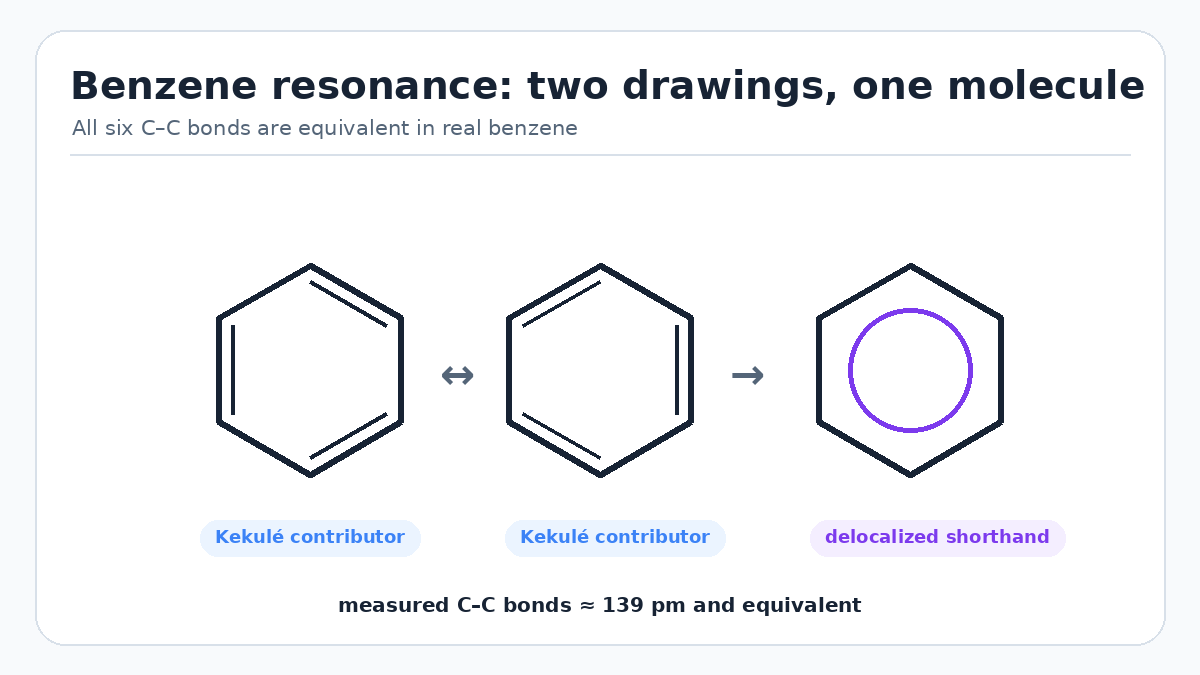
OpenStax notes that all six C–C bonds are equivalent, around 139 pm, intermediate between typical isolated single and double bonds. The two alternating-bond drawings are equivalent resonance contributors.
Source: OpenStax Organic Chemistry — Structure and Stability of Benzene
Molecular orbitals Six p orbitals combine into a delocalized π system Three occupied bonding π MOs hold six π electrons.
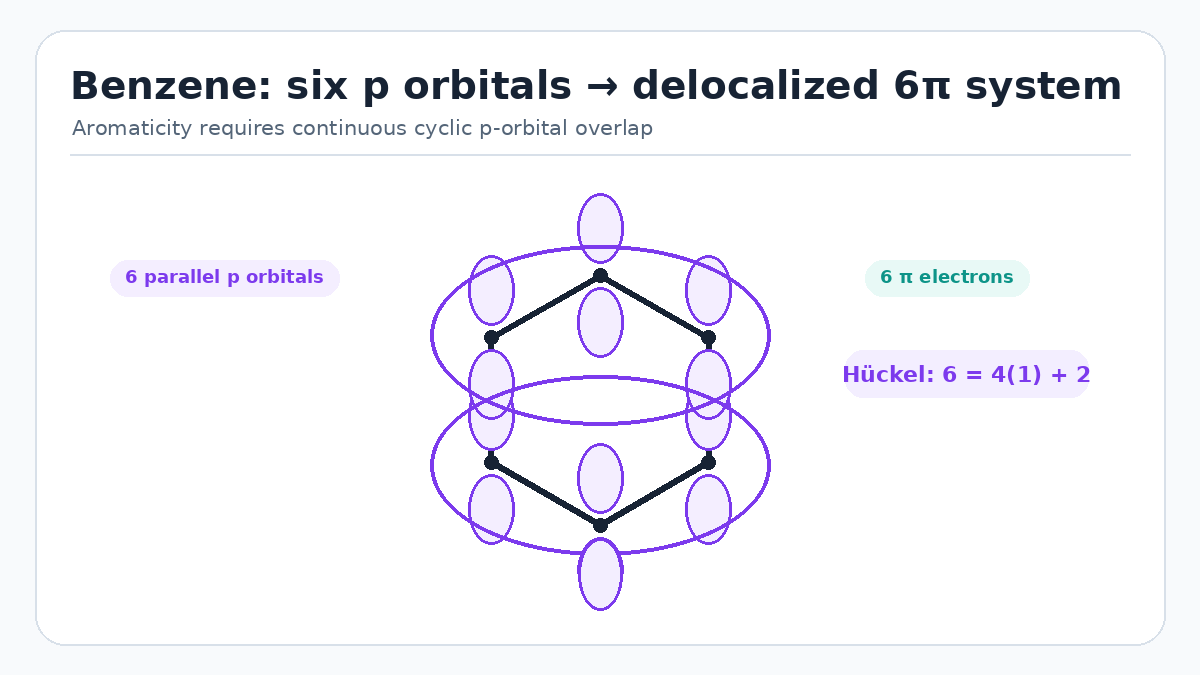
Each sp² carbon contributes one perpendicular p orbital. Combining six around the ring produces six π MOs; six π electrons occupy the three bonding orbitals.
Source: OpenStax Organic Chemistry — Structure and Stability of Benzene
Aromaticity Hückel’s 4n + 2 rule identifies the six-electron aromatic shell Benzene has 6 π electrons = 4(1) + 2.
Aromaticity requires cyclic conjugation, sufficient planarity and 4n + 2 π electrons. Benzene meets the rule with n = 1.
Reactivity Why substitution preserves aromaticity better than simple addition Electrophilic aromatic substitution restores the six-π-electron ring.
Benzene often resists alkene-like addition because the product would sacrifice aromatic stabilization. Substitution temporarily disrupts and then restores aromaticity.
No reaction recipe is provided.
Source: OpenStax Organic Chemistry — Electrophilic Aromatic Substitution
Safety / physical chemistry Aromatic stability does not mean biologically safe “Stable ring” and “safe substance” are unrelated.
Aromatic stabilization describes molecular energy/reactivity. Benzene is still volatile, flammable and carcinogenic, so “stable” must not be read as a safety label.
Source: PubChem — Benzene
Worked examples
6 = 4n + 2 → n = 1.
Combined with cyclic conjugation and planarity, this supports aromatic classification.
6(12.011) + 6(1.008) ≈ 78.11 g/mol
Resonance does not change formula or molar mass.
Related compounds
Sources & evidence Reference sources Open the evidence and reference list used for this compound page.
Compound pages separate formula interpretation from reference data and from contextual explanation. Check the linked source when a value or condition matters to your work.
- PubChem — Benzene — Identity, formula, molecular weight and hazard context.
- NIST Chemistry WebBook — Benzene — Reference data index.
- OpenStax Organic Chemistry — Structure and Stability of Benzene — Equal bond lengths, resonance and π-MO description.
- OpenStax Organic Chemistry — Aromaticity and Hückel Rule — Aromaticity criteria and π-electron rule.
Found an error, something unclear, or a missing topic?
Tell us what you noticed. Feedback goes to a private review queue and is never published automatically.