

Acetone C3H6O
Acetone is C₃H₆O, more informatively written (CH₃)₂CO. It is the simplest common ketone: a carbonyl carbon bonded to two methyl groups. The C=O bond is strongly polar, making acetone a polar aprotic solvent.
What does C3H6O mean?
C₃H₆O is a molecular formula shared by constitutional isomers; CH₃COCH₃ shows acetone’s ketone connectivity. The carbonyl carbon is approximately trigonal planar.
Once you can count every element correctly, the same formula becomes the basis for formula mass and molar mass.
What kind of chemical substance is it?
Acetone is covalent. Its C=O bond has σ and π components and is polarized toward oxygen. Oxygen can accept hydrogen bonds, but acetone has no O–H/N–H bond and is not a conventional hydrogen-bond donor.
Why does Acetone behave this way?
The carbonyl creates a substantial dipole and oxygen accepts hydrogen bonds from water/alcohols, yet acetone cannot donate a conventional hydrogen bond because it lacks O–H or N–H.
What is acetone’s formula?
C₃H₆O; a structural formula is (CH₃)₂CO.
What is its IUPAC name?
Propan-2-one.
Is acetone polar?
Yes, because of the strongly polarized C=O group.
Can acetone hydrogen-bond with water?
Yes as an acceptor through oxygen, not as a conventional donor.
What is its molar mass?
About 58.079 g/mol.
What is the geometry at the carbonyl carbon?
Approximately trigonal planar.
Is acetone flammable?
Yes; it is a volatile, highly flammable liquid.
Key properties and classification
Why this compound matters: Acetone gives ElementLookup a foundational organic hub: molecular vs structural formula, carbonyl polarity, intermolecular forces, solvent classification, nucleophilic addition and enolate resonance.
Where does Acetone appear in chemical equations?
These equations are included to connect the compound to chemistry concepts and stoichiometry. They are not laboratory procedures.
Conceptual electron-flow pattern, not a synthetic procedure.
Acid–base activation concept.
Idealized resonance contributors for an acetone-derived enolate.
Safety depends on form, concentration and situation
Acetone is volatile and highly flammable; sufficiently high exposure can irritate and depress the central nervous system. This page is not a cleaning, extraction, fire or handling guide.
Study the chemistry, not just the topic names
Acetone introduces two recurring carbonyl themes: electrophilic carbon and oxygen-centered lone-pair/basicity behavior.
Core organic chemistry Molecular formula vs structural formula: C₃H₆O does not tell the whole story CH₃COCH₃ identifies ketone connectivity.
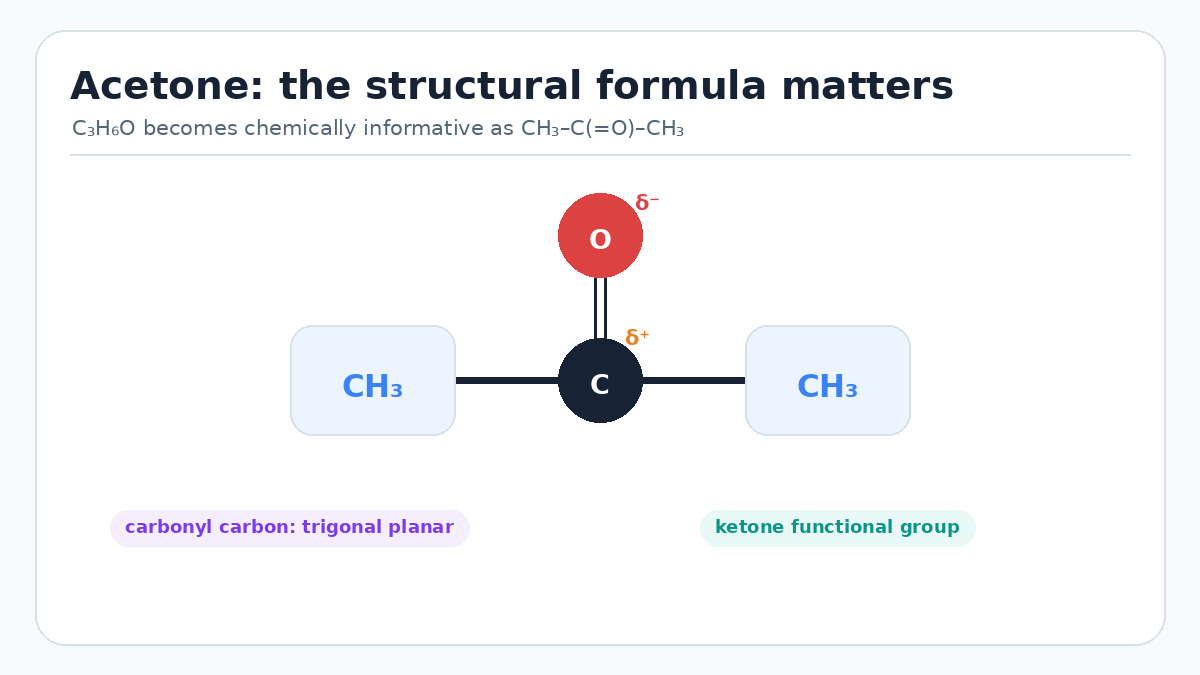
C₃H₆O is shared by multiple constitutional isomers. CH₃–C(=O)–CH₃ shows the functional group that defines acetone’s chemistry.
Source: PubChem — Acetone
Polarity / intermolecular forces Why acetone is polar but aprotic A strong C=O dipole coexists with no O–H/N–H donor bond.

Oxygen pulls electron density from carbonyl carbon, giving O δ− and C δ+. Acetone accepts hydrogen bonds through oxygen but cannot donate a conventional one.
Source: NIOSH Pocket Guide — Acetone
Reactivity Carbonyl polarization makes the carbon electrophilic Nucleophiles interact with the δ+ carbonyl carbon.
A central aldehyde/ketone pattern is nucleophilic addition: electron density moves toward carbonyl carbon while π electrons shift toward oxygen.
Exact products depend on reagents and conditions, so this remains conceptual.
Enolate chemistry Alpha hydrogens connect acetone to resonance-stabilized enolates Negative charge can delocalize between alpha carbon and oxygen.
An acetone-derived enolate has resonance contributors with charge on carbon or oxygen. The hybrid is the real electronic structure.
Physical chemistry / safety Volatility and flammability are separate from polarity A polar molecule can still be volatile and flammable.
NIOSH lists acetone as a volatile flammable liquid with boiling point near 56 °C. Polarity does not imply nonflammability.
Source: NIOSH Pocket Guide — Acetone
Worked examples
3(12.011) + 6(1.008) + 15.999 ≈ 58.08 g/mol
Structural formula changes interpretation, not atom count.
Its carbonyl carbon is bonded to two carbon groups, not to H.
Aldehydes have at least one H directly attached to the carbonyl carbon.
Related compounds
Sources & evidence Reference sources Open the evidence and reference list used for this compound page.
Compound pages separate formula interpretation from reference data and from contextual explanation. Check the linked source when a value or condition matters to your work.
- PubChem — Acetone — Identity, formula, structure, molecular weight and property context.
- NIST Chemistry WebBook — Acetone — Reference data index.
- NIOSH Pocket Guide — Acetone — Volatility, flammability and exposure context.
- OpenStax Organic Chemistry — Nucleophilic Addition — Carbonyl reactivity framework.
Found an error, something unclear, or a missing topic?
Tell us what you noticed. Feedback goes to a private review queue and is never published automatically.