

Sulfur Dioxide SO2
Sulfur dioxide is SO₂, a bent, polar molecular gas containing sulfur in oxidation state +4. Lewis structures use resonance contributors; VSEPR gives trigonal-planar electron-domain geometry and a bent molecular shape.
Also called: sulphur dioxide · sulfurous anhydride · SO2
What does SO2 mean?
SO₂ is a discrete triatomic molecule in the gas phase. “Sulfur” and “sulphur” dioxide are spelling variants. Its 1:2 formula does not imply a linear molecule because sulfur has a lone-pair domain.
Once you can count every element correctly, the same formula becomes the basis for formula mass and molar mass.
What kind of chemical substance is it?
SO₂ has covalent S–O bonding and delocalization. Lewis structures are useful bookkeeping models; the measured molecule is not one permanent single bond plus one permanent double bond.
Why does Sulfur Dioxide behave this way?
SO₂ is a useful case where resonance, expanded-valence drawings and molecular-orbital descriptions coexist. VSEPR captures bent shape, while formal charge and bond-order drawings are electron bookkeeping.
What is the Lewis structure of SO₂?
Common treatments use resonance contributors around central sulfur with one lone pair. The real molecule has delocalized S–O bonding.
What is the shape of SO₂?
Bent, with trigonal-planar electron-domain geometry at sulfur.
Is SO₂ polar?
Yes; the polar S–O bond dipoles do not cancel in a bent molecule.
What is sulfur’s oxidation state?
+4.
What is the molar mass?
About 64.064 g/mol.
Is sulfur dioxide a greenhouse gas?
It is primarily an air pollutant and sulfate-aerosol/acid-rain precursor rather than a long-lived greenhouse gas like CO₂; its climate effects are mechanism-dependent.
What happens when SO₂ dissolves in water?
It participates in hydration and acid–base equilibria involving bisulfite/sulfite species; “H₂SO₃” is a useful overall convention but simplified.
What happens when sulfur burns in oxygen?
The main simple oxide formed when elemental sulfur burns in oxygen is sulfur dioxide, SO₂. In oxidation-state terms, sulfur moves from 0 in elemental sulfur to +4 in SO₂ while oxygen is reduced from 0 to −2.
Move sulfur from element 0 to +4 and then through the sulfur-oxide network
SO₂ connects oxidation-state bookkeeping, molecular geometry, atmospheric chemistry and acid–base chemistry. Start by tracking sulfur’s electrons.
Formation
S + O₂ → SO₂ moves sulfur from oxidation state 0 to +4.
Molecular structure
SO₂ is bent, so bond dipoles do not cancel completely.
Further oxidation / hydration context
SO₂ can be oxidized toward sulfur(VI) chemistry and participates in aqueous sulfite/bisulfite equilibria; exact species depend on conditions.
Check your reasoning SO₂ must be linear because CO₂ is linear and both have two oxygens. Click to reveal the explanation Explanation revealed
Common wrong reasoning: Same atom count means same VSEPR shape.
Better answer: SO₂ has a lone-pair/electron-domain pattern at sulfur that gives a bent molecular geometry.
Common misconceptions and exam traps
Sulfur is +4 in SO₂ and +6 in sulfate.
Aqueous sulfur(IV) chemistry is an equilibrium mixture whose description depends on convention and conditions.
They are distinct chemical species with different states and chemistry.
Key properties and classification
Why this compound matters: SO₂ connects Lewis resonance, VSEPR, polarity, sulfur oxidation states, aqueous acid–base chemistry and atmospheric oxidation, with meaningful demand under both sulfur/sulphur spellings.
Where does Sulfur Dioxide appear in chemical equations?
These equations are included to connect the compound to chemistry concepts and stoichiometry. They are not laboratory procedures.
Important sulfur-oxidation chemistry; equilibrium and rate depend on conditions.
Compact representation; detailed hydration/speciation depends on conditions.
Generic environmental/redox connection; actual oxidants/pathways vary.
A compact combustion/redox equation: sulfur is oxidized from 0 to +4 while oxygen is reduced from 0 to −2.
Safety depends on form, concentration and situation
Sulfur dioxide is a toxic, irritating gas that can seriously affect the respiratory system. This page provides no generation, exposure, preservation or handling instructions.
Study the chemistry, not just the topic names
SO₂ spans structural models, polarity, oxidation states and atmospheric aqueous chemistry in one small molecule.
Core chemistry Lewis structure and resonance: why one drawing is not enough
SO₂ has delocalized S–O bonding and a lone pair on sulfur.

OpenStax shows resonance contributors for SO₂. Equivalent contributors place formal bond order/charge differently; the molecule itself is one resonance hybrid.
VSEPR / polarity Three electron domains produce a bent molecule
Two bonding regions plus one lone-pair region give trigonal-planar electron geometry.
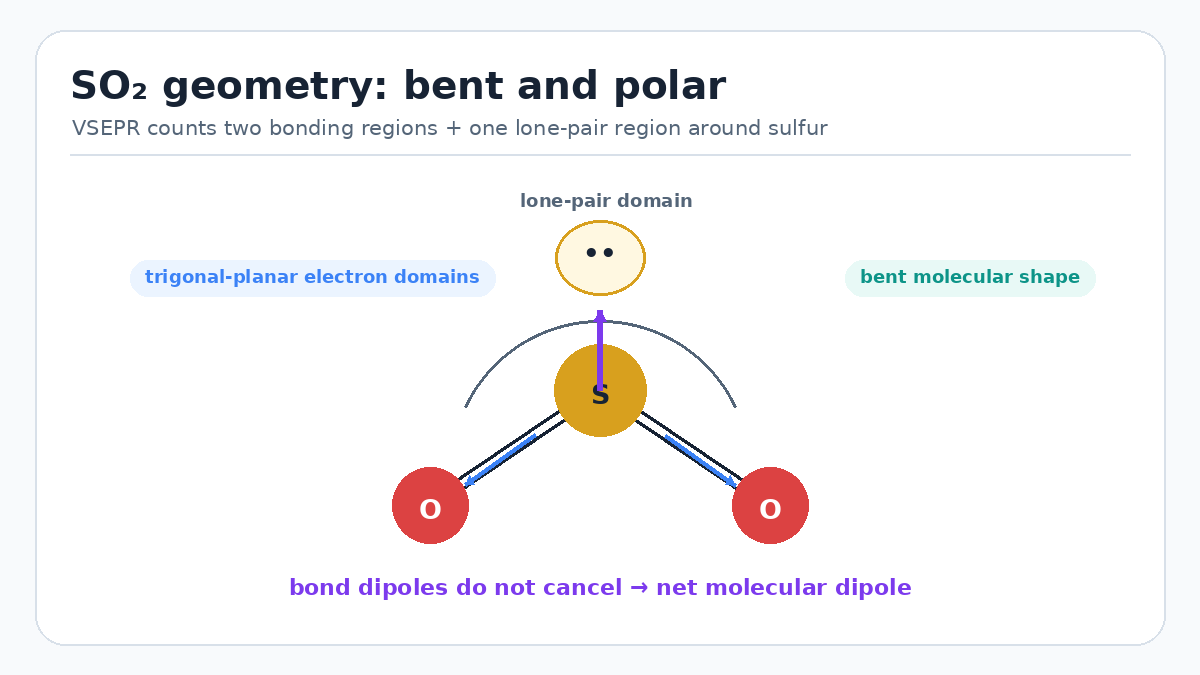
With two S–O bonding regions and one lone pair, the molecular shape is bent. The S–O dipoles therefore do not cancel.
Oxidation states SO₂ places sulfur at +4
Further oxidation toward sulfate moves sulfur to +6.
S + 2(−2) = 0 gives S = +4. This is distinct from formal charge in any Lewis contributor.
Aqueous / environmental chemistry Dissolved SO₂ is an equilibrium system, not just “H₂SO₃ in water”
Bisulfite and sulfite speciation vary with pH.
General chemistry often uses sulfurous-acid notation as a convenient overall representation, while aqueous/atmospheric chemistry tracks dissolved SO₂, HSO₃⁻ and SO₃²⁻ more explicitly. Oxidation to sulfate connects SO₂ emissions to acid deposition.
Source: PubChem — Sulfur Dioxide
Atmospheric chemistry SO₂ is not simply “another greenhouse gas”
Its air-quality and climate effects are dominated by oxidation and aerosol formation.
SO₂ is a regulated pollutant and sulfate-particle precursor. The mechanism differs fundamentally from long-lived well-mixed CO₂, so a binary vocabulary answer is misleading.
Redox connection From elemental sulfur to SO₂: a simple equation with useful oxidation-state bookkeeping
S + O₂ → SO₂ connects formula writing, combustion and redox in one compact example.
OpenStax identifies sulfur dioxide as the characteristic oxide produced when sulfur burns in oxygen. The balanced equation is already 1:1:1 because one sulfur atom and two oxygen atoms appear on each side.
S + O₂ → SO₂
Oxidation numbers reveal the electron-bookkeeping story: elemental sulfur begins at 0 and is oxidized to +4, while oxygen begins at 0 in O₂ and is reduced to −2 in the oxide. This does not mean the reaction contains free S⁴⁺ and O²⁻ ions; SO₂ is a covalent molecular substance.
Worked examples
S + 2(−2) = 0 → S = +4
Oxidation state is not Lewis formal charge.
Two polar S–O bonds are arranged at an angle, so dipole vectors do not cancel.
Contrast with linear CO₂.
Related compounds
Sources & evidence Reference sources Open the evidence and reference list used for this compound page.
Compound pages separate formula interpretation from reference data and from contextual explanation. Check the linked source when a value or condition matters to your work.
- PubChem — Sulfur Dioxide — Identity, formula, molecular weight and environmental/safety context.
- NIST Chemistry WebBook — Sulfur dioxide — Reference data index.
- OpenStax Chemistry — Multiple Bonds — SO₂ resonance/VSEPR example.
- NIOSH Pocket Guide — Sulfur dioxide — Exposure and physical-property context.
- OpenStax Chemistry 2e — Compounds of Oxygen — Sulfur oxides, sulfur combustion and SO₂/SO₃ chemistry.
Found an error, something unclear, or a missing topic?
Tell us what you noticed. Feedback goes to a private review queue and is never published automatically.