

Potassium Permanganate KMnO4
Potassium permanganate is KMnO₄, an ionic solid composed of K⁺ and MnO₄⁻. Manganese is +7 and the permanganate ion is approximately tetrahedral. Its intense purple color and strong oxidizing behavior make it a central redox compound.
What does KMnO4 mean?
K⁺ balances MnO₄⁻ in a 1:1 formula unit. Potassium is not inserted into the covalent Mn–O framework. Lewis structures are bookkeeping approximations for a delocalized tetrahedral anion.
Once you can count every element correctly, the same formula becomes the basis for formula mass and molar mass.
What kind of chemical substance is it?
The crystal is ionic between K⁺ and MnO₄⁻; within permanganate, Mn–O bonding is covalent/delocalized.
Why does Potassium Permanganate behave this way?
Manganese is already at high oxidation state +7, so permanganate commonly acts as an oxidizing agent by being reduced. Which lower manganese product forms depends strongly on conditions.
What is the formula of potassium permanganate?
KMnO₄.
What is Mn’s oxidation state?
+7.
What shape is MnO₄⁻?
Approximately tetrahedral.
Why is KMnO₄ purple?
Strong charge-transfer absorption associated with permanganate produces the intense color.
What is the molar mass?
About 158.034 g/mol.
What does permanganate reduce to?
It depends on medium: Mn²⁺ is common in sufficiently acidic solution, MnO₂ in neutral/weakly basic conditions, and MnO₄²⁻ can be favored in strongly basic chemistry.
Is KMnO₄ dangerous?
It is a strong oxidizer and can react dangerously with incompatible reducing/organic materials.
Key properties and classification
Why this compound matters: KMnO₄ unifies oxidation-state arithmetic, polyatomic-ion structure, color/electronic transitions and condition-dependent half-reaction balancing, with particularly strong India demand.
Where does Potassium Permanganate appear in chemical equations?
These equations are included to connect the compound to chemistry concepts and stoichiometry. They are not laboratory procedures.
Common acidic-medium reduction half-reaction.
Common balancing form for Mn(IV) dioxide formation.
Mn(VII) to manganate Mn(VI).
Safety depends on form, concentration and situation
Potassium permanganate is a powerful oxidizer and can intensify combustion or react vigorously with incompatible materials. This page gives no preparation, concentration, medical or reactive-mixing instructions.
Study the chemistry, not just the topic names
The safe educational center is electron bookkeeping: charge balance, Mn(+7), tetrahedral permanganate and reduction products that change with chemical environment.
Core chemistry KMnO₄ is K⁺ plus tetrahedral MnO₄⁻ The 1:1 ionic ratio hides a covalently bonded polyatomic anion.

K⁺ and MnO₄⁻ cancel charge 1:1. Four oxygens surround manganese approximately tetrahedrally, with delocalized bonding.
Source: PubChem — Potassium Permanganate
Oxidation states Why manganese is +7 Oxidation-state arithmetic identifies a highly oxidized manganese species.
(+1) + x + 4(−2) = 0 gives x = +7. Oxidation state is formal bookkeeping, not a literal +7 point charge.
Redox chemistry The reduction product depends on the medium Acidic, near-neutral and strongly basic chemistry need different half-reactions.
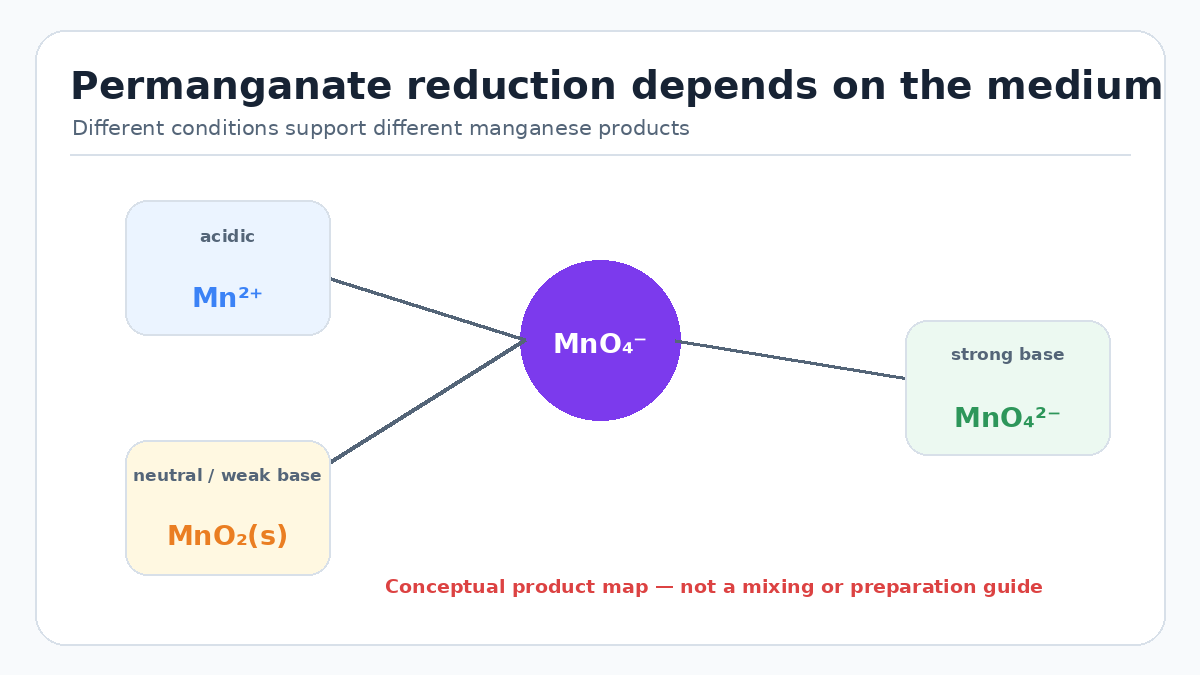
Permanganate is not a single “five-electron oxidizer” under every condition. Mn²⁺, MnO₂ and MnO₄²⁻ are common teaching products in different media.
Source: PubChem — Potassium Permanganate
Electronic structure Why permanganate is intensely purple Visible absorption is dominated by charge-transfer character.
Mn(VII) is formally d⁰, so the intense purple color is not a simple conventional d–d transition. Strong ligand-to-metal charge-transfer absorption is central.
Source: PubChem — Potassium Permanganate
Safety / interpretation Strong oxidizer does not mean “reacts instantly with everything” Thermodynamics, kinetics, medium and contact determine behavior.
Actual rate and product depend on substrate, pH, temperature, concentration and catalysis. This page therefore stays at half-reaction/concept level rather than recipes.
Source: PubChem — Potassium Permanganate
Worked examples
(+1) + Mn + 4(−2) = 0 → Mn = +7
Formal bookkeeping.
+7 → +2 corresponds to 5 e⁻ gained per Mn.
H⁺/H₂O terms balance O, H and charge in acidic solution.
Related compounds
Sources & evidence Reference sources Open the evidence and reference list used for this compound page.
Compound pages separate formula interpretation from reference data and from contextual explanation. Check the linked source when a value or condition matters to your work.
- PubChem — Potassium Permanganate — Formula, molecular weight, identity and oxidizer hazards.
- OpenStax Chemistry 2e — Classifying Chemical Reactions — Oxidation-state framework.
- OpenStax Chemistry 2e — Balancing Oxidation–Reduction Reactions — Half-reaction balancing framework.
Found an error, something unclear, or a missing topic?
Tell us what you noticed. Feedback goes to a private review queue and is never published automatically.