

Ammonium Chloride NH4Cl
Ammonium chloride is NH₄Cl, an ionic salt made from NH₄⁺ and Cl⁻. In water, NH₄⁺ can donate a proton to water while Cl⁻ has negligible basicity, so the solution is acidic.
Also called: sal ammoniac · ammonium muriate · NH4Cl
What does NH4Cl mean?
NH₄Cl consists of one tetrahedral ammonium cation and one chloride anion. N–H bonds are covalent inside NH₄⁺; ionic interactions hold the salt together.
Once you can count every element correctly, the same formula becomes the basis for formula mass and molar mass.
What kind of chemical substance is it?
Ammonium chloride combines covalent bonding inside NH₄⁺ with ionic bonding between NH₄⁺ and Cl⁻. In water it dissociates into hydrated ions; acid–base chemistry then comes mainly from NH₄⁺.
Why does Ammonium Chloride behave this way?
Electrical neutrality of the solid does not guarantee neutral pH. NH₄⁺ is a weak Brønsted acid and transfers some proton character to water.
What is the formula of ammonium chloride?
NH₄Cl.
Is ammonium chloride acidic or basic?
Its aqueous solution is acidic because NH₄⁺ is a weak acid while Cl⁻ has negligible basicity in water.
What is the molar mass?
About 53.491 g/mol.
What is the geometry of NH₄⁺?
Approximately tetrahedral around nitrogen.
How is NH₄Cl related to ammonia and HCl?
NH₃ accepts a proton to form NH₄⁺; HCl supplies chloride as the counterion. In water the corresponding ions and equilibria matter.
Why is chloride not making the solution basic?
Cl⁻ is the conjugate base of strong acid HCl, so its basicity is negligible in ordinary aqueous general chemistry.
What happens on heating?
Heating can produce gaseous NH₃ and HCl in a reversible dissociation/recombination process.
Explain why an NH₄Cl solution can be acidic
The salt contains a conjugate acid (NH₄⁺) and a largely spectator conjugate base (Cl⁻). The pH follows from hydrolysis equilibria, not from the word 'salt'.
Dissociate the salt
NH₄Cl → NH₄⁺ + Cl⁻ in water.
Identify acid/base roles
NH₄⁺ can donate a proton to water; Cl⁻ is the conjugate base of a strong acid and has negligible basicity in ordinary treatment.
Relate constants
Ka(NH₄⁺) = Kw / Kb(NH₃), connecting the salt directly to ammonia chemistry.
Check your reasoning All salts give neutral solutions. Click to reveal the explanation Explanation revealed
Common wrong reasoning: Ionic compounds are automatically pH 7 in water.
Better answer: Salt pH depends on the acid–base behavior of the ions; NH₄⁺ makes ammonium-chloride solutions acidic.
Common misconceptions and exam traps
The solid is ionic, containing NH₄⁺ and Cl⁻.
Cl⁻ is an extremely weak base; acidity comes mainly from NH₄⁺ hydrolysis.
They are different chemical species with different charge and equilibrium behavior.
Key properties and classification
Why this compound matters: Ammonium chloride cleanly teaches polyatomic ions, conjugate acids, salt hydrolysis, pH and reversible thermal dissociation while linking directly to ammonia and hydrochloric acid.
Where does Ammonium Chloride appear in chemical equations?
These equations are included to connect the compound to chemistry concepts and stoichiometry. They are not laboratory procedures.
Idealized dissociation into hydrated ions.
Responsible for acidic aqueous behavior.
High-temperature gas-phase dissociation/recombination concept.
Safety depends on form, concentration and situation
Ammonium chloride can irritate eyes, skin and the respiratory tract; heating can produce irritating vapors. This page is not a heating, dosing or formulation guide.
Study the chemistry, not just the topic names
Track the scale: tetrahedral NH₄⁺ → ionic NH₄Cl crystal → hydrated ions → NH₄⁺ proton-transfer equilibrium.
Core chemistry Ionic salt outside, covalent tetrahedral ammonium inside
One NH₄⁺ balances one Cl⁻.

Ammonium has four N–H bonds and +1 overall charge. Four bonding domains and no nitrogen lone pair give idealized tetrahedral geometry.
Source: PubChem — Ammonium Chloride
Acid–base chemistry Why NH₄Cl solution is acidic
NH₄⁺ hydrolyzes; Cl⁻ is essentially a spectator.
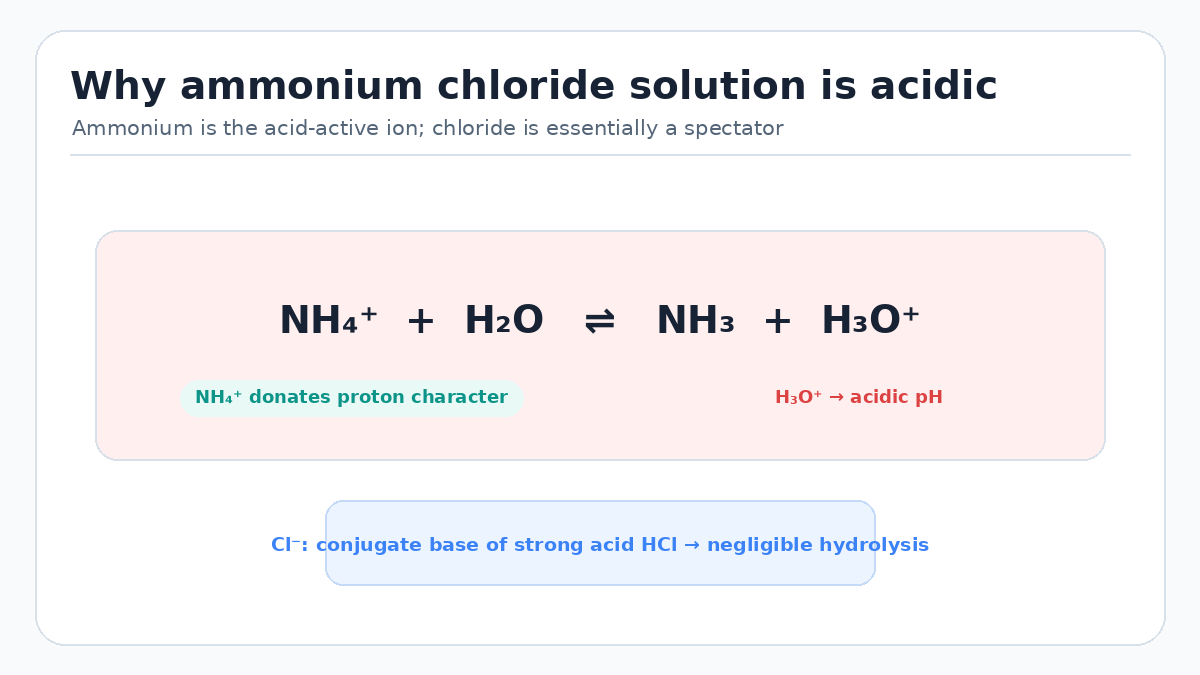
OpenStax gives NH₄⁺ + H₂O ⇌ H₃O⁺ + NH₃. Chloride is the conjugate base of strong acid HCl and does not appreciably raise pH.
Quantitative equilibrium Ka for NH₄⁺ is connected to Kb for NH₃
For a conjugate pair, Ka·Kb = Kw at the same temperature.
Ka(NH₄⁺) = Kw/Kb(NH₃) at a stated temperature. This turns ammonia base data into the ammonium acid constant used in simple pH calculations.
Thermal chemistry Heating NH₄Cl involves reversible chemical dissociation
NH₃ and HCl gases can recombine on cooling.
A chemically complete picture includes NH₄Cl(s) ⇌ NH₃(g) + HCl(g) at elevated temperature, rather than treating the behavior as purely physical sublimation.
Concept connection NH₄Cl closes the loop between NH₃ and HCl
The same proton can be followed across base, acid and salt chemistry.
NH₃ accepts H⁺ to become NH₄⁺; HCl is a strong proton donor in water; NH₄Cl contains the resulting conjugate-acid cation paired with chloride.
Worked examples
NH₄⁺ is +1 and Cl⁻ is −1, so a 1:1 ratio is neutral.
Parentheses are unnecessary when only one ammonium is present.
Ka(NH₄⁺) × Kb(NH₃) = Kw.
Use values defined at the same temperature.
Related compounds
Sources & evidence Reference sources Open the evidence and reference list used for this compound page.
Compound pages separate formula interpretation from reference data and from contextual explanation. Check the linked source when a value or condition matters to your work.
- PubChem — Ammonium Chloride — Identity, formula, physical and safety context.
- NIST Chemistry WebBook — Ammonium Chloride — Molecular weight and thermochemistry/spectroscopy index.
- OpenStax Chemistry: Atoms First 2e — Hydrolysis of Salts — Explicit NH₄Cl hydrolysis example.
Found an error, something unclear, or a missing topic?
Tell us what you noticed. Feedback goes to a private review queue and is never published automatically.