

Copper(II) Sulfate CuSO4
Copper(II) sulfate is CuSO₄, an ionic salt containing Cu²⁺ and SO₄²⁻ in a 1:1 ratio. The anhydrous salt and the familiar blue pentahydrate, CuSO₄·5H₂O, are different solid forms with different formula masses and crystal structures.
What does CuSO4 mean?
CuSO₄ represents one Cu²⁺ ion and one SO₄²⁻ ion per formula unit. It is not a discrete six-atom molecule. The common pentahydrate is written CuSO₄·5H₂O; the centered dot records stoichiometric water of crystallization and changes the formula mass from about 159.61 to 249.69 g/mol.
Once you can count every element correctly, the same formula becomes the basis for formula mass and molar mass.
What kind of chemical substance is it?
Copper(II) sulfate is an ionic solid overall, with Cu²⁺ cations and covalently bonded sulfate anions. In hydrates and aqueous solution, Cu²⁺ also participates in coordination chemistry with water and other ligands. The familiar blue color therefore depends on copper’s coordination/electronic environment, not simply on “copper atoms being blue.”
Why does Copper(II) Sulfate behave this way?
Anhydrous CuSO₄ and CuSO₄·5H₂O contain the same copper:sulfate ratio but differ by five stoichiometric waters per formula unit. Heating can remove water in stages; dissolving separates ions and gives hydrated/solvated Cu²⁺. Those changes alter mass, crystal structure and optical behavior.
What is the formula of copper sulfate?
For anhydrous copper(II) sulfate, the formula is CuSO₄. The common pentahydrate is CuSO₄·5H₂O.
Why is it called copper(II) sulfate?
The Roman numeral II specifies Cu in oxidation state +2. Sulfate is SO₄²⁻, so one Cu²⁺ balances one sulfate ion.
Why is copper sulfate blue?
The familiar bright blue crystals are commonly CuSO₄·5H₂O. Cu²⁺ electronic transitions depend on its coordination environment, and hydration changes that environment and therefore the observed color.
Is anhydrous CuSO₄ also blue?
Anhydrous copper(II) sulfate is commonly described as white or off-white. The vivid blue form familiar from laboratories is the pentahydrate.
What is the molar mass of copper sulfate pentahydrate?
CuSO₄·5H₂O has molar mass about 249.69 g/mol, compared with about 159.61 g/mol for anhydrous CuSO₄.
What does the dot in CuSO₄·5H₂O mean?
It indicates five stoichiometric waters of crystallization associated with each CuSO₄ formula unit in that hydrate. It does not mean the solid is merely damp.
What happens when copper sulfate dissolves in water?
The ionic solid dissociates into solvated Cu²⁺ and SO₄²⁻ species. Cu²⁺ becomes coordinated by water molecules, and solution speciation can change further if other ligands are present.
Key properties and classification
Why this compound matters: Copper(II) sulfate is an unusually rich teaching salt: charge balance, polyatomic ions, hydrates, crystal water, molar-mass calculations, coordination color and electrochemistry can all be taught from one familiar compound.
Where does Copper(II) Sulfate appear in chemical equations?
These equations are included to connect the compound to chemistry concepts and stoichiometry. They are not laboratory procedures.
In water, the ions are hydrated/solvated rather than bare.
Overall formula accounting; real dehydration occurs through lower hydrates over temperature ranges.
One standard electrochemical half-reaction connecting Cu²⁺ solutions to metallic copper.
Safety depends on form, concentration and situation
Copper(II) sulfate is a laboratory/industrial chemical and can be harmful if swallowed or released inappropriately; copper salts are also hazardous to aquatic organisms at sufficient concentration. This page is not a pesticide, crystal-growing or handling procedure.
Study the chemistry, not just the topic names
The key distinction is between composition and coordination. CuSO₄ identifies the ionic salt; CuSO₄·5H₂O identifies a specific hydrate; dissolving either produces a different solvated environment around Cu²⁺.
Core chemistry CuSO₄ is an ionic formula unit, not a discrete molecule Cu²⁺ and SO₄²⁻ balance 1:1; covalent bonding remains inside sulfate.
Copper is specified as Cu²⁺ and sulfate as SO₄²⁻, so the lowest neutral ratio is 1:1. The sulfate ion itself contains covalent S–O bonding and resonance/delocalization.
This mixed ionic/covalent picture is common for salts containing polyatomic ions.
Source: PubChem — Copper Sulfate
Core → quantitative Anhydrous CuSO₄ and CuSO₄·5H₂O are different formula-mass problems Five waters raise formula mass from about 159.61 to 249.69 g/mol.
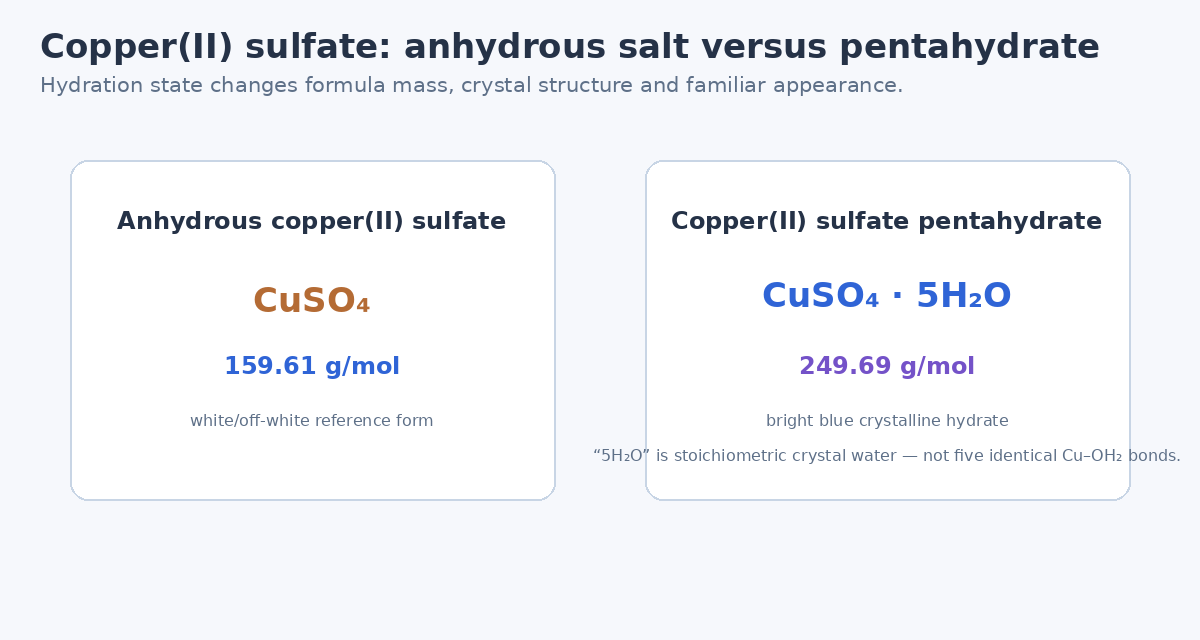
OpenStax uses copper(II) sulfate pentahydrate as a standard example of an ionic hydrate. The dot formula CuSO₄·5H₂O means five water molecules are included per formula unit in the crystal.
Those waters must be counted in any molar-mass or percent-composition calculation involving the pentahydrate.
Solid-state chemistry Water of crystallization leaves in stages; “dehydration” is not one sharp event Hydrate → lower hydrates → anhydrous salt over temperature ranges.
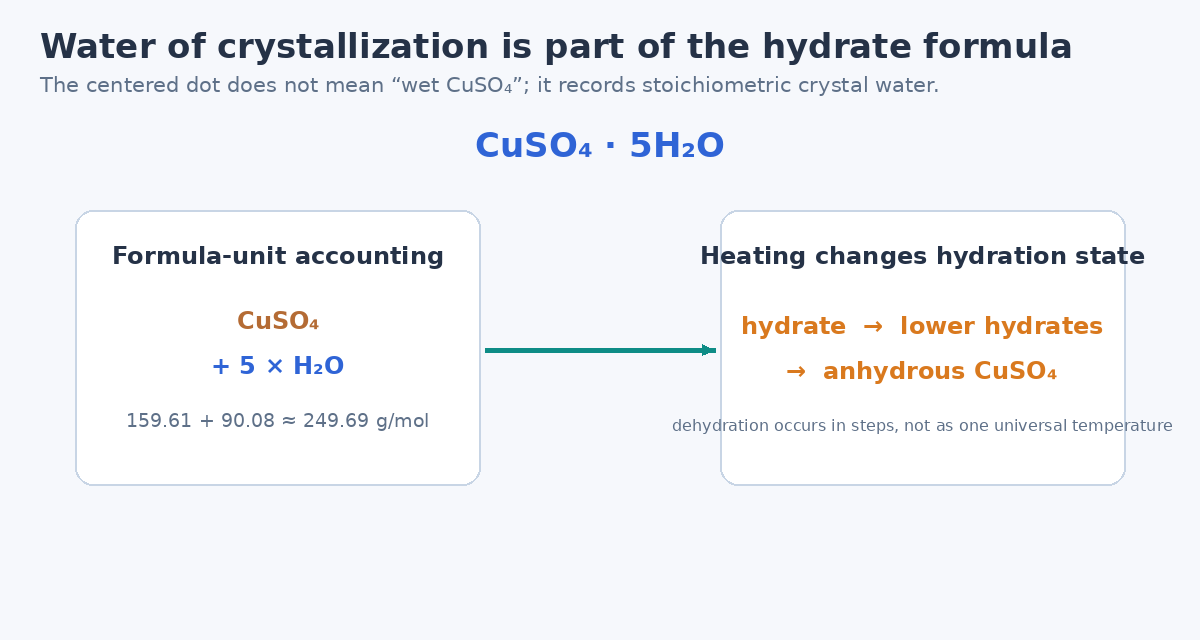
PubChem compiles reports that the pentahydrate can lose water stepwise, passing through lower hydrates before reaching anhydrous CuSO₄. The exact transitions depend on temperature and water-vapor conditions.
Therefore, the shorthand CuSO₄·5H₂O → CuSO₄ + 5H₂O is useful stoichiometric bookkeeping but not a claim that all five waters leave identically at one temperature.
Coordination chemistry Why hydration changes color: Cu²⁺ electronic levels depend on ligands Color is tied to Cu²⁺ coordination and d-electron energy splitting, not to water as a blue pigment.
When Cu²⁺ is surrounded by ligands such as water, ligand-field interactions split metal d-orbital energies. Visible-light absorption associated with these electronic states gives characteristic colors.
Changing hydration or ligand identity changes the coordination environment and can change the spectrum/color. This is why hydrate state and solution chemistry matter.
Source: Chemistry LibreTexts — Bonding in Coordination Complexes
Electrochemistry / applied In solution, Cu²⁺ becomes a mobile redox species Dissolution creates solvated ions, and Cu²⁺ can accept electrons to form Cu metal.
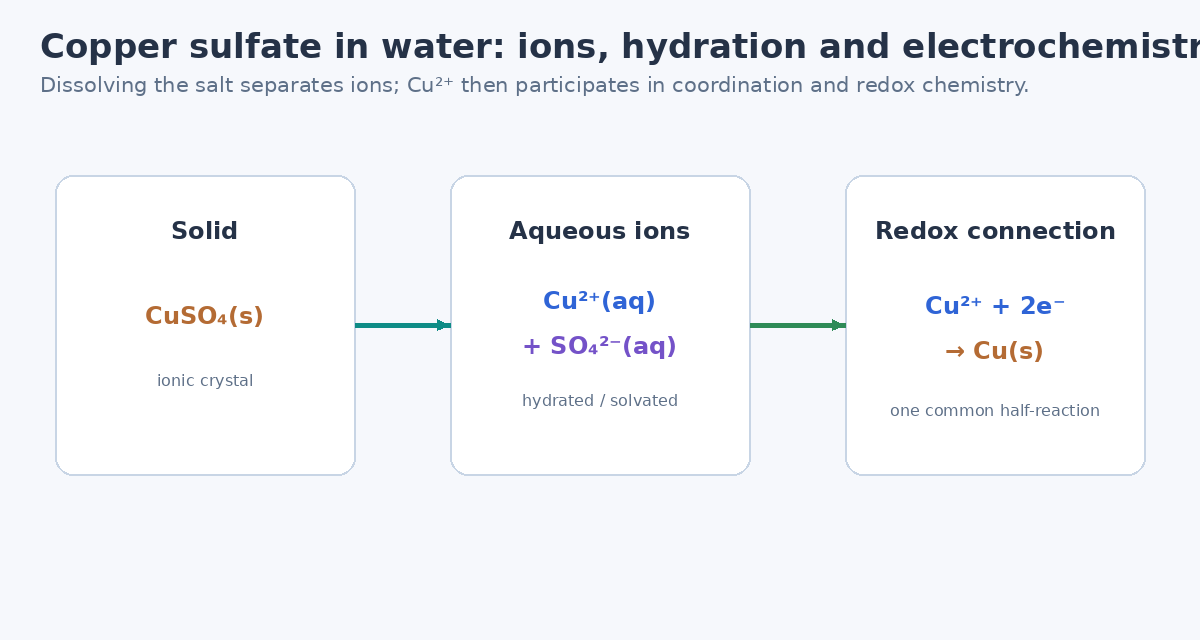
Idealized dissolution is written CuSO₄(s) → Cu²⁺(aq) + SO₄²⁻(aq). The Cu²⁺ ion can participate in the reduction half-reaction Cu²⁺ + 2e⁻ → Cu(s).
Electroplating and electrorefining use related chemistry, but real cell behavior depends on electrodes, current density, complexation, mass transfer and impurities — not just the half-equation.
Source: PubChem — Copper Sulfate
Worked examples
5H₂O ≈ 5 × 18.015 = 90.075 g/mol; total ≈ 159.61 + 90.075 = 249.69 g/mol
About 36.1% of the pentahydrate formula mass is water by this calculation.
Cu²⁺ + SO₄²⁻ gives +2 + (−2) = 0, so the lowest whole-number ratio is 1:1
Formula units are written in the lowest neutral ionic ratio.
Related compounds
Sources & evidence Reference sources Open the evidence and reference list used for this compound page.
Compound pages separate formula interpretation from reference data and from contextual explanation. Check the linked source when a value or condition matters to your work.
- PubChem — Copper Sulfate — Anhydrous identity, molecular weight and safety/property context.
- PubChem — Copper Sulfate Pentahydrate — Pentahydrate formula, mass, blue appearance and dehydration data.
- OpenStax Chemistry 2e — Ionic Hydrates — Hydrate naming and dot-formula conventions.
- Chemistry LibreTexts — Bonding in Coordination Complexes — Copper sulfate hydrate and coordination-color teaching context.
Found an error, something unclear, or a missing topic?
Tell us what you noticed. Feedback goes to a private review queue and is never published automatically.