

Nitric Acid HNO3
Nitric acid is HNO₃, a strong monoprotic oxoacid of nitrogen. In water it ionizes essentially completely in ordinary general-chemistry treatment, forming hydronium and nitrate. Nitric acid is also a strong oxidizing reagent, so its chemistry with metals cannot be reduced to the usual “acid gives hydrogen gas” rule.
What does HNO3 mean?
HNO₃ contains one H, one N and three O atoms per molecule. The conventional Lewis structure places H on an oxygen (an –OH group), with nitrogen bonded to three oxygens. Resonance exchanges the N=O and N–O⁻ character between the two non-OH oxygens.
Once you can count every element correctly, the same formula becomes the basis for formula mass and molar mass.
What kind of chemical substance is it?
Nitric acid is a covalent molecular oxoacid. In a common Lewis description, nitrogen is formally positive and one terminal non-OH oxygen is negative in each resonance contributor. The real electron distribution is a resonance hybrid, not a molecule switching between two fixed drawings.
Why does Nitric Acid behave this way?
The O–H group supplies the acidic proton, while nitrogen is at oxidation state +5 in nitrate/nitric acid. As a result, HNO₃ can participate in ordinary acid–base neutralization and also in redox chemistry where nitrogen-containing products depend on concentration, reactant and conditions.
What is the formula of nitric acid?
HNO₃.
Is nitric acid a strong acid?
Yes. Standard general-chemistry tables classify HNO₃ among the common strong acids, meaning aqueous ionization is treated as essentially complete at ordinary dilute concentrations.
What is the Lewis structure of nitric acid?
H is bonded to oxygen, not directly to nitrogen. A common Lewis model is HO–N(=O)–O with N⁺/O⁻ formal charges and resonance between the two non-OH oxygen positions.
Why is nitric acid an oxidizing acid?
Nitrogen is at the high oxidation state +5. In reactions with suitable reducing agents, nitrate/nitric-acid nitrogen can be reduced to lower oxidation-state products such as nitrogen oxides.
Why does nitric acid not always produce H₂ with metals?
Because nitrate/nitric acid can itself be reduced. OpenStax notes that metal reactions commonly produce nitrogen oxides instead of simple H₂ evolution, with products depending on acid concentration, metal and temperature.
What is the Ostwald process?
It is the industrial route that oxidizes ammonia to NO, then NO to NO₂, followed by absorption/oxidation chemistry to form nitric acid.
What is the molar mass of HNO₃?
NIST lists molecular weight 63.0128 g/mol.
Key properties and classification
Why this compound matters: Nitric acid links Lewis resonance, strong-acid chemistry, redox reactions, nitrogen oxides, nitrate salts and industrial process chemistry. It is a particularly good case where a simple acid–metal rule fails because oxidation-reduction chemistry takes over.
Where does Nitric Acid appear in chemical equations?
These equations are included to connect the compound to chemistry concepts and stoichiometry. They are not laboratory procedures.
Strong-acid treatment for ordinary aqueous general chemistry.
Monoprotic acid gives 1:1 stoichiometry with NaOH.
One stage in the industrial sequence; this is chemistry context, not operating instructions.
Safety depends on form, concentration and situation
Nitric acid is highly corrosive and a strong oxidizer. Concentrated solutions can react dangerously with many organic or reducing materials and can release toxic nitrogen oxides. This page intentionally avoids preparation, concentration, mixing or handling procedures.
Study the chemistry, not just the topic names
Nitric acid is easiest to understand when acid–base and redox roles are kept distinct. Structure explains the acidic O–H bond and nitrate resonance, while oxidation-state analysis explains why many reactions produce nitrogen oxides rather than H₂.
Core chemistry Lewis structure and resonance: H is on O, not on N Two major resonance contributors exchange N=O / N–O⁻ character between the non-OH oxygens.
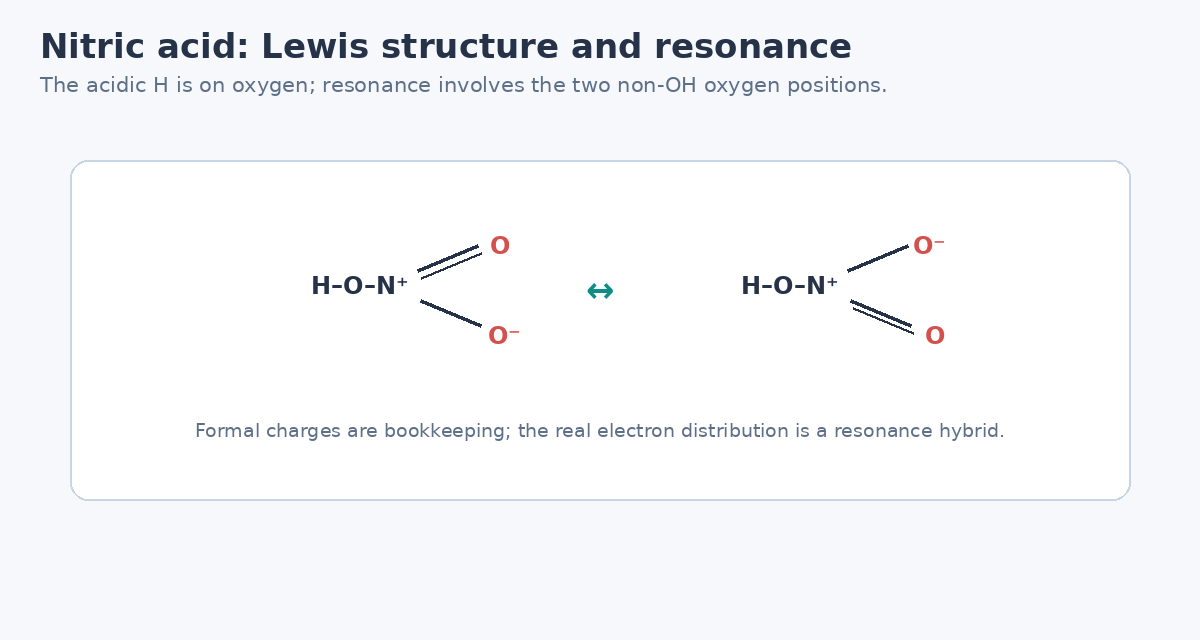
OpenStax shows nitric acid with an H–O–N framework. In each common Lewis contributor, nitrogen carries a formal +1 charge and one terminal oxygen carries −1.
The two non-OH oxygens are linked by resonance, so the real bonding is delocalized. Formal charge is a model for electron accounting, not a complete charge-density map.
Acid–base chemistry Strong acid means extensive ionization, not “high concentration” HNO₃ is classified as a strong acid; concentration is a separate property.
OpenStax lists HNO₃ among the common strong acids. In dilute aqueous treatment, HNO₃ + H₂O → H₃O⁺ + NO₃⁻ is written with a forward arrow because ionization is essentially complete.
A concentrated nitric-acid solution is a different solvent environment from a dilute one. “Strong” describes acid ionization; “concentrated” describes composition.
Source: OpenStax Chemistry 2e — Relative Strengths of Acids and Bases
Redox chemistry Nitric acid is also an oxidizing agent — nitrogen starts at +5 Acid-base and oxidizing behavior come from different parts of the chemistry.
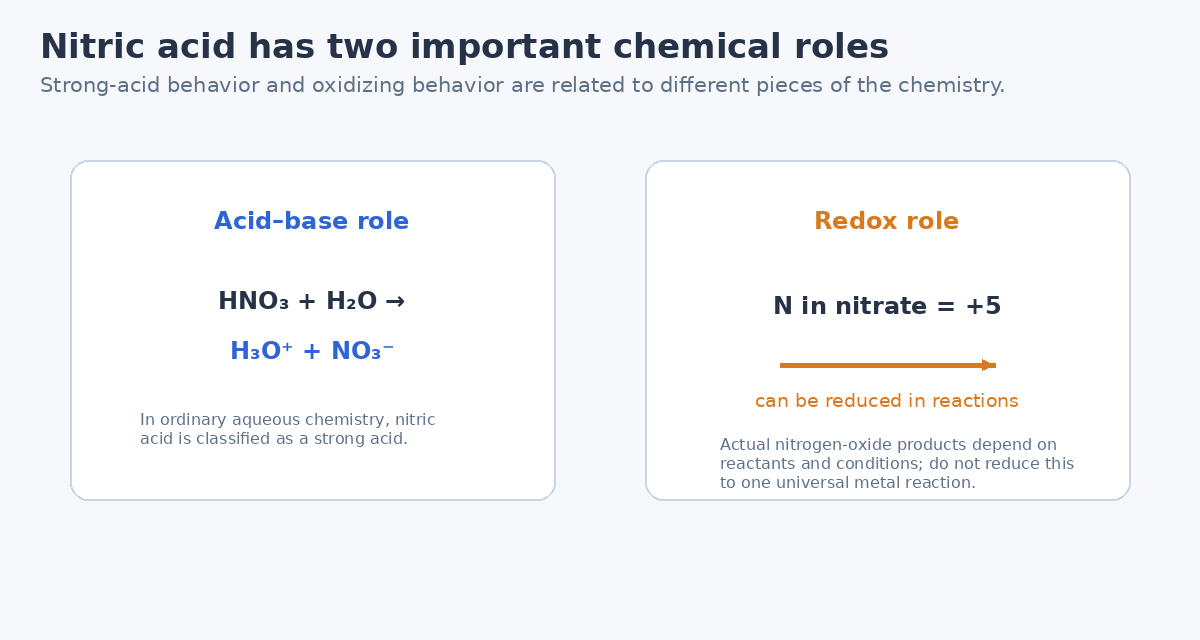
In HNO₃/NO₃⁻, nitrogen has oxidation state +5. Suitable reducing agents can therefore reduce nitrogen to lower oxidation states.
OpenStax notes that reactions with metals often generate nitrogen oxides rather than hydrogen gas, and that products depend on acid concentration, metal activity and temperature. That is why one universal acid–metal equation is misleading here.
Industrial chemistry Ostwald process: NH₃ → NO → NO₂ → HNO₃ Industrial nitric acid is produced by staged oxidation/absorption chemistry.

OpenStax summarizes the commercial sequence as oxidation of ammonia to NO, oxidation of NO to NO₂, and further oxidation/hydration/absorption chemistry to nitric acid.
The process is an excellent example of coupling kinetics, catalysis, gas-phase oxidation and mass transfer. The diagram shows only the reaction sequence, not plant conditions.
University / atmospheric Nitrate and nitrogen oxides form a connected redox family HNO₃ chemistry connects NOx oxidation, nitrate salts and atmospheric deposition.
Nitrogen can occupy many oxidation states, so NO, NO₂, nitrate and other nitrogen species interconvert under different redox conditions. HNO₃ is the highly oxidized acid endpoint in many NOx oxidation pathways.
In atmospheric and process chemistry, concentration alone is not enough: photochemistry, oxidants, water, surfaces and gas–liquid transfer can all control speciation.
Worked examples
H = +1, each O = −2: +1 + x + 3(−2) = 0 → x = +5
Oxidation state is electron-bookkeeping, not literal atomic charge.
HNO₃ + NaOH → NaNO₃ + H₂O; ratio 1:1 → 0.075 mol NaOH
Ideal stoichiometric neutralization.
Related compounds
Sources & evidence Reference sources Open the evidence and reference list used for this compound page.
Compound pages separate formula interpretation from reference data and from contextual explanation. Check the linked source when a value or condition matters to your work.
- NIST Chemistry WebBook — Nitric Acid — Identity, molecular weight, phase, thermochemistry and spectroscopy.
- OpenStax Chemistry 2e — Compounds of Oxygen / Nitric Acid — Nitric-acid resonance, oxidizing behavior and Ostwald process.
- OpenStax Chemistry 2e — Relative Strengths of Acids and Bases — HNO₃ classification as a strong acid.
Found an error, something unclear, or a missing topic?
Tell us what you noticed. Feedback goes to a private review queue and is never published automatically.