

Acetic Acid C2H4O2
Acetic acid, also called ethanoic acid, has molecular formula C₂H₄O₂ and is commonly written structurally as CH₃COOH. It is a weak carboxylic acid: in water it establishes an equilibrium with acetate and hydronium rather than ionizing essentially completely like HCl.
What does C2H4O2 mean?
C₂H₄O₂ tells only the atom count. CH₃COOH shows the connectivity and reveals the –COOH carboxyl group. The empirical formula is CH₂O, demonstrating why empirical and molecular formulas cannot by themselves identify the functional group.
Once you can count every element correctly, the same formula becomes the basis for formula mass and molar mass.
What kind of chemical substance is it?
Acetic acid is a covalent molecular compound containing a methyl group attached to a carboxyl group. The carboxyl carbon is approximately trigonal planar. The molecule can donate an O–H proton, and its conjugate base acetate is resonance-stabilized by delocalization over two oxygens.
Why does Acetic Acid behave this way?
The carbonyl oxygen withdraws electron density while the O–H bond provides an acidic proton. After deprotonation, the acetate ion spreads negative charge over two oxygens. Acetic-acid molecules also hydrogen-bond strongly with one another, so structure explains both acid–base behavior and physical properties.
What is the formula of acetic acid?
The molecular formula is C₂H₄O₂. The condensed structural formula CH₃COOH is usually more informative because it shows the carboxyl group.
Is acetic acid a strong acid?
No. It is a weak acid. OpenStax gives Ka ≈ 1.75 × 10⁻⁵ at 25 °C, corresponding to pKa ≈ 4.76.
Is vinegar the same as acetic acid?
Vinegar is an aqueous food mixture that contains acetic acid plus water and other components. Pure or nearly pure acetic acid is not the same material as household vinegar.
Why is pure acetic acid called glacial acetic acid?
Nearly pure acetic acid freezes around 16.6 °C, so it can form ice-like crystals in a cool room. The historical name “glacial” comes from that behavior.
Why is acetate more stable than a localized negative oxygen ion?
In acetate, the negative charge is delocalized over two equivalent oxygens through resonance. This stabilizes the conjugate base and helps explain the acidity of carboxylic acids.
What is the boiling point of acetic acid?
NIST evaluates a normal boiling point near 391.2 K, about 118.1 °C, at approximately 1 atm. Boiling temperature changes with pressure.
What is glacial acetic acid?
The term refers to highly concentrated/nearly water-free acetic acid, not a stronger acid species. Concentration and acid strength are different concepts.
Key properties and classification
Why this compound matters: Acetic acid is one of the best bridges between general and organic chemistry: formula interpretation, weak-acid equilibria, resonance, hydrogen bonding, functional groups, concentration effects and ester chemistry all meet in one familiar molecule.
Where does Acetic Acid appear in chemical equations?
These equations are included to connect the compound to chemistry concepts and stoichiometry. They are not laboratory procedures.
Equilibrium lies strongly toward molecular acetic acid in moderately acidic solutions.
One acidic proton gives 1:1 neutralization stoichiometry with NaOH.
Conceptual reversible esterification connecting acetic acid to ethanol; equilibrium and rate depend on conditions.
Safety depends on form, concentration and situation
Dilute food-grade vinegar and concentrated/glacial acetic acid are not interchangeable safety contexts. Concentrated acetic acid is corrosive and its vapor can be irritating; it is also combustible. This page is for chemistry education, not preparation or handling instructions.
Study the chemistry, not just the topic names
Acetic acid is a compact model for the structure–reactivity logic of carboxylic acids. The key is to connect the carboxyl group to conjugate-base resonance, hydrogen bonding and concentration-dependent physical behavior.
Core chemistry Molecular formula versus structural formula: why CH₃COOH tells you more C₂H₄O₂ counts atoms; CH₃COOH reveals the carboxyl functional group.

The molecular formula C₂H₄O₂ does not show which oxygen is carbonyl O and which is hydroxyl O. The structural formula CH₃–C(=O)–OH exposes the chemistry directly.
The empirical formula CH₂O is even less specific: other compounds can share that simplest ratio. Chemical identity therefore depends on connectivity, not just composition.
Acid–base chemistry Weak-acid equilibrium and acetate resonance pKa ≈ 4.76 at 25 °C, and the conjugate base is resonance-stabilized.

OpenStax gives Ka = 1.75 × 10⁻⁵ at 25 °C, so pKa ≈ 4.76. That means acetic acid ionizes only partially in water under typical dilute-solution conditions.
After deprotonation, acetate has two equivalent resonance contributors. Delocalization of negative charge over both oxygens stabilizes the conjugate base relative to a localized alkoxide-like anion.
Source: OpenStax Organic Chemistry — Carboxylic Acid Properties
Intermolecular forces Hydrogen-bonded association raises boiling point and supports dimer formation Carboxylic-acid molecules can associate through two O–H···O=C hydrogen bonds.
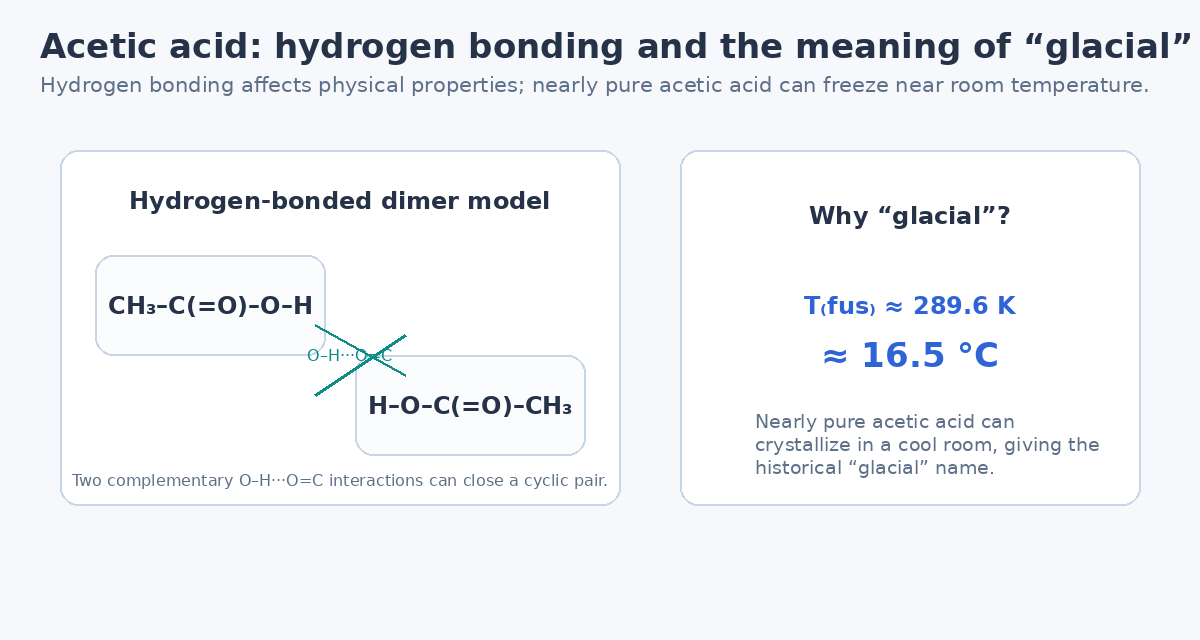
Acetic acid contains both a hydrogen-bond donor (O–H) and a strong acceptor (carbonyl O). Carboxylic acids commonly form cyclic hydrogen-bonded dimers, especially in less polar environments and the vapor/condensed phases.
These intermolecular forces help explain why the boiling point is high for such a small molecule.
Source: OpenStax Organic Chemistry — Structure and Properties of Carboxylic Acids
Physical chemistry “Glacial” describes composition/phase behavior, not acid strength Nearly pure acetic acid freezes around 16.5 °C and boils near 118.1 °C at 1 atm.
NIST evaluates a fusion temperature near 289.6 K and normal boiling point near 391.2 K. The relatively high fusion point explains why concentrated acetic acid can crystallize in a cool room.
Calling the material “glacial” says nothing about a new acid species. It mainly distinguishes concentrated/nearly water-free acetic acid from dilute aqueous solutions such as vinegar.
Organic / applied chemistry Acetate chemistry connects acids, salts, esters and solvents The same carboxyl carbon participates in neutralization and carbonyl-substitution chemistry.
Neutralization gives acetate salts, while reaction with alcohols can establish esterification equilibria. With ethanol, the product is ethyl acetate plus water.
Industrial chemistry also uses acetic acid as a feedstock for acetate esters and other derivatives. A balanced equation identifies stoichiometry, but reaction rate, equilibrium and separation still require conditions and process design.
Source: OpenStax Organic Chemistry — Carboxylic Acids and Derivatives
Worked examples
[H+] ≈ √(KaC) = √(1.75×10⁻⁵ × 0.100) ≈ 1.32×10⁻³ M; pH ≈ 2.88
Ideal dilute-solution approximation; activity corrections are neglected.
CH₃COOH + NaOH → CH₃COONa + H₂O; ratio 1:1 → 0.050 mol NaOH
Assumes complete stoichiometric neutralization.
Related compounds
Sources & evidence Reference sources Open the evidence and reference list used for this compound page.
Compound pages separate formula interpretation from reference data and from contextual explanation. Check the linked source when a value or condition matters to your work.
- NIST Chemistry WebBook — Acetic Acid — Identity, molecular weight, phase and thermochemical data.
- OpenStax Organic Chemistry — Structure and Properties of Carboxylic Acids — pKa, structure, hydrogen bonding and dimerization.
- OpenStax Chemistry — Chemical Formulas — Acetic-acid molecular, empirical and structural formula example.
Found an error, something unclear, or a missing topic?
Tell us what you noticed. Feedback goes to a private review queue and is never published automatically.