

Carbon Monoxide CO
Carbon monoxide is CO, a neutral diatomic molecule containing one carbon atom and one oxygen atom. Its familiar Lewis structure has a C≡O triple bond with one lone pair on each atom and formal charges C⁻ and O⁺. CO is a very different substance from carbon dioxide, CO₂.
What does CO mean?
CO contains one carbon and one oxygen atom per molecule. Because it is a two-atom molecule, its molecular geometry is necessarily linear. The formula should never be confused with Co, the symbol for the element cobalt, or with CO₂, carbon dioxide.
Once you can count every element correctly, the same formula becomes the basis for formula mass and molar mass.
What kind of chemical substance is it?
Carbon monoxide is a covalent diatomic molecule. The octet Lewis structure is commonly written :C≡O:, with one lone pair on each atom. Formal-charge bookkeeping gives carbon −1 and oxygen +1. Those formal charges are a Lewis-model accounting device, not a statement that the real molecule is simply C⁻ next to O⁺.
Why does Carbon Monoxide behave this way?
The triple-bond Lewis structure satisfies both octets but produces formal charges that look counterintuitive. Real electron density is described more completely by molecular-orbital ideas. That same electronic structure helps explain CO’s strong bond, small dipole and ability to bind transition metals through carbon.
What is the Lewis structure of carbon monoxide?
A standard octet Lewis structure is :C≡O:, with one lone pair on carbon and one lone pair on oxygen. Formal charges are −1 on carbon and +1 on oxygen, while the molecule as a whole is neutral.
Is carbon monoxide polar?
Yes, but only weakly. CO is a heteronuclear diatomic molecule, so it has a small dipole moment. A simple electronegativity-only picture does not capture the full electron distribution.
Why does CO have a triple bond?
CO has 10 valence electrons. A triple bond plus one lone pair on each atom gives both carbon and oxygen an octet in the conventional Lewis model.
What is the difference between CO and CO₂?
CO has one oxygen and is a diatomic molecule; CO₂ has two oxygens and is a linear three-atom molecule. Their electron counts, bonding, redox behavior, physical properties and hazards are different.
What is the molar mass of carbon monoxide?
Using standard atomic weights, the molar mass is about 28.0101 g/mol.
How can carbon monoxide form in combustion?
CO can appear when carbon-containing fuels are oxidized without enough oxygen or with incomplete mixing/reaction. Real combustion products depend on fuel, temperature, mixing and residence time.
Why can CO bind to transition metals?
CO can donate electron density from a carbon-centered lone-pair-type orbital to a metal and accept electron density back into antibonding orbitals. This synergic σ-donation/π-back-bonding model is central to metal carbonyl chemistry.
Go deeper on the questions students search
These lessons expand one important question without duplicating the compound reference page.
Key properties and classification
Why this compound matters: Carbon monoxide connects Lewis structures, formal charge, molecular polarity, combustion, redox chemistry and transition-metal coordination. Its strong low-difficulty search interest around Lewis structure also makes it a valuable teaching page rather than only a safety definition.
Where does Carbon Monoxide appear in chemical equations?
These equations are included to connect the compound to chemistry concepts and stoichiometry. They are not laboratory procedures.
Idealized oxidation stoichiometry. Real combustion systems can contain mixed products.
A major industrial equilibrium used in synthesis-gas processing; position depends on temperature, composition and catalyst system.
Generic coordination notation only; actual metal carbonyl stoichiometry and bonding depend on the metal complex.
Safety depends on form, concentration and situation
Carbon monoxide is a colorless, odorless, highly toxic gas. It can accumulate when combustion is incomplete and cannot be detected reliably by human senses. This page explains molecular and combustion chemistry; it is not medical advice or an exposure-response guide.
Study the chemistry, not just the topic names
CO is small enough to look elementary but electronically rich enough to introduce formal charge, molecular orbitals, combustion chemistry and organometallic bonding. The modules below deliberately separate Lewis bookkeeping from measurable molecular behavior.
Core chemistry Lewis structure: triple bond, lone pairs and formal charges The octet structure is :C≡O: with C −1 and O +1 formal charges.
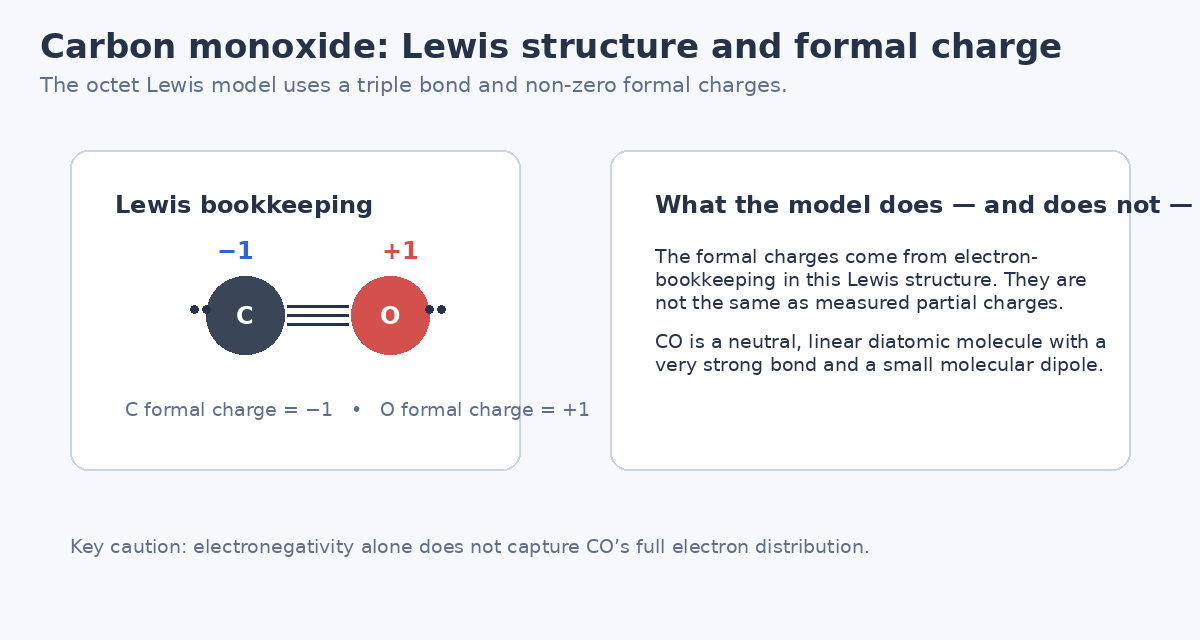
Carbon contributes four valence electrons and oxygen contributes six, for 10 valence electrons. A triple bond uses six; one lone pair on each atom uses the remaining four. Both atoms then have octets.
Formal-charge calculation gives C = −1 and O = +1. OpenStax emphasizes that formal charge is a bookkeeping construct, not the literal atomic charge distribution.
Core → university Polarity: a small dipole despite the simple electronegativity story CO is polar, but the measured dipole is small and electron distribution is not predicted well by one rule alone.
Because CO is heteronuclear, its bond can carry a dipole. OpenStax classifies CO as having a small dipole moment. The Lewis formal charges also remind us that electronegativity and formal charge answer different questions.
Molecular-orbital descriptions explain the electron distribution more realistically than treating the bond as a purely ionic C–O pair.
Source: OpenStax Chemistry — Molecular Structure and Polarity
Combustion chemistry CO formation is about reaction completeness, not one universal fuel equation Limited oxygen or incomplete oxidation can leave carbon at the CO oxidation level.

Complete oxidation of carbon in a fuel tends toward CO₂, while oxygen-limited or kinetically incomplete combustion can produce CO among other products. The exact mixture is controlled by fuel composition, oxygen availability, temperature and mixing.
Once formed, CO can be oxidized further: 2 CO + O₂ → 2 CO₂.
University / inorganic Why CO is a classic transition-metal ligand σ donation from CO and π back-donation from a metal can act together.
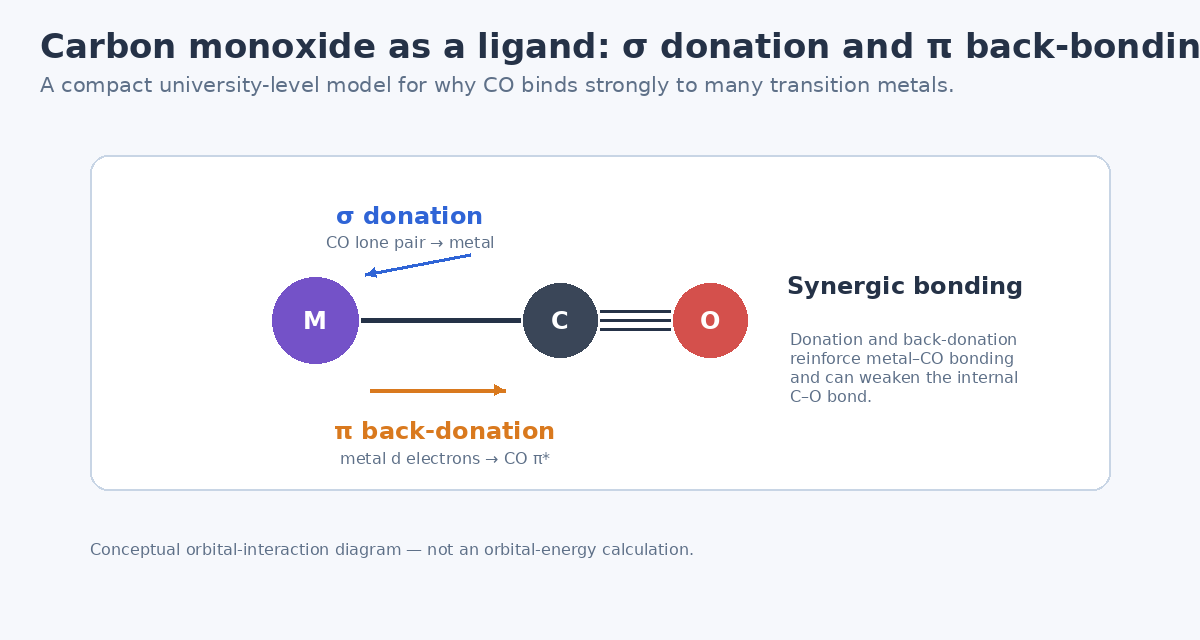
In the standard synergic-bonding model, CO donates electron density to a metal through carbon and can accept metal d-electron density into CO π* orbitals. The two interactions reinforce metal–CO bonding.
Back-bonding can also weaken the internal C–O bond, which is why vibrational spectroscopy is so informative in metal-carbonyl chemistry.
Engineering / process chemistry Synthesis gas and the water-gas shift connect CO to industrial hydrogen chemistry CO is a feed/intermediate in gas processing, but equilibrium and catalyst choice matter.
Mixtures of CO and H₂ are broadly called synthesis gas. One important equilibrium is CO + H₂O ⇌ CO₂ + H₂, used to adjust CO/H₂ composition in industrial gas processing.
Equilibrium conversion and rate are not the same thing: temperature, gas composition and catalyst system affect them differently. Industrial systems therefore rely on engineered reactors and gas-cleanup steps rather than a single balanced equation.
Source: NIST Chemistry WebBook — Carbon Monoxide thermochemistry
Worked examples
C: 4 − 2 lone-pair e⁻ − 3 bonds = −1; O: 6 − 2 lone-pair e⁻ − 3 bonds = +1
The charges sum to zero, matching the neutral molecule.
2 CO + O₂ → 2 CO₂; 2.50 × (1/2) = 1.25 mol O₂
Theoretical stoichiometry only.
Related compounds
Sources & evidence Reference sources Open the evidence and reference list used for this compound page.
Compound pages separate formula interpretation from reference data and from contextual explanation. Check the linked source when a value or condition matters to your work.
- NIST Chemistry WebBook — Carbon Monoxide — Identity, molecular weight, phase, thermochemistry and spectroscopy data.
- OpenStax Chemistry — Lewis Symbols and Structures — CO triple-bond Lewis representation.
- OpenStax Chemistry — Formal Charges and Resonance — Formal charges C −1 and O +1.
- OpenStax Chemistry — Molecular Structure and Polarity — Small dipole in heteronuclear CO.
Found an error, something unclear, or a missing topic?
Tell us what you noticed. Feedback goes to a private review queue and is never published automatically.