

Hydrogen Peroxide H2O2
Hydrogen peroxide is H₂O₂, a molecular peroxide with an O–O single bond. Its oxygen atoms have oxidation state −1—between oxygen in water (−2) and elemental O₂ (0)—which helps explain why H₂O₂ can participate in both oxidation and reduction chemistry and can disproportionate to water and oxygen.
What does H2O2 mean?
H₂O₂ contains two H and two O atoms, but connectivity matters: the structural skeleton is H–O–O–H. It is not simply “H₂O plus an extra oxygen.” The O–O peroxide bond is central to its chemistry.
Once you can count every element correctly, the same formula becomes the basis for formula mass and molar mass.
What kind of chemical substance is it?
H₂O₂ is a covalent molecule with an O–O single bond and two O–H bonds. Each oxygen also has two lone pairs in a simple Lewis description. The equilibrium molecular geometry is nonplanar/skewed around the O–O bond rather than a perfectly flat H–O–O–H chain.
Why does Hydrogen Peroxide behave this way?
Peroxide oxygen has oxidation state −1. That intermediate oxidation state means H₂O₂ can be reduced toward water (oxygen −2) or oxidized toward O₂ (oxygen 0). The same molecule can therefore act as an oxidant or reductant depending on reaction partner and conditions—and it can disproportionate so that some peroxide oxygen is oxidized while some is reduced.
What is the chemical formula of hydrogen peroxide?
H₂O₂. A more informative structural shorthand is H–O–O–H because it shows the oxygen–oxygen peroxide bond.
Is hydrogen peroxide an acid or a base?
It is a weak acid in water. PubChem reports pKa ≈ 11.62 for H₂O₂ ⇌ H⁺ + HOO⁻. Its acid–base behavior is much weaker than mineral acids such as HCl or H₂SO₄.
What is the oxidation state of oxygen in H₂O₂?
−1 for each oxygen. That is the defining peroxide oxidation state and differs from the usual −2 oxidation state of oxygen in water.
Why does hydrogen peroxide decompose?
The products water and oxygen are thermodynamically favorable, while the uncatalyzed reaction can still have a significant kinetic barrier. Light, heat, surfaces, enzymes or transition-metal species can change the rate by providing alternative pathways.
Does a catalyst change how much energy the reaction releases?
No. A catalyst changes the activation pathway and reaction rate; it does not change the energy difference between the same reactants and products.
Why can hydrogen peroxide act as both oxidizing and reducing agent?
Its oxygen is at intermediate oxidation state −1. H₂O₂ can accept electrons and be reduced toward H₂O, or donate electrons/be oxidized toward O₂, depending on the other reactant and medium.
Is household hydrogen peroxide the same as pure H₂O₂?
No. Consumer products are aqueous solutions with stated concentrations and stabilizers. Chemical properties and hazards depend strongly on concentration and formulation.
Key properties and classification
Why this compound matters: Hydrogen peroxide is an unusually compact bridge between Lewis structure, oxidation numbers, reaction kinetics, catalysis and redox chemistry. It is also an ideal comparison with water because one additional O atom changes bonding, oxidation state and chemical behavior dramatically.
Where does Hydrogen Peroxide appear in chemical equations?
These equations are included to connect the compound to chemistry concepts and stoichiometry. They are not laboratory procedures.
Some peroxide oxygen is reduced to water while some is oxidized to O₂. Catalysts change rate, not stoichiometry.
Only a small fraction is ionized near neutral pH because pKa is about 11.62.
One common redox bookkeeping form; actual reaction depends on medium and partner species.
Safety depends on form, concentration and situation
Hydrogen-peroxide hazards are strongly concentration-dependent. Higher-concentration solutions are powerful oxidizers and can be corrosive; decomposition can release heat and oxygen gas. This page intentionally avoids preparation or concentration procedures and treats consumer/industrial solutions as distinct contexts.
Study the chemistry, not just the topic names
Hydrogen peroxide becomes coherent when the peroxide bond and oxygen oxidation state are used as the organizing ideas. The modules below connect 3-D structure to acid–base behavior, disproportionation, catalysis and redox potential.
Core chemistry H–O–O–H: Lewis structure and nonplanar molecular geometry The O–O single bond is the defining structural feature, and the equilibrium molecule is skewed rather than perfectly planar.
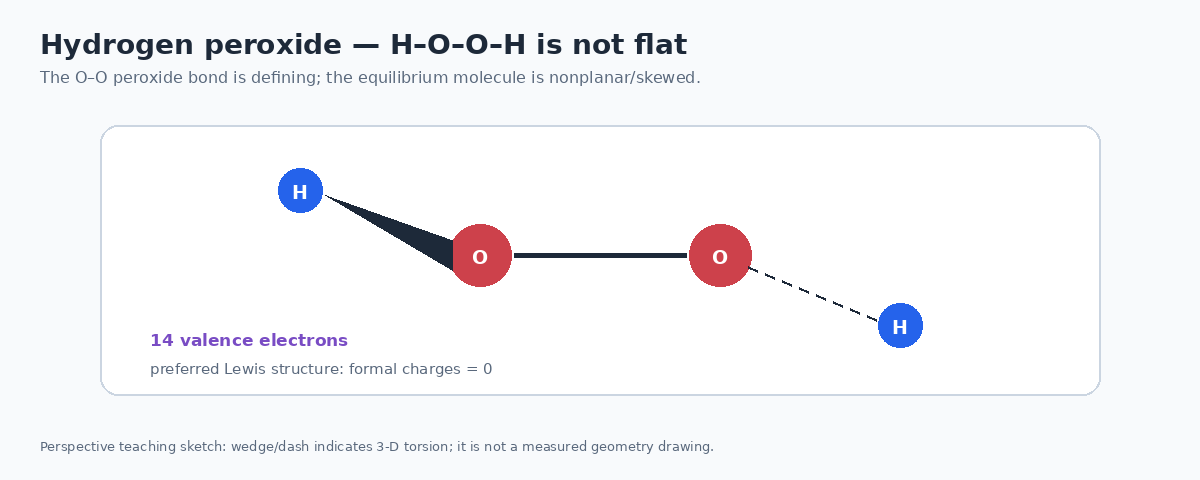
H₂O₂ has 14 valence electrons. A simple Lewis structure uses H–O–O–H connectivity, with two lone pairs on each oxygen. Formal charges are zero in that preferred structure.
The molecule is not best pictured as a rigid flat zigzag. Rotation/torsion around the O–O bond gives a nonplanar equilibrium geometry, so a perspective drawing communicates structure better than a flat line formula.
Source: PubChem — Hydrogen Peroxide
Core → university Peroxide oxygen is −1 — the midpoint that unlocks the redox chemistry O at −1 can move toward −2 in water or 0 in O₂.
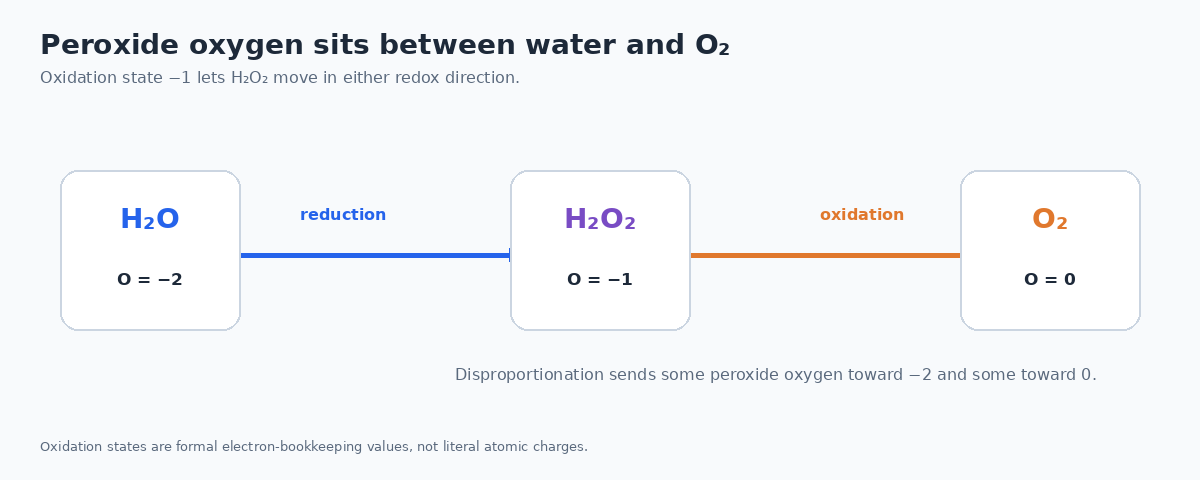
OpenStax lists oxygen as usually −2, but −1 in peroxides. In H₂O₂, hydrogen is +1, so the two oxygen atoms together must sum to −2 and each oxygen is assigned −1.
That intermediate state makes both directions possible: reduction of H₂O₂ toward water and oxidation of H₂O₂ toward O₂. Disproportionation combines both directions in one overall reaction.
Acid–base chemistry Hydrogen peroxide is a weak acid, not a strong mineral acid H₂O₂ can donate H⁺ to form hydroperoxide, HOO⁻, but only weakly in water.
PubChem reports pKa ≈ 11.62 for hydrogen peroxide. At neutral pH, therefore, most peroxide remains as H₂O₂ rather than HOO⁻.
That acid–base equilibrium matters because HOO⁻ can have different nucleophilicity/reactivity from neutral H₂O₂. It also shows why a product’s measured pH cannot be inferred from the formula alone; formulation and concentration matter.
Kinetics Catalysts accelerate decomposition without changing the overall thermodynamics Alternative pathways lower activation energy while reactant/product energy difference stays the same.

The decomposition 2 H₂O₂ → 2 H₂O + O₂ is thermodynamically favorable, but rate depends on the activation barrier. Catalytic surfaces, metal ions or enzymes such as catalase can provide lower-barrier pathways.
A catalyst does not change the balanced equation or the energy difference between initial and final states. It changes how quickly the system can reach products.
Source: NIST Chemistry WebBook — Hydrogen Peroxide reaction data
University / applied chemistry Oxidant, reductant and industrial reagent — context decides the role Redox behavior depends on reaction partner, pH, catalysts and concentration.
Hydrogen peroxide is widely described as an oxidizing agent, but it can also be oxidized to O₂ and therefore act as a reducing agent in suitable redox couples. In practical chemistry, kinetics and catalysis are often as important as formal electrode potentials.
Industrial H₂O₂ is used in bleaching, chemical synthesis and treatment processes. The page keeps manufacturing and application discussion at high level because concentrated peroxide requires specialized materials, contamination control and safety engineering.
Source: PubChem — Hydrogen Peroxide
Worked examples
2(+1 for H) + 2(x for O) = 0 → 2 + 2x = 0 → x = −1
Peroxide oxygen is −1, not the usual −2.
2 H₂O₂ → 2 H₂O + O₂; 0.500 mol H₂O₂ × (1 mol O₂ / 2 mol H₂O₂) = 0.250 mol O₂
Theoretical stoichiometry only; it is not a decomposition procedure.
Related compounds
Sources & evidence Reference sources Open the evidence and reference list used for this compound page.
Compound pages separate formula interpretation from reference data and from contextual explanation. Check the linked source when a value or condition matters to your work.
- PubChem — Hydrogen Peroxide — Identity, structure, molecular weight, pKa, physical and safety data.
- NIST Chemistry WebBook — Hydrogen Peroxide — Thermochemistry, phase, spectroscopy and reaction reference data.
- OpenStax Chemistry — Oxidation-number rules — Peroxide oxygen oxidation state −1.
Found an error, something unclear, or a missing topic?
Tell us what you noticed. Feedback goes to a private review queue and is never published automatically.