

Methane CH4
Methane is CH₄, the simplest hydrocarbon. One carbon atom forms four C–H bonds in a tetrahedral arrangement. The symmetric geometry gives the molecule no permanent dipole and provides a clean starting point for learning carbon valence, combustion and hydrocarbon chemistry.
What does CH4 mean?
CH₄ contains one carbon and four hydrogen atoms per molecule. It is a molecular formula for one discrete methane molecule; natural gas is a mixture and is not chemically identical to pure CH₄.
Once you can count every element correctly, the same formula becomes the basis for formula mass and molar mass.
What kind of chemical substance is it?
Carbon forms four equivalent σ bonds to hydrogen in a tetrahedral molecular geometry. Four bonding electron domains and no lone pairs arrange symmetrically around carbon, giving H–C–H angles close to 109.5°. That symmetry also makes the net molecular dipole zero.
Why does Methane behave this way?
The useful chain is: four carbon valence electrons → four C–H bonds → tetrahedral symmetry → nonpolar molecule. From there, the balanced combustion equation connects one CH₄ molecule to oxygen demand, CO₂ production and energy release, while industrial reforming connects the same molecule to hydrogen and syngas chemistry.
Why is methane tetrahedral rather than flat?
Carbon has four bonding electron domains and no lone pairs in CH₄. Four equivalent domains spread out in three dimensions to minimize repulsion, giving tetrahedral geometry and angles close to 109.5°.
Why is CH₄ nonpolar?
The four C–H bonds are arranged symmetrically in a tetrahedron. Any small bond-dipole contributions cancel as vectors, so methane has no permanent net molecular dipole.
Is methane the same thing as natural gas?
No. Methane is the pure compound CH₄. Natural gas is a mixture in which methane is normally the principal component, with other hydrocarbons and non-hydrocarbon gases varying by source and processing.
What is complete combustion of methane?
With sufficient oxygen and appropriate mixing, the ideal overall equation is CH₄ + 2O₂ → CO₂ + 2H₂O. The equation gives the stoichiometric oxygen requirement and product ratios.
What changes when oxygen is insufficient?
Real oxygen-limited combustion can produce mixtures containing carbon monoxide, carbon dioxide, water, unburned hydrocarbons and soot. “Incomplete combustion” is therefore not one single universal equation; product distribution depends on mixing, temperature and kinetics.
How much CO₂ can one mole of methane produce in complete combustion?
The balanced equation has a 1:1 CH₄:CO₂ mole ratio. One mole of CH₄ can therefore form one mole of CO₂, about 44.01 g, if combustion goes completely to CO₂.
Why is methane used to make hydrogen?
Methane can react with steam at high temperature over catalysts to form CO and H₂. A subsequent water–gas shift reaction converts CO plus more steam to CO₂ and additional H₂. Industrial plants then separate and purify the gas mixture.
Go deeper on the questions students search
These lessons expand one important question without duplicating the compound reference page.
Key properties and classification
Why this compound matters: Methane connects molecular geometry to organic chemistry, fuels, combustion stoichiometry, industrial hydrogen, natural-gas processing, atmospheric chemistry and process safety. It is also the simplest compound for understanding carbon’s common four-bond valence pattern.
Where does Methane appear in chemical equations?
These equations are included to connect the compound to chemistry concepts and stoichiometry. They are not laboratory procedures.
The ideal complete-combustion equation; real flames require adequate mixing and oxygen.
One simplified stoichiometric representation. Real oxygen-limited combustion can produce mixed products and soot.
Industrial hydrogen/syngas chemistry; operation requires high temperature, catalysts and engineered equipment.
Often follows reforming to increase hydrogen yield.
Safety depends on form, concentration and situation
Methane is highly flammable, can form explosive mixtures with air, and can displace oxygen in confined spaces. Fuel-gas systems also involve pressure, ignition-control and ventilation hazards. The equations here explain chemistry; they are not instructions for generating, storing or igniting methane.
Study the chemistry, not just the topic names
Methane is a simple molecule with unusually broad consequences. The modules below connect its tetrahedral electronic structure to combustion stoichiometry, industrial hydrogen and atmospheric behavior without treating natural gas, combustion products or climate metrics as though they were the molecule itself.
Core chemistry Lewis structure and tetrahedral geometry — why the flat drawing is misleading Four bonding domains point toward the corners of a tetrahedron, not the corners of a flat square.

- Count valence electrons: carbon contributes 4 and four hydrogens contribute 4, giving 8 total.
- Make four C–H bonds: all 8 electrons are used as four shared pairs.
- Check the shells: each H has a duet and carbon has an octet.
- Check formal charge: the preferred Lewis structure has formal charge 0 on every atom.
- Apply VSEPR: four bonding domains and no lone pairs arrange tetrahedrally, giving H–C–H angles near 109.5°.
A flat structural formula is only a drawing convention; the equilibrium molecule is three-dimensional.
Core chemistry Symmetry explains why methane has no permanent dipole Four equivalent bond directions make CH₄ a useful counterexample to the idea that bond polarity alone decides molecular polarity.
The C–H bonds have only modest bond polarity, but the more important molecular idea is symmetry. In a perfect tetrahedral arrangement, the four bond-direction vectors sum to zero. Methane therefore has no permanent molecular dipole.
This is the same vector principle used for linear CO₂, but with tetrahedral rather than linear symmetry. Comparing CH₄, CO₂, NH₃ and H₂O is a powerful way to learn how molecular shape controls polarity.
Source: OpenStax Chemistry 2e — Molecular Structure and Polarity
Stoichiometry / combustion Complete versus oxygen-limited combustion A balanced complete-combustion equation gives exact ratios; real oxygen-limited flames can produce a mixture rather than one neat product set.

For ideal complete combustion, CH₄ + 2O₂ → CO₂ + 2H₂O. This tells us that 1 mol CH₄ requires 2 mol O₂ and can form 1 mol CO₂.
If oxygen supply or mixing is inadequate, oxidation may stop short of CO₂. Carbon monoxide, soot, unburned hydrocarbons and CO₂ can coexist. A textbook “incomplete-combustion equation” is therefore a simplified limiting case, while real product distributions are governed by mixing, temperature and reaction kinetics.
University / engineering Steam reforming turns methane into syngas and hydrogen Methane can be converted with steam to CO + H₂, followed by water–gas shift to make additional H₂.
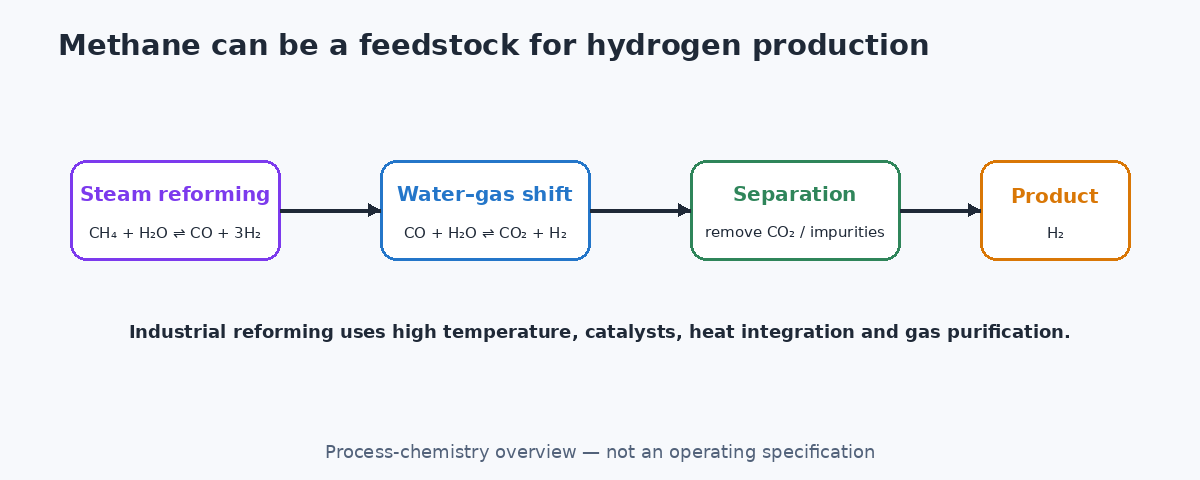
The core steam-reforming reaction is CH₄ + H₂O ⇌ CO + 3H₂. It is an endothermic high-temperature process and is carried out industrially with catalysts. The carbon monoxide can then participate in the water–gas shift: CO + H₂O ⇌ CO₂ + H₂.
After reaction, industrial systems separate CO₂ and other impurities to obtain a hydrogen-rich product. The chemistry is simple to write but the real process depends on heat integration, catalyst performance, equilibrium, reactor design and gas purification.
Atmospheric chemistry Methane the molecule is not the same thing as natural gas or an emissions inventory Chemical identity, fuel composition and climate accounting answer different questions and should not be mixed together.
Pure methane is CH₄. Natural gas is a mixture in which methane is normally the principal component, along with varying amounts of other hydrocarbons and gases. Biogas is another mixture and often contains substantial CO₂ as well as methane.
Atmospheric methane is also a greenhouse gas. EPA notes that methane is emitted from energy systems, agriculture, waste and natural sources and that it is more effective per unit mass than CO₂ at trapping heat over a 100-year comparison period. Those climate metrics describe atmospheric impact, not a change in methane’s molecular formula.
Source: US EPA — Methane Emissions
Worked examples
1.00 mol CH₄ × (2 mol O₂ / 1 mol CH₄) = 2.00 mol O₂; 2.00 × 32.00 g/mol = 64.0 g O₂
The balanced equation sets the ideal stoichiometric oxygen demand.
1000 g / 16.043 g/mol = 62.33 mol CH₄ → 62.33 mol CO₂ × 44.0095 g/mol ≈ 2743 g CO₂
The product contains oxygen taken from O₂, so the CO₂ mass can exceed the original methane mass.
Related compounds
Sources & evidence Reference sources Open the evidence and reference list used for this compound page.
Compound pages separate formula interpretation from reference data and from contextual explanation. Check the linked source when a value or condition matters to your work.
- PubChem — Methane — Identity, formula, molecular weight and hazard/reference information.
- NIST Chemistry WebBook — Methane — Thermochemistry, phase and reaction reference data.
- OpenStax Biology 2e — Carbon — Tetrahedral geometry of methane and hydrocarbon context.
- U.S. Department of Energy — Natural Gas Reforming — Steam-methane reforming and water–gas shift overview.
- US EPA — Methane Emissions — Atmospheric methane, sources and greenhouse-gas context.
Found an error, something unclear, or a missing topic?
Tell us what you noticed. Feedback goes to a private review queue and is never published automatically.