

Ammonia NH3
Ammonia is NH₃, a polar molecular compound with three N–H bonds and one lone pair on nitrogen. Those four electron domains give a trigonal-pyramidal molecule, and the lone pair is the key to both its shape and its ability to act as a Brønsted and Lewis base.
What does NH3 mean?
NH₃ contains one N and three H atoms. The subscript 3 applies to H only. NH₃ is neutral ammonia; NH₄⁺ is the ammonium ion and is a different chemical species.
Once you can count every element correctly, the same formula becomes the basis for formula mass and molar mass.
What kind of chemical substance is it?
NH₃ contains three N–H covalent bonds and one lone pair on nitrogen. Four electron domains around N give an approximately tetrahedral electron-domain arrangement; because one domain is a lone pair, the molecular geometry is trigonal pyramidal, with an H–N–H angle close to 107°.
Why does Ammonia behave this way?
The nitrogen lone pair is not a decorative pair of dots. It helps make NH₃ trigonal pyramidal, contributes to a permanent molecular dipole, accepts a proton to form NH₄⁺, and can donate electron density to Lewis acids/metal centers. Following that one electron pair turns several “facts” into one coherent model.
Why is NH₃ trigonal pyramidal instead of trigonal planar?
Nitrogen has four electron domains in NH₃: three N–H bonds and one lone pair. The electron-domain geometry is approximately tetrahedral, but molecular shape counts only atom positions, giving a trigonal-pyramidal molecule with an angle around 107°.
Why is ammonia a base even though its formula contains no OH?
A Brønsted base does not need OH in its formula; it needs to accept a proton. The nitrogen lone pair can accept H⁺. In water, NH₃ + H₂O ⇌ NH₄⁺ + OH⁻, so hydroxide is produced by proton transfer.
What is the difference between ammonia and ammonium?
Ammonia is neutral NH₃ with one lone pair. Ammonium is NH₄⁺, formed after ammonia accepts a proton. Ammonium has four N–H bonds, no lone pair on nitrogen in the simple Lewis picture, and a +1 net charge.
Is “ammonium hydroxide, NH₄OH” a bottle full of NH₄OH molecules?
That is an oversimplification. Aqueous ammonia is better described as NH₃ dissolved in H₂O together with equilibrium amounts of NH₄⁺ and OH⁻. Writing NH₄OH can be convenient in some contexts, but it should not be mistaken for a dominant discrete molecular solute.
Can ammonia form hydrogen bonds?
Yes. N–H bonds can donate hydrogen bonds and the nitrogen lone pair can accept them. Ammonia therefore has intermolecular interactions stronger than a comparable nonpolar molecule, although its hydrogen-bond network differs from water.
Does a catalyst increase the equilibrium yield of ammonia in Haber–Bosch synthesis?
No. A catalyst speeds the forward and reverse reactions and helps the system approach equilibrium faster, but it does not change the equilibrium constant or the equilibrium composition at a fixed temperature and pressure.
Why does Haber–Bosch use both high pressure and fairly high temperature if low temperature favors ammonia?
High pressure favors the side with fewer gas molecules, so it helps equilibrium yield. Lower temperature also favors this exothermic reaction, but the rate becomes too slow. Industry therefore uses a compromise temperature plus a catalyst, high pressure, product removal and recycle.
Go deeper on the questions students search
These lessons expand one important question without duplicating the compound reference page.
Key properties and classification
Why this compound matters: Ammonia links Lewis structures and VSEPR to acid–base chemistry, hydrogen bonding, coordination chemistry, fertilizers, refrigeration and industrial equilibrium. It is one of the clearest examples of a single lone pair controlling both molecular structure and chemical reactivity.
Where does Ammonia appear in chemical equations?
These equations are included to connect the compound to chemistry concepts and stoichiometry. They are not laboratory procedures.
Shows ammonia accepting a proton from water; equilibrium is incomplete because ammonia is a weak base.
A simple stoichiometric acid–base reaction that converts neutral ammonia to ammonium.
Exothermic industrial equilibrium; pressure, temperature, catalyst, separation and recycle all matter.
Safety depends on form, concentration and situation
Ammonia gas and concentrated ammonia solutions are hazardous and can injure the eyes, skin and respiratory tract. High concentrations can be life-threatening, and ammonia refrigeration/process systems add pressure and materials-compatibility hazards. This page explains chemistry, not handling or operating procedures.
Study the chemistry, not just the topic names
Ammonia becomes much easier to understand when the nitrogen lone pair is used as the organizing idea. The sections below connect that lone pair to shape, proton transfer, hydrogen bonding and industrial equilibrium rather than treating each topic as an unrelated fact.
Core chemistry Lewis structure, formal charge and trigonal-pyramidal geometry Eight valence electrons produce three N–H bonds and one lone pair; four electron domains become a pyramidal molecule.
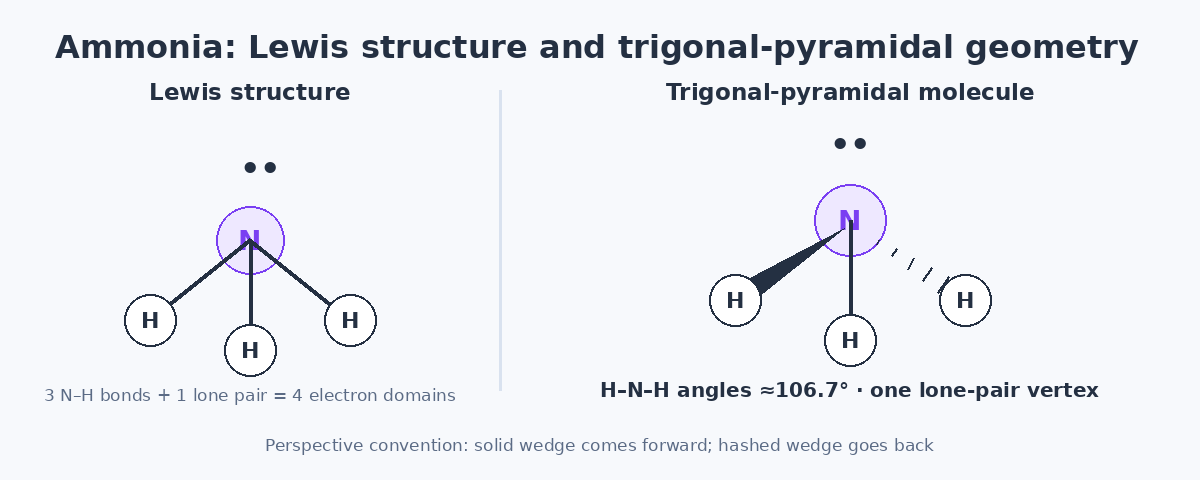
- Count valence electrons: nitrogen contributes 5 and three hydrogens contribute 3, giving 8 total.
- Make three N–H bonds: six electrons are used in bonding.
- Place the last pair: the remaining two electrons form one lone pair on nitrogen.
- Check formal charge: the preferred NH₃ Lewis structure has formal charge 0 on N and on each H.
- Apply VSEPR: four electron domains are approximately tetrahedral, but only three contain atoms. The molecular geometry is therefore trigonal pyramidal, with H–N–H angles close to 106.7°.
The lone pair also breaks symmetry, so NH₃ has a permanent molecular dipole.
Core → university The lone pair explains why ammonia is a Brønsted and Lewis base The same electron pair that shapes NH₃ can accept H⁺ or be donated to an electron-pair acceptor.

In Brønsted–Lowry language, ammonia is a proton acceptor:
NH₃ + H₂O ⇌ NH₄⁺ + OH⁻.
Because the equilibrium lies only partly toward products under ordinary conditions, ammonia is described as a weak base in water. In Lewis language, the nitrogen lone pair can be donated to an electron-pair acceptor to form a coordinate bond. Protonation to NH₄⁺ is a simple example: NH₃ supplies the electron pair used to make the new N–H bond.
Source: OpenStax — Lewis Acids and Bases
Solution chemistry Ammonia, ammonium and “aqueous ammonia” are related but not interchangeable A bottle labeled ammonia solution contains an equilibrium system, not one pure molecular species.
Neutral NH₃ can dissolve in water and accept protons to form NH₄⁺, while OH⁻ is produced at the same time. The solution therefore contains water, dissolved NH₃ and equilibrium amounts of NH₄⁺ and OH⁻. Treating “NH₄OH” as though the liquid were made mainly from discrete NH₄OH molecules hides the equilibrium chemistry.
This distinction becomes important when calculating pH, buffer behavior, ammonium-salt chemistry or nitrogen speciation.
Intermolecular forces Polarity and hydrogen bonding help explain ammonia’s physical behavior The pyramidal geometry gives NH₃ a net dipole, while N–H bonds and the lone pair allow hydrogen-bond interactions.
NH₃ is polar because its three N–H bond dipoles do not cancel in a trigonal-pyramidal geometry. Ammonia molecules can also participate in hydrogen bonding: N–H groups can donate, and the nitrogen lone pair can accept, hydrogen-bond interactions.
Water solubility is not explained by polarity alone. Hydrogen bonding and acid–base reaction both contribute to the strong interaction between ammonia and water.
University / engineering Haber–Bosch is a compromise between equilibrium, rate, separation and recycle High pressure helps equilibrium yield; lower temperature helps equilibrium but hurts rate; catalysts accelerate approach to equilibrium without moving it.
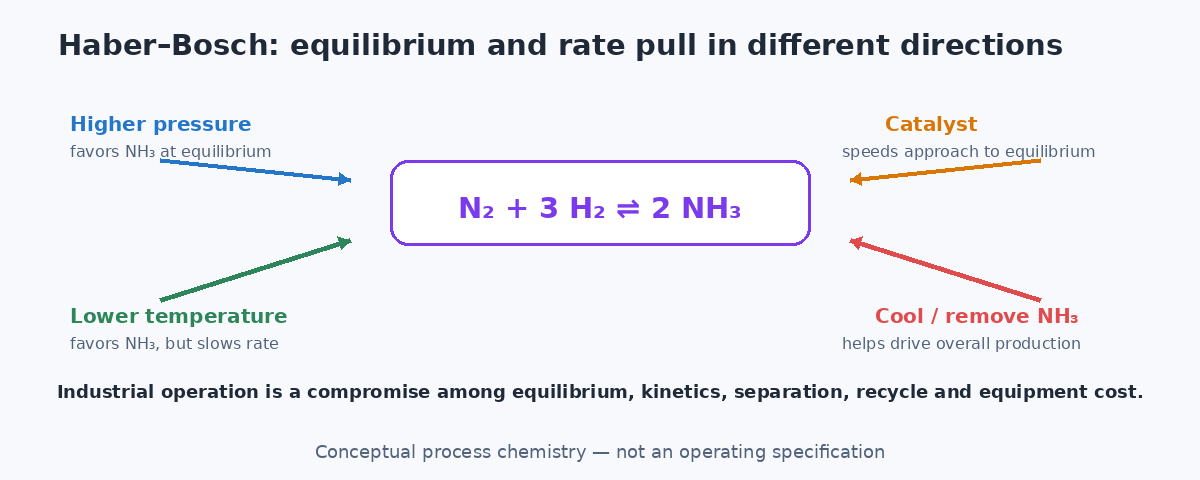
The synthesis equilibrium is N₂(g) + 3H₂(g) ⇌ 2NH₃(g) and is exothermic. Because four moles of reactant gas become two moles of product gas, higher pressure favors ammonia at equilibrium. Lower temperature also favors product for an exothermic reaction, but the reaction becomes too slow for useful production.
Industrial practice therefore uses a compromise temperature, high pressure and a catalyst. Cooling/condensing ammonia removes product from the reacting gas, while unreacted N₂ and H₂ are recycled. OpenStax describes typical modern teaching ranges around 400–500 °C and roughly 150–250 atm, though actual plants and catalyst systems vary.
Catalyst misconception: the catalyst changes reaction rate, not the equilibrium constant at a fixed temperature.
Source: OpenStax Chemistry 2e — Le Châtelier / ammonia production
Worked examples
1.00 mol N₂ × (2 mol NH₃ / 1 mol N₂) = 2.00 mol NH₃; 2.00 × 17.031 g/mol = 34.06 g NH₃
This is the theoretical stoichiometric amount, not a claim of single-pass industrial conversion.
NH₃ + H⁺ → NH₄⁺ gives a 1:1 mole ratio → 0.100 mol NH₄⁺
Actual solution composition also depends on equilibrium and what acid/base species are present.
Related compounds
Sources & evidence Reference sources Open the evidence and reference list used for this compound page.
Compound pages separate formula interpretation from reference data and from contextual explanation. Check the linked source when a value or condition matters to your work.
- PubChem — Ammonia — Identity, formula, molecular weight and safety/reference data.
- NIST Chemistry WebBook — Ammonia — Thermochemistry, phase, spectroscopy and reference data.
- OpenStax — Lewis Acids and Bases — Lone-pair donation and ammonia/ammonium examples.
- OpenStax Chemistry 2e — Le Châtelier / Haber–Bosch — Pressure, temperature, catalyst, separation and recycle concepts.
- NIOSH Pocket Guide — Ammonia — Occupational hazard and exposure context.
Found an error, something unclear, or a missing topic?
Tell us what you noticed. Feedback goes to a private review queue and is never published automatically.