

Ammonia vs Ammonium (NH₃ vs NH₄⁺)
Ammonia and ammonium differ by one proton and one unit of charge, but that small change controls their acid–base role, geometry, mobility and pH-dependent speciation in water.
Start simple, then go as deep as you need
The levels are cumulative: Deep dive keeps the earlier explanation visible and adds the more technical layer, caveats, comparisons, retrieval practice and scientific sources.
Ammonia vs Ammonium (NH₃ vs NH₄⁺) in one minute
Ammonia is NH₃, a neutral weak base. Ammonium is NH₄⁺, the positively charged conjugate acid formed when NH₃ accepts a proton. In water they are connected by the reversible acid–base relationship NH₄⁺ ⇌ NH₃ + H⁺, so pH and temperature influence which form is more abundant.
NH₃ and NH₄⁺ are not interchangeable names. They are a conjugate acid–base pair separated by one proton: lower pH favors NH₄⁺; higher pH favors NH₃.
What you will understand before you leave
Learning outcomes
- Distinguish NH₃ from NH₄⁺ by formula, charge, geometry and acid–base role.
- Explain why ammonia is a weak Brønsted base and ammonium is its conjugate acid.
- Use pH relative to pKa to predict which form is favored in water.
- Avoid confusing ammonia solution, ammonium salts and the historical label “ammonium hydroxide”.
- Connect molecular structure to equilibrium and environmental/solution chemistry.
Ideas to know first
A Brønsted base accepts H⁺; a Brønsted acid donates H⁺.
A base and its conjugate acid differ by one proton.
pH describes hydrogen-ion activity; changing pH can shift acid–base speciation.
See how the idea connects
These are explanatory steps, not buttons. Read from left to right to follow the cause-and-effect chain.
Nitrogen has a lone pair that can accept a proton.
Protonation changes net charge from 0 to +1 and removes the lone pair from the simple Lewis picture.
Ammonia is the base; ammonium is its conjugate acid.
Below the NH₄⁺ pKa, ammonium is favored; above it, un-ionized ammonia becomes more important.
What changes when NH₃ becomes NH₄⁺?
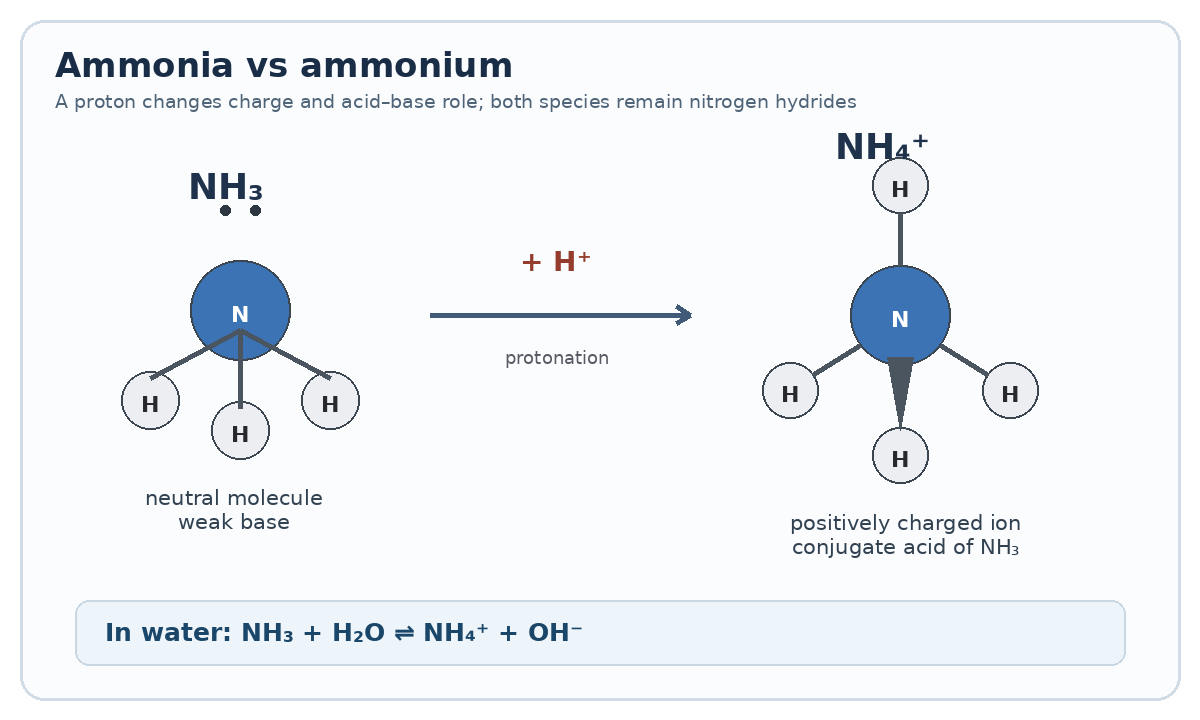
Ammonia, NH₃, is a neutral molecule. In the simple Lewis/VSEPR picture, nitrogen has three N–H bonds and one lone pair, giving a trigonal-pyramidal molecular geometry. Ammonium, NH₄⁺, is a positively charged ion with four N–H bonds and no lone pair on nitrogen in the ordinary Lewis structure; its molecular geometry is tetrahedral.
| Ammonia | Ammonium | |
|---|---|---|
| Formula | NH₃ | NH₄⁺ |
| Net charge | 0 | +1 |
| Role in the pair | Weak base | Conjugate acid |
| Introductory geometry | Trigonal pyramidal | Tetrahedral |
Why are ammonia and ammonium a conjugate acid–base pair?
Under the Brønsted–Lowry model, ammonia acts as a base because the nitrogen lone pair can accept a proton. In water:
The reverse direction also matters: NH₄⁺ can donate a proton and regenerate NH₃. This reversibility is why the pair appears in buffers, aqueous equilibria and biological/environmental chemistry.
How does pH change the NH₃ : NH₄⁺ balance?
The equilibrium can be written as NH₄⁺ ⇌ NH₃ + H⁺. At 25 °C, the pKa of NH₄⁺ is about 9.25 in common dilute-solution treatments. The Henderson–Hasselbalch form is:
At pH = pKa, the idealized concentration ratio is 1:1. At pH 7, the ratio [NH₃]/[NH₄⁺] is only about 107−9.25 ≈ 0.0056, so ammonium strongly predominates. As pH rises, the un-ionized NH₃ fraction increases.
Temperature matters too. Authoritative water-quality treatments explicitly account for temperature dependence when estimating NH₃/NH₄⁺ fractions.
Is aqueous ammonia the same thing as “ammonium hydroxide”?
Commercial and historical language sometimes labels aqueous ammonia as “ammonium hydroxide,” but the useful microscopic picture is an equilibrium mixture dominated by solvated NH₃ and water, with smaller equilibrium amounts of NH₄⁺ and OH⁻. It should not be imagined as a solution made mainly of discrete NH₄OH molecules.
This distinction matters because formula labels can hide the actual species present in solution. In chemistry, writing the equilibrium makes the acid–base behavior clearer than treating “NH₄OH” as though it were a simple molecular solute.
Worked reasoning: which form dominates?
These are equilibrium illustrations, not universal sample analyses; ionic strength, temperature and the definition of the measured “total ammonia” matter in real systems.
What students often mix up
Do not use ammonia and ammonium as synonyms: NH₃ is neutral; NH₄⁺ carries +1 charge.
Do not call NH₃ a strong base. It reacts only partially with water under ordinary dilute conditions.
Do not assume a fixed NH₃/NH₄⁺ percentage without stating pH and temperature.
Do not treat “ammonium hydroxide” as proof that aqueous ammonia consists mainly of NH₄OH molecules.
Check your understanding
Answer before opening the explanation. The aim is understanding, not speed.
1Which species is the conjugate acid: NH₃ or NH₄⁺?
NH₄⁺. It can donate a proton to regenerate NH₃.
2Why does NH₃ act as a base?
The nitrogen lone pair can accept a proton.
3What happens to the NH₃ fraction when pH rises?
It generally increases relative to NH₄⁺ because the equilibrium shifts toward the deprotonated form.
4At pH equal to pKa, what is the idealized NH₃:NH₄⁺ ratio?
Approximately 1:1.
5Does adding one proton change only the formula?
No. It also changes net charge, geometry in the simple VSEPR picture, and acid–base behavior.
Sources and terminology
Definitions and reference claims are anchored to authoritative scientific organizations and peer-reviewed literature where needed. Element Lookup adds teaching explanation, examples and visual structure; it does not treat AI as the source of scientific definitions or numbers.
Found an error, something unclear, or a missing topic?
Tell us what you noticed. Feedback goes to a private review queue and is never published automatically.