

Atomic / phase data
Reference values are evaluated.
Helical-chain structure
Trigonal tellurium chain topology is measured; viewer is a motif-level model.
Compound uses
CdTe and Bi2Te3 are distinct compounds, not elemental tellurium.
Isotopes
Stable and ultra-long-lived natural isotope distinctions are preserved.
Supply geography
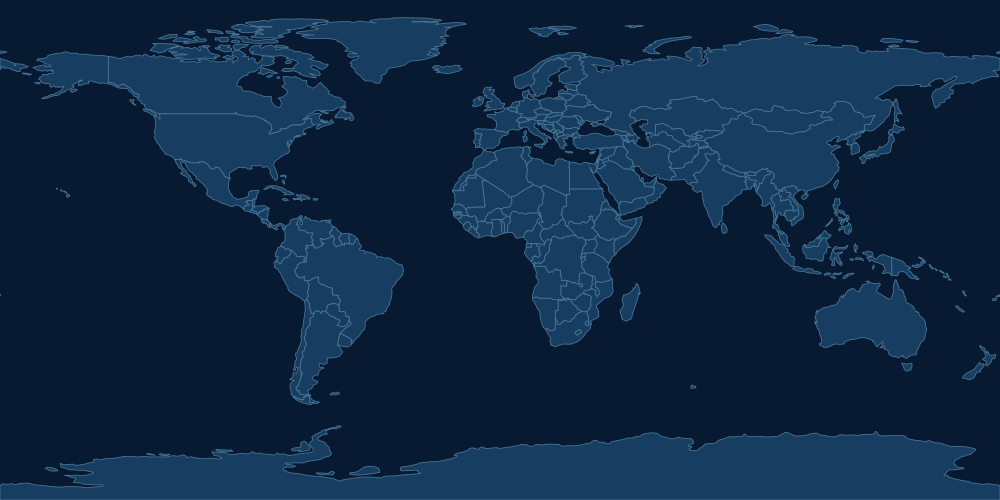
By-product recovery context is used instead of fake native-element mine pins.
The lens describes evidence status, not confidence theatre. “Unknown” is kept unknown, and teaching schematics are not presented as direct measurements.
Tellurium (Te)
Tellurium is element 52, a brittle Group 16 metalloid whose trigonal helical-chain structure links p-block bonding to thermoelectric compounds, solar materials and a supply chain dominated by by-product recovery.
Tellurium atomic number, mass, electron configuration and key properties
Tellurium: quick answers
How many protons, neutrons and electrons does tellurium have?
Tellurium’s atomic number is 52, so every tellurium atom has 52 protons, and a neutral atom also has 52 electrons. Its most common natural isotope, tellurium-130, has 78 neutrons (other isotopes have different neutron counts).
What is the symbol for tellurium?
The chemical symbol for tellurium is Te.
Is tellurium a solid, liquid or gas at room temperature?
Tellurium is a solid at room temperature (about 25 °C).
What family (group) is tellurium in?
Tellurium is a metalloid, in group 16, period 5 of the periodic table.
How many valence electrons does tellurium have?
Tellurium has 6 valence electrons, the electrons in its outer shell, which matches its position in group 16.
What is the electron configuration of tellurium?
The ground-state electron configuration of tellurium is [Kr] 4d¹⁰ 5s² 5p⁴.
From atomic number to chemistry
Read these as a chain of causes, not as isolated facts. Each step links to the concept hub if you want the underlying idea explained.
52 protons define tellurium.
The reference ground-state configuration frames atomic and chemical behavior.
Periodic position organizes recurring trends without replacing element-specific evidence.
The teaching nucleus is one isotope, not the relative atomic mass.
Phase claims preserve measured/evaluated/predicted/unknown evidence labels.
Tellurium in its period and family
Tellurium sits below selenium in Group 16. Its 5s²5p⁴ valence pattern supports −2, +4 and +6 chemistry, while heavier-atom bonding favors a trigonal helical-chain solid.
Tellurium Visual Lab
Explore Te across the teaching nucleus, isolated-atom orbitals, evidence-aware material structure and temperature/evidence views, then connect those models to uses, isotopes and source-backed context.
Every mark points to one exact feature
The numbered markers explain the same information system used throughout Element Lookup. Unknown or predicted fields remain visibly labelled rather than being replaced with guesses.
Tellurium in one minute
Atomic number 52 means 52 protons.
Tellurium is commonly classified as a metalloid.
Crystalline tellurium has trigonal helical chains.
Tellurides and elemental tellurium are different chemical materials.
Commercial tellurium is commonly recovered as a by-product of copper refining.
Shell rings organize electron counts. They are not electron trajectories or orbital shapes.
2 · 8 · 18 · 18 · 6 electrons
The 5s/5p visuals are isolated-atom probability clouds; they are not the band structure of trigonal tellurium or telluride compounds.
Crystalline tellurium forms spiral chains in a trigonal structure. The viewer uses a repeating helical-chain motif, not a complete crystallographic coordinate model.. The viewer is evidence-aware: measured structures are identified as such; unknown bulk structures stay unknown.
Teaching visualization; not a literal finite sample or thermal trajectory.What this model does—and does not—show
The 5s/5p visuals are isolated-atom probability clouds; they are not the band structure of trigonal tellurium or telluride compounds.
Where do I meet tellurium?
Clickable learning cards connect the element to materials, environment, technology, biology or research - depending on what the evidence actually supports.
Thermoelectrics
Bismuth telluride and related compounds convert temperature differences and electrical energy in thermoelectric devices.
Trigonal helical chains → telluride compounds → by-product supply
Tellurium’s signature science connects chain-like elemental bonding with high-value compound materials and a supply chain that rarely starts with a tellurium mine.
Helical Te chains
Crystalline tellurium forms a trigonal helical-chain structure.
Selenium, tellurium and polonium
Six outer electrons persist while structure and metallic character evolve down the chalcogens.
| Structure | helical chains |
|---|---|
| Class | nonmetal |
| Structure | helical chains |
|---|---|
| Class | metalloid |
| Structure | simple cubic α-Po |
|---|---|
| Class | metallic radioactive |
Tellurium properties: atomic, physical, thermal and chemical
Categories follow the science of this element rather than a fixed decorative template. Each row carries condition/provenance context and an evidence label; unknown values stay unknown.
| Property | Value | Context / provenance | Evidence |
|---|---|---|---|
| Atomic number | 52 | Source-reviewed; see Sources below | Evaluated |
| Relative atomic mass | 127.60 | Source-reviewed; see Sources below | Evaluated |
| Ground-state electron configuration | [Kr] 4d¹⁰ 5s² 5p⁴ | Source-reviewed; see Sources below | Evaluated |
| Group / period / block | Group 16 · Period 5 · p-block | Periodic-table placement | Evaluated |
| Electronegativity | 2.1 | Source-reviewed; see Sources below | Evaluated |
| Reference isotope | ¹³⁰Te | Source-reviewed; see Sources below | Evaluated |
| Property | Value | Context / provenance | Evidence |
|---|---|---|---|
| State context | Silvery brittle metalloid | Source-reviewed; see Sources below | Evaluated |
| Density | 6.232 g/cm³ | Source-reviewed; see Sources below | Evaluated |
| Material / molecular structure | Trigonal · helical chains | Crystalline tellurium forms spiral chains in a trigonal structure. The viewer uses a repeating helical-chain motif, not a complete crystallographic coordinate model. | Measured |
| Classification | Metalloid | Periodic-table / chemistry classification | Evaluated |
| Structure-model scope | Crystalline tellurium forms spiral chains in a trigonal structure. The viewer uses a repeating helical-chain motif, not a complete crystallographic coordinate model. | Teaching visualization; exact crystallographic coordinates are not implied unless stated. | Reviewed |
| Property | Value | Context / provenance | Evidence |
|---|---|---|---|
| Melting / transition reference | 722.66 K | Source-reviewed; see Sources below | Evaluated |
| Boiling / gas reference | 1261 K | Source-reviewed; see Sources below | Evaluated |
| Phase-path context | At approximately standard pressure, crystalline tellurium is solid below 722.66 K, liquid to about 1261 K, and gaseous above the boiling reference. | Shared phase registry drives the slider, regions and markers. | Evaluated |
| Condition warning | Temperature and pressure define phase behavior; purity/allotropy may matter. | Teaching condition statement | Reviewed |
| Property | Value | Context / provenance | Evidence |
|---|---|---|---|
| Common oxidation states | +6, +4, −2 | Source-reviewed; see Sources below | Evaluated |
| Ion / common ion context | Te²⁻ | Source-reviewed; see Sources below | Evaluated |
| Periodic chemistry context | Tellurium sits below selenium in Group 16. Its 5s²5p⁴ valence pattern supports −2, +4 and +6 chemistry, while heavier-atom bonding favors a trigonal helical-chain solid. | Element-specific interpretation | Reviewed |
| Chemistry caution | Elemental form, ions and compounds are distinct chemical objects. | Interpretive teaching rule | Reviewed |
| Property | Value | Context / provenance | Evidence |
|---|---|---|---|
| ¹³⁰Te | Very long-lived double-beta emitter | One of tellurium’s naturally occurring isotopes; its decay half-life is enormous. | Evaluated |
| ¹²⁸Te | Very long-lived double-beta emitter | Another extraordinarily long-lived natural radioisotope. | Evaluated |
| Natural tellurium | Multiple stable and very long-lived isotopes | Relative atomic mass represents a complex natural mixture. | Evaluated |
| Teaching nucleus | ¹³⁰Te · 52 protons + 78 neutrons | Reference isotope used in the nucleus model | Reviewed |
| Property | Value | Context / provenance | Evidence |
|---|---|---|---|
| Page evidence note | Atomic and phase values are evaluated. The structural viewer is a helical-chain teaching motif grounded in trigonal tellurium. Supply geography is by-product context, not a native-element mine map. | Evidence summary for this guide | Reviewed |
| Structure evidence | Crystalline tellurium forms spiral chains in a trigonal structure. The viewer uses a repeating helical-chain motif, not a complete crystallographic coordinate model. | Measured structure, labelled schematic, prediction or explicit unknown as applicable. | Reviewed |
| Map evidence rule | Real pins are reviewed examples; conceptual layers are used when pins would mislead. | Geography Explorer 2.0 | Reviewed |
| Source set | 3 primary/reference links listed below | Open the Sources section for the actual references. | Reviewed |
Is Tellurium a solid, liquid or gas? State at temperature
At approximately standard pressure, crystalline tellurium is solid below 722.66 K, liquid to about 1261 K, and gaseous above the boiling reference.
Where on Earth is Tellurium found or produced?
Who discovered Tellurium, and when?
Franz-Joseph Müller von Reichenstein recognized an unusual component in Transylvanian ores.
Martin Heinrich Klaproth confirmed the new element and named it tellurium, from Latin tellus for Earth.
Tellurium compounds became important in metallurgy, thermoelectrics and electronics.
Supply remains closely connected to by-product recovery and semiconductor demand.
From copper-refining by-product to tellurium materials: high-level path
Tellurium is dispersed in sulfide ore systems and is commonly concentrated in anode slimes during copper refining.
Further refining produces tellurium metal or compound feedstocks.
Manufacturing converts tellurium into specific compounds such as CdTe or Bi₂Te₃ with properties different from elemental Te.
Recycling may recover tellurium from selected manufacturing or end-of-life streams.
What is tellurium used for?
Thermoelectrics
Bi₂Te₃-based materials are widely studied and used for thermoelectric cooling and power generation.
Photovoltaics
CdTe is used in thin-film solar cells.
Metallurgy
Tellurium additions can improve machinability in selected alloys.
Electronics
Telluride compounds support specialized phase-change, detector and semiconductor applications.
Tellurium isotopes and natural abundance
¹³⁰Te
Very long-lived double-beta emitterOne of tellurium’s naturally occurring isotopes; its decay half-life is enormous.
¹²⁸Te
Very long-lived double-beta emitterAnother extraordinarily long-lived natural radioisotope.
Natural tellurium
Multiple stable and very long-lived isotopesRelative atomic mass represents a complex natural mixture.
Five-question Tellurium check
What is tellurium’s symbol?
How is tellurium commonly classified?
What structural motif characterizes crystalline Te?
Which is a tellurium compound?
What is a common supply route?
Tellurium questions students commonly ask
Each answer starts with the direct fact, then explains the chemistry, evidence or material context so the result is understandable rather than merely memorized.
What is tellurium?
Short answer: Tellurium is chemical element 52, symbol Te, commonly classified as a metalloid.
Atomic number 52 means every tellurium nucleus contains 52 protons. In the periodic table, Tellurium is classified here as a metalloid in Period 5 and Group 16. Tellurium sits below selenium in Group 16. Its 5s²5p⁴ valence pattern supports −2, +4 and +6 chemistry, while heavier-atom bonding favors a trigonal helical-chain solid.
Key point: Te is element 52; its periodic position and electron structure explain the rest of the page.
Is tellurium a metal?
Short answer: It has a metallic appearance but is commonly classified as a metalloid.
This guide classifies Tellurium as a metalloid. Its periodic position is Period 5, p-block, Group 16. Tellurium sits below selenium in Group 16. Its 5s²5p⁴ valence pattern supports −2, +4 and +6 chemistry, while heavier-atom bonding favors a trigonal helical-chain solid.
Key point: Periodic-table classification describes recurring atomic/chemical behavior; it does not make every element in a column physically identical.
What is tellurium used for?
Short answer: Important uses are mostly through compounds, including thermoelectric materials and CdTe solar cells, plus some metallurgy.
Thermoelectrics: Bi₂Te₃-based materials are widely studied and used for thermoelectric cooling and power generation. Photovoltaics: CdTe is used in thin-film solar cells. Tellurium is often searched as “tellerium.” Spelling assistance should route that query to the same element, not create a duplicate page. Scientifically, Te metal-like appearance does not erase its common metalloid classification or its compound-specific behavior.
Key point: Always distinguish the pure element from the compound, alloy, isotope or device material that actually performs the application.
What element is Te?
Short answer: Tellurium, atomic number 52.
Tellurides and elemental tellurium are different chemical materials. Tellurium is often searched as “tellerium.” Spelling assistance should route that query to the same element, not create a duplicate page. Scientifically, Te metal-like appearance does not erase its common metalloid classification or its compound-specific behavior.
Key point: Use the direct answer together with the material, isotope and evidence context shown elsewhere on the page.
How many valence electrons does tellurium have?
Short answer: Six in the simple outer-shell count: 5s²5p⁴.
The neutral-atom ground-state reference used on this page is [Kr] 4d¹⁰ 5s² 5p⁴. This is an isolated-atom reference: bonding and ion formation can change which outer electrons are present or chemically active. The listed common oxidation-state context is +6, +4, −2, which helps connect the atomic configuration to ordinary chemistry without treating electron counting as a single universal rule.
Key point: Electron configuration is a ground-state atomic reference, not a literal picture of every compound.
Where is tellurium found?
Short answer: It is dispersed in ores and is commonly recovered as a by-product of copper refining.
Tellurium is dispersed in sulfide ore systems and is commonly concentrated in anode slimes during copper refining. Commercial tellurium is commonly recovered as a by-product of copper refining.
Key point: Natural occurrence, resources, production and recycling are different geography questions.
Is “tellerium” the same element?
Short answer: “Tellerium” is a common misspelling of tellurium; the chemical symbol is Te.
Tellurium is often searched as “tellerium.” Spelling assistance should route that query to the same element, not create a duplicate page. Scientifically, Te metal-like appearance does not erase its common metalloid classification or its compound-specific behavior. Spelling/search “Tellerium” is a common misspelling; scientific identity remains Te, element 52.
Key point: Use the direct answer together with the material, isotope and evidence context shown elsewhere on the page.
Scientific sources for Tellurium
- Royal Society of Chemistry - Tellurium
- Los Alamos National Laboratory - Tellurium
- USGS - Mineral Commodity Summaries 2026
Questions to ask next about Tellurium
A good element lesson should lead to the next useful question, not end after a list of facts.
Found an error, something unclear, or a missing topic?
Tell us what you noticed. Feedback goes to a private review queue and is never published automatically.