

Element identity
Atomic number, symbol, relative atomic mass display and periodic position are established reference data.
Atomic / electronic model
Ground-state electron configuration and atomic reference values are compiled/evaluated data; orbital graphics are teaching probability models, not photographs.
Material / molecular structure
The displayed ordinary structure is based on established material or molecular science; simplified viewers are labelled as teaching schematics where exact crystallographic coordinates are not rendered.
Temperature / phase path
Transition values are reference/evaluated values for the stated teaching path; pressure, purity and allotropy can matter.
Geography
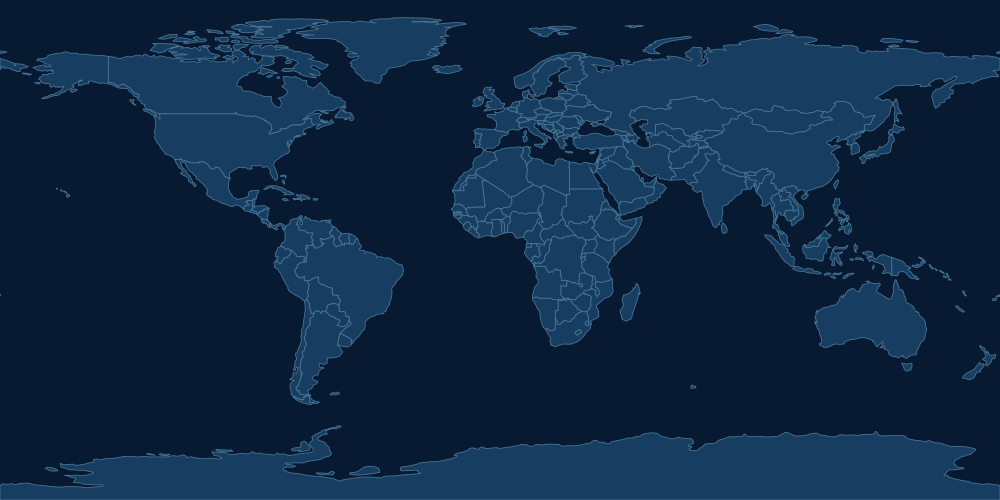
Real pins use reviewed place/dataset context. Conceptual layers are used when country pins would imply false occurrence, unsafe inventory or an incomplete global distribution.
The lens describes evidence status, not confidence theatre. “Unknown” is kept unknown, and teaching schematics are not presented as direct measurements.
Nickel (Ni)
Nickel is a corrosion-resistant Group 10 transition metal used widely in alloys, plating, catalysts and batteries. Its 3d electrons connect atomic structure to magnetism, bonding and surface chemistry, while its ore geology spans both laterite and sulfide deposits.
Nickel atomic number, mass, electron configuration and key properties
Nickel has 28 protons. A neutral nickel atom also has 28 electrons; nickel-58 has 30 neutrons, while other nickel isotopes have different neutron counts.
Nickel: quick answers
How many protons, neutrons and electrons does nickel have?
Nickel’s atomic number is 28, so every nickel atom has 28 protons, and a neutral atom also has 28 electrons. Its most common natural isotope, nickel-58, has 30 neutrons (other isotopes have different neutron counts).
What is the symbol for nickel?
The chemical symbol for nickel is Ni.
Is nickel a solid, liquid or gas at room temperature?
Nickel is a solid at room temperature (about 25 °C).
What family (group) is nickel in?
Nickel is a transition metal, in group 10, period 4 of the periodic table.
What is the electron configuration of nickel?
The ground-state electron configuration of nickel is [Ar] 3d⁸ 4s².
From atomic number to chemistry
Read these as a chain of causes, not as isolated facts. Each step links to the concept hub if you want the underlying idea explained.
Twenty-eight protons define nickel.
Nickel is a 3d transition metal; both d and s electrons matter in chemistry.
Nickel begins the Group 10 series with palladium and platinum below it.
Five stable isotopes occur naturally, led by 58Ni.
Nickel atoms form a face-centred cubic structure near room temperature.
Nickel in its period and family
Nickel sits in Period 4, Group 10, between cobalt and copper. It begins the Group 10 vertical family that also includes palladium and platinum, but 3d, 4d and 5d metals can differ substantially in density, surface chemistry and relativistic effects.
Nickel Visual Lab
Decode nickel’s tile, rotate a ⁵⁸Ni teaching nucleus and FCC metal cell, compare occupied 4s and named 3d orbital models, then connect nickel to stainless steel, batteries, catalysts and global mine-supply geology.
Every mark points to one exact feature
The numbered markers explain the same information system used throughout Element Lookup. Unknown or predicted fields remain visibly labelled rather than being replaced with guesses.
Nickel in one minute
Atomic number 28 means every nickel nucleus has 28 protons.
The common reference configuration is [Ar] 3d⁸ 4s².
Nickel metal is face-centred cubic near room temperature.
⁵⁸Ni and ⁶⁰Ni are the two most abundant natural isotopes.
Modern nickel supply comes from both laterite ores and magmatic sulfide deposits, and production geography changes with time.
Shell rings organize electron counts. They are not electron trajectories or orbital shapes.
2 · 8 · 16 · 2 electrons
The selected orbital models include occupied 4s and two named members of the occupied 3d subshell: 3d z² and 3d xy. A d subshell contains five spatial orbitals; these buttons are representative members, not a claim that “3d” has one single shape.
Face-centred cubic nickel metal near room temperature (Fm-3m teaching cell). The viewer is evidence-aware: measured structures are identified as such; unknown bulk structures stay unknown.
Teaching visualization; not a literal finite sample or thermal trajectory.What this model does—and does not—show
The selected orbital models include occupied 4s and two named members of the occupied 3d subshell: 3d z² and 3d xy. A d subshell contains five spatial orbitals; these buttons are representative members, not a claim that “3d” has one single shape.
Where do I meet nickel?
Clickable learning cards connect the element to materials, environment, technology, biology or research - depending on what the evidence actually supports.
Stainless & alloys
Nickel is a major alloying element in stainless steels and superalloys, improving corrosion resistance and high-temperature performance.
Nickel changes role across metal, alloy and battery chemistry
The word “nickel” can refer to the element, an alloy component or nickel-bearing electrode compounds.
Ferromagnetic metal
Elemental nickel is a metallic solid with characteristic magnetic and catalytic behavior.
Nickel, palladium and platinum
Group 10 links 3d, 4d and 5d transition metals, but surface chemistry, density, magnetism and relativistic effects change substantially down the column.
| Reference config. | [Ar] 3d⁸ 4s² |
|---|---|
| Crystal | FCC |
| Density | 8.90 g/cm³ |
| Period | 5 |
|---|---|
| Context | 4d platinum-group metal |
| Reference config. | [Xe] 4f¹⁴ 5d⁹ 6s¹ |
|---|---|
| Crystal | FCC |
| Context | strong heavy-atom effects |
Nickel properties: atomic, physical, thermal and chemical
Categories follow the science of this element rather than a fixed decorative template. Each row carries condition/provenance context and an evidence label; unknown values stay unknown.
| Property | Value | Context / provenance | Evidence |
|---|---|---|---|
| Atomic number | 28 | Source-reviewed; see Sources below | Evaluated |
| Relative atomic mass | 58.6934 | Source-reviewed; see Sources below | Evaluated |
| Ground-state electron configuration | [Ar] 3d⁸ 4s² | Source-reviewed; see Sources below | Evaluated |
| Group / period / block | Group 10 · Period 4 · d-block | Periodic-table placement | Evaluated |
| Electronegativity | 1.91 | Source-reviewed; see Sources below | Evaluated |
| Reference isotope | ⁵⁸Ni | Source-reviewed; see Sources below | Evaluated |
| Property | Value | Context / provenance | Evidence |
|---|---|---|---|
| State context | Solid metal at 20 °C | Source-reviewed; see Sources below | Evaluated |
| Density | 8.90 g/cm³ | Source-reviewed; see Sources below | Evaluated |
| Material / molecular structure | FCC | Face-centred cubic nickel metal near room temperature (Fm-3m teaching cell) | Measured |
| Classification | Transition metal | Periodic-table / chemistry classification | Evaluated |
| Structure-model scope | Face-centred cubic nickel metal near room temperature (Fm-3m teaching cell) | Teaching visualization; exact crystallographic coordinates are not implied unless stated. | Reviewed |
| Property | Value | Context / provenance | Evidence |
|---|---|---|---|
| Melting / transition reference | 1728 K | Source-reviewed; see Sources below | Evaluated |
| Boiling / gas reference | 3186 K | Source-reviewed; see Sources below | Evaluated |
| Phase-path context | On this approximately standard-pressure teaching path, nickel is solid below 1728 K, liquid from 1728 K to 3186 K, and gaseous above 3186 K. | Shared phase registry drives the slider, regions and markers. | Evaluated |
| Condition warning | Temperature and pressure define phase behavior; purity/allotropy may matter. | Teaching condition statement | Reviewed |
| Property | Value | Context / provenance | Evidence |
|---|---|---|---|
| Ordinary electrical behavior | Metallic conductor | Qualitative bulk behavior; exact resistivity depends on temperature, purity and alloy state. | Measured |
| Conduction model | Collective solid-state electrons | Do not interpret isolated-atom orbital clouds as literal current paths. | Reviewed |
| Surface / compound caveat | Oxides, salts and alloys can behave differently from the pure metal | Material context | Reviewed |
| Engineering values | Condition-dependent | Use condition-specific materials data for engineering calculations. | Reviewed |
| Property | Value | Context / provenance | Evidence |
|---|---|---|---|
| Common oxidation states | +2 common; other states occur | Source-reviewed; see Sources below | Evaluated |
| Ion / common ion context | Ni²⁺ | Source-reviewed; see Sources below | Evaluated |
| Periodic chemistry context | Nickel sits in Period 4, Group 10, between cobalt and copper. It begins the Group 10 vertical family that also includes palladium and platinum, but 3d, 4d and 5d metals can differ substantially in density, surface chemistry and relativistic effects. | Element-specific interpretation | Reviewed |
| Chemistry caution | Elemental form, ions and compounds are distinct chemical objects. | Interpretive teaching rule | Reviewed |
| Property | Value | Context / provenance | Evidence |
|---|---|---|---|
| ⁵⁸Ni | Stable · ≈68.1% natural abundance | The dominant natural isotope; 28 protons and 30 neutrons. | Evaluated |
| ⁶⁰Ni | Stable · ≈26.2% | The second most abundant natural isotope. | Evaluated |
| ⁶¹Ni / ⁶²Ni / ⁶⁴Ni | Stable · minor natural isotopes | Three additional stable isotopes complete the natural isotopic mixture. | Evaluated |
| Teaching nucleus | ⁵⁸Ni · 28 protons + 30 neutrons | Reference isotope used in the nucleus model | Reviewed |
Is Nickel a solid, liquid or gas? State at temperature
On this approximately standard-pressure teaching path, nickel is solid below 1728 K, liquid from 1728 K to 3186 K, and gaseous above 3186 K.
Where on Earth is Nickel found or produced?
Who discovered Nickel, and when?
Axel Fredrik Cronstedt isolated nickel from an ore historically called kupfernickel and recognized a distinct metal.
Nickel plating and nickel-containing alloys expanded as industrial metallurgy developed.
Stainless steels, high-temperature alloys and electrochemical uses made nickel strategically important.
Nickel demand spans stainless steel, superalloys, catalysts, plating and battery supply chains.
From nickel ore to useful metal and alloys: a high-level materials path
Nickel is produced from both laterite and sulfide ore systems; the geology and processing routes are not the same.
Mining and concentration/upgrading prepare nickel-bearing feed for extractive metallurgy.
Smelting, refining or hydrometallurgical routes produce nickel products appropriate to the ore and final specification.
Nickel then enters alloys, plating, catalysts and batteries, with recycling contributing secondary supply.
What is nickel used for?
Stainless steel & alloys
Nickel improves corrosion resistance and mechanical performance in many steels and specialized alloys.
Batteries
Nickel is important in NiMH batteries and in several nickel-rich lithium-ion cathode materials.
Catalysts
Nickel is widely used in heterogeneous catalysis, including hydrogenation chemistry.
Plating
Nickel coatings protect surfaces and can provide a durable decorative finish.
Nickel isotopes and natural abundance
⁵⁸Ni
Stable · ≈68.1% natural abundanceThe dominant natural isotope; 28 protons and 30 neutrons.
⁶⁰Ni
Stable · ≈26.2%The second most abundant natural isotope.
⁶¹Ni / ⁶²Ni / ⁶⁴Ni
Stable · minor natural isotopesThree additional stable isotopes complete the natural isotopic mixture.
Five-question Nickel check
What is nickel’s atomic number?
What crystal structure does nickel have near room temperature?
Which are the two most abundant natural nickel isotopes?
Which statement about nickel orbitals is best?
Which country dominates recent nickel mine output?
Nickel questions students commonly ask
Each answer starts with the direct fact, then explains the chemistry, evidence or material context so the result is understandable rather than merely memorized.
What is nickel?
Short answer: Nickel is chemical element 28, a silvery transition metal in Group 10.
Atomic number 28 means every nickel nucleus contains 28 protons. In the periodic table, Nickel is classified here as a transition metal in Period 4 and Group 10. Nickel sits in Period 4, Group 10, between cobalt and copper. It begins the Group 10 vertical family that also includes palladium and platinum, but 3d, 4d and 5d metals can differ substantially in density, surface chemistry and relativistic effects.
Key point: Ni is element 28; its periodic position and electron structure explain the rest of the page.
Is nickel a metal?
Short answer: Yes. Nickel is a transition metal and is solid at room temperature.
This guide classifies Nickel as a transition metal. Its periodic position is Period 4, d-block, Group 10. Nickel sits in Period 4, Group 10, between cobalt and copper. It begins the Group 10 vertical family that also includes palladium and platinum, but 3d, 4d and 5d metals can differ substantially in density, surface chemistry and relativistic effects.
Key point: Periodic-table classification describes recurring atomic/chemical behavior; it does not make every element in a column physically identical.
What is nickel used for?
Short answer: Its major uses include stainless steel and other alloys, batteries, catalysts and electroplating.
Stainless steel & alloys: Nickel improves corrosion resistance and mechanical performance in many steels and specialized alloys. Batteries: Nickel is important in NiMH batteries and in several nickel-rich lithium-ion cathode materials. The word “nickel” can mean the element, a nickel-containing alloy, or a five-cent coin. Element Lookup keeps the chemical element separate from coin-search intent and focuses on Ni science.
Key point: Always distinguish the pure element from the compound, alloy, isotope or device material that actually performs the application.
How many valence electrons does nickel have?
Short answer: For transition metals, “valence electron” counting depends on context. The neutral ground-state reference configuration is [Ar] 3d⁸ 4s², and both 3d and 4s electrons can participate in chemistry.
The neutral-atom ground-state reference used on this page is [Ar] 3d⁸ 4s². This is an isolated-atom reference: bonding and ion formation can change which outer electrons are present or chemically active. The listed common oxidation-state context is +2 common; other states occur, which helps connect the atomic configuration to ordinary chemistry without treating electron counting as a single universal rule.
Key point: Electron configuration is a ground-state atomic reference, not a literal picture of every compound.
Where is nickel found?
Short answer: Important ore systems include laterites and magmatic sulfides. Recent mine production is concentrated in countries such as Indonesia, but rankings change with year and dataset.
Nickel is produced from both laterite and sulfide ore systems; the geology and processing routes are not the same. Modern nickel supply comes from both laterite ores and magmatic sulfide deposits, and production geography changes with time.
Key point: Natural occurrence, resources, production and recycling are different geography questions.
What color is nickel?
Short answer: Nickel metal is silvery-white with a metallic luster.
The ordinary elemental-material description used here is: Solid metal at 20 °C. Nickel metal is face-centred cubic near room temperature.
Key point: Elemental appearance can differ from the colors of its ions, compounds, oxide films or host materials.
How many protons does nickel have?
Short answer: Nickel has 28 protons, because its atomic number is 28.
A neutral nickel atom also has 28 electrons. Its neutron count depends on the isotope: nickel-58 has 58 − 28 = 30 neutrons, while nickel-60 has 32. An ion may gain or lose electrons without changing its proton count or becoming another element.
Key point: Atomic number 28 means 28 protons in every nickel isotope.
Scientific sources for Nickel
- Royal Society of Chemistry - Nickel
- NIST - Atomic Data for Nickel
- USGS - Mineral Commodity Summaries 2026
- WebElements - Nickel crystal structure
Questions to ask next about Nickel
A good element lesson should lead to the next useful question, not end after a list of facts.
Found an error, something unclear, or a missing topic?
Tell us what you noticed. Feedback goes to a private review queue and is never published automatically.