

Methane vs Natural Gas
Methane is one pure chemical compound. Natural gas is a fuel mixture whose largest component is usually methane but whose composition—and therefore properties—varies by source and processing.
Start simple, then go as deep as you need
The levels are cumulative: Deep dive keeps the earlier explanation visible and adds the more technical layer, caveats, comparisons, retrieval practice and scientific sources.
Methane vs Natural Gas in one minute
Methane is CH₄, a single chemical compound with a fixed molecular formula. Natural gas is a mixture. Methane is usually its largest component, but natural gas can also contain ethane, propane, other hydrocarbon gas liquids and nonhydrocarbon gases such as CO₂, N₂ and water vapor. Processing changes the mixture before pipeline use.
“Methane” names a molecule; “natural gas” names a mixture. The two are related but not interchangeable.
What you will understand before you leave
Learning outcomes
- Distinguish a pure compound from a variable mixture.
- Explain why natural-gas composition can vary while methane’s formula cannot.
- Connect gas processing to dry gas, hydrocarbon gas liquids and pipeline quality.
- Relate mixture composition to heat content and combustion products.
- Avoid confusing methane, natural gas, biogas and LNG.
Ideas to know first
A compound has fixed chemical identity; a mixture can contain variable proportions of several substances.
CH₄ is a tetrahedral hydrocarbon molecule and the simplest alkane.
See how the idea connects
These are explanatory steps, not buttons. Read from left to right to follow the cause-and-effect chain.
One carbon and four hydrogens define methane’s molecular identity.
It contains methane plus varying other hydrocarbon and nonhydrocarbon gases.
Water, CO₂, H₂S and heavier hydrocarbons may be removed or separated depending on the stream.
Heat content and emissions depend on both methane and the remaining composition.
Why methane and natural gas are not the same thing
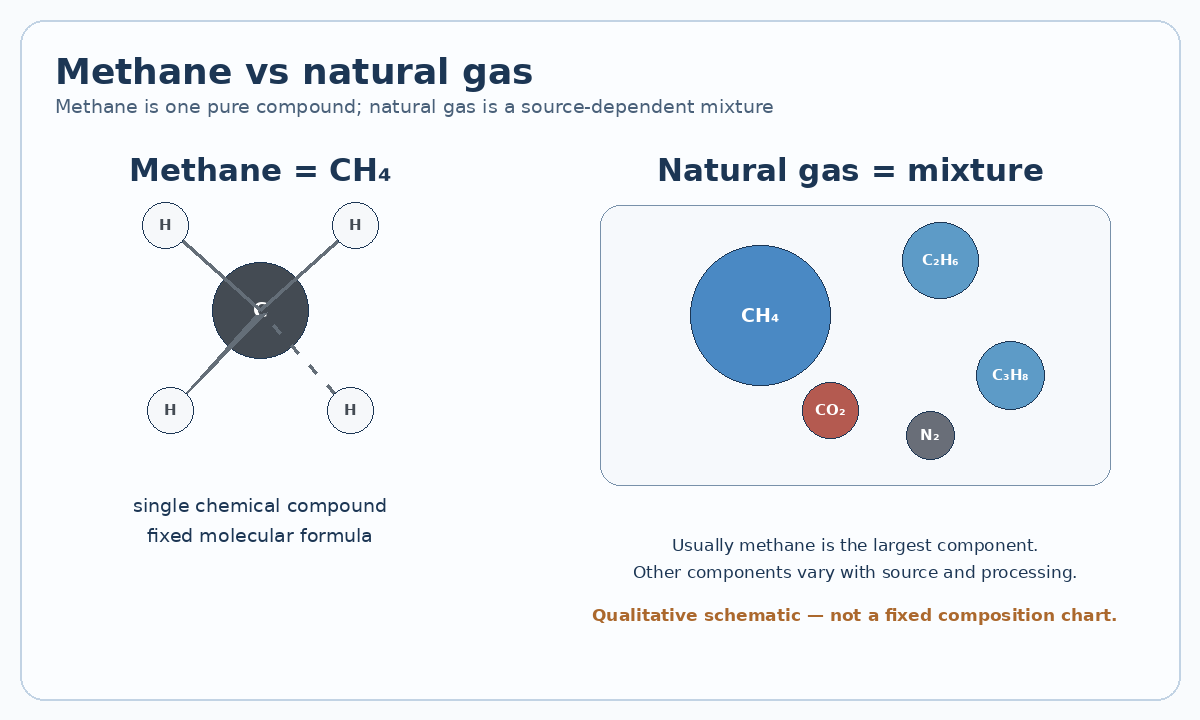
Methane is a pure chemical substance with formula CH₄. If a sample is pure methane, every molecule has the same composition.
Natural gas is a mixture. The U.S. Energy Information Administration describes methane as its largest component, while smaller amounts of hydrocarbon gas liquids and nonhydrocarbon gases can also be present. A single universal “natural gas formula” therefore does not exist.
What does gas processing change?
Raw natural gas can contain water vapor, carbon dioxide, nitrogen, hydrogen sulfide and heavier hydrocarbons in addition to methane. Processing removes unwanted components and can recover ethane, propane, butanes and other hydrocarbon gas liquids.
EIA describes processed dry gas as mostly methane after much of the hydrocarbon liquids and nonhydrocarbon material have been removed. Pipeline specifications then constrain properties such as heat content and impurity levels.
How does methane chemistry connect to natural-gas combustion?
For pure methane, the ideal complete-combustion equation is:
Natural gas contains methane plus other combustible species, so the exact oxygen demand and heat release depend on composition. This is why engineering fuel calculations use actual gas composition/heating value rather than pretending every natural-gas stream is pure CH₄.
Methane, LNG and biogas are related—but not synonyms
LNG is liquefied natural gas, not necessarily pure liquid methane. Biogas from anaerobic digestion commonly contains methane plus substantial CO₂ and other constituents; upgrading can remove CO₂ and other gases to produce a methane-rich gas suitable for certain uses.
These distinctions matter because chemistry, heating value, density, processing and emissions calculations depend on what is actually in the mixture.
Why methane leakage and combustion CO₂ are different climate questions
Burning methane converts much of its carbon to CO₂, while methane released without combustion remains CH₄ in the atmosphere until it is removed by atmospheric processes. EPA identifies methane as a powerful greenhouse gas and also as the primary component of natural gas.
A fuel-system assessment therefore distinguishes combustion emissions from methane leakage/emissions. The chemistry and climate timescales are different.
What students often mix up
Do not write a single chemical formula for “natural gas”; it is a mixture.
Do not assume every natural-gas stream contains the same percentage of methane.
Do not use LNG and liquid methane as automatic synonyms.
Do not treat methane leakage and CO₂ from methane combustion as the same emissions pathway.
Check your understanding
Answer before opening the explanation. The aim is understanding, not speed.
1Which has a fixed chemical formula: methane or natural gas?
Methane. Its formula is CH₄; natural gas is a variable mixture.
2Is methane usually an important component of natural gas?
Yes. It is generally the largest component, though the exact fraction varies.
3Why can natural gas heating value vary?
Because the amounts of methane, ethane, propane and other components vary.
4Is LNG necessarily pure methane?
No. LNG is liquefied natural gas; its composition depends on the processed gas.
Sources and terminology
Definitions and reference claims are anchored to authoritative scientific organizations and peer-reviewed literature where needed. Element Lookup adds teaching explanation, examples and visual structure; it does not treat AI as the source of scientific definitions or numbers.
Found an error, something unclear, or a missing topic?
Tell us what you noticed. Feedback goes to a private review queue and is never published automatically.