

Why Does Sodium Chloride Dissolve in Water?
Salt dissolving looks simple at the macroscopic scale, but the microscopic story connects ionic lattices, water polarity, hydration, free energy and electrical conductivity.
Start simple, then go as deep as you need
The levels are cumulative: Deep dive keeps the earlier explanation visible and adds the more technical layer, caveats, comparisons, retrieval practice and scientific sources.
Why Does Sodium Chloride Dissolve in Water? in one minute
Water molecules stabilize separated Na⁺ and Cl⁻ ions through ion–dipole interactions. Dissolution occurs when the total free-energy balance—lattice disruption, hydration and entropy—favors dispersed hydrated ions. Once the ions are mobile in solution, they can carry electric current.
“Water is polar” is only the beginning. NaCl dissolution is a competition among lattice interactions, ion hydration and entropy; conductivity appears because the dissolved ions can move.
What you will understand before you leave
Learning outcomes
- Explain how water molecules orient around Na⁺ and Cl⁻.
- Distinguish dissociation from ionization and from simply “breaking a molecule”.
- Explain why solid NaCl does not conduct well while molten/aqueous NaCl can.
- Connect lattice energy, hydration and entropy to the free-energy criterion for dissolution.
- Understand why “polar dissolves ionic” is a useful shortcut but not a universal solubility law.
Ideas to know first
Solid NaCl is an extended lattice of Na⁺ and Cl⁻, not a set of separate NaCl molecules.
Water has a partially negative oxygen side and partially positive hydrogen side.
A process is thermodynamically favored when the total Gibbs free-energy change is negative under the stated conditions.
See how the idea connects
These are explanatory steps, not buttons. Read from left to right to follow the cause-and-effect chain.
Na⁺ and Cl⁻ are held in an ordered ionic solid.
Oxygen-rich sides orient toward Na⁺; hydrogen-rich sides orient toward Cl⁻.
Water stabilizes ions after they leave the lattice.
The hydrated ions can move through the liquid and transport charge.
What happens microscopically when NaCl dissolves?
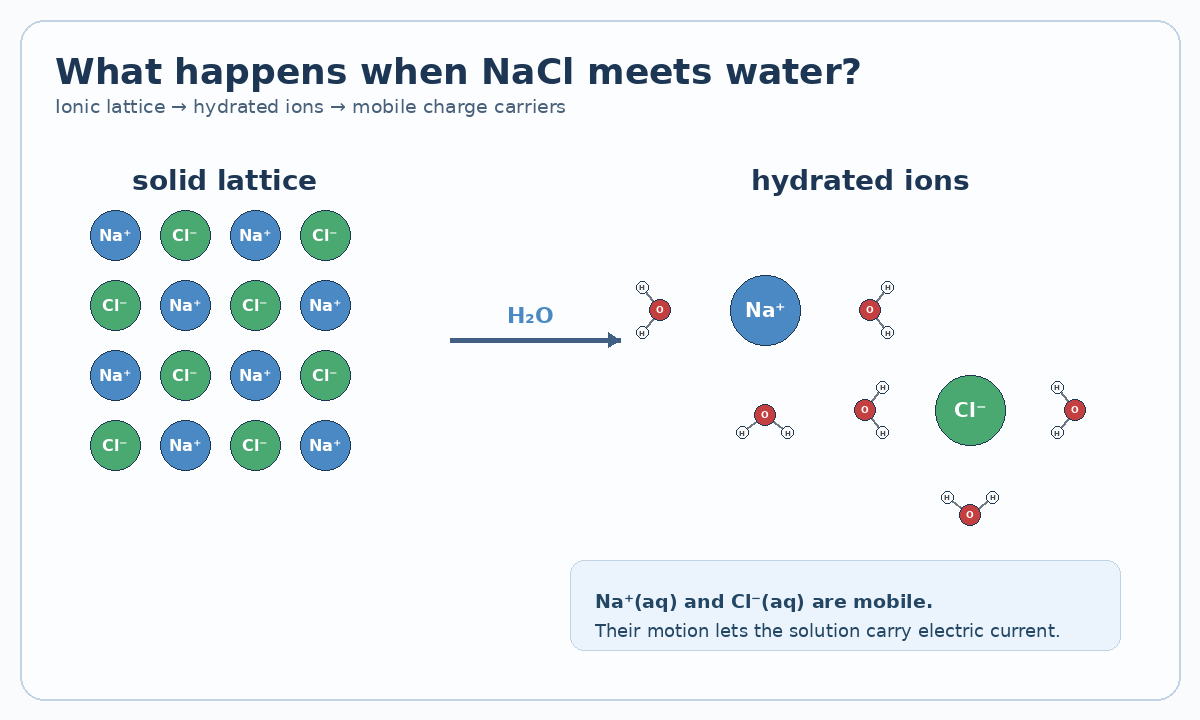
In solid NaCl, Na⁺ and Cl⁻ ions occupy an extended crystal lattice. When the solid contacts water, ion–dipole attractions form between the ions and polar H₂O molecules. The oxygen side of water preferentially faces Na⁺, while the hydrogen side preferentially faces Cl⁻.
The symbol (aq) means the ions are hydrated by water. It does not mean water has chemically converted sodium or chlorine into new elements.
Why is “water breaks the ionic bond” too simple?
Dissolving an ionic solid is an energy balance, not a contest between one “water bond” and one “salt bond.” Separating ions from the lattice requires energy; hydration of the ions releases energy; dispersing particles changes entropy. The relevant thermodynamic quantity is:
A salt dissolves spontaneously under a stated set of conditions when the overall ΔG for the dissolution process is negative. This is why polarity is helpful but cannot, by itself, predict the solubility of every ionic solid.
Why does salt water conduct electricity but solid NaCl does not?
The ions already exist in solid NaCl, but in the crystal they are locked into lattice positions and cannot carry charge through the material by long-range motion. In molten NaCl or aqueous NaCl, the ions are mobile.
That is why sodium chloride is a strong electrolyte when dissolved: a dissolved formula unit contributes separated ions to the solution. Conductivity then depends on ion concentration, ion mobility, temperature and the rest of the solution—not merely on the label “ionic compound.”
Solubility is an equilibrium property, not just “does it dissolve?”
A solution can dissolve only up to its saturation condition at a specified temperature and pressure. Adding more solid after saturation does not force all of it into solution; instead, solid and dissolved species can coexist at equilibrium.
NaCl is quite soluble in water, but its solubility is finite and its temperature dependence is much less dramatic than some salts. A numerical solubility value should always be accompanied by temperature and units.
Worked particle accounting for dissolved NaCl
That particle doubling is useful for introductory colligative-property reasoning, but real solutions are not perfectly ideal. At higher concentrations, ion–ion interactions make activities and effective particle behavior deviate from the simplest model.
What students often mix up
Do not call solid NaCl a collection of NaCl molecules; it is an ionic lattice.
Do not say water dissolves NaCl because “covalent bonds in water are stronger than ionic bonds in salt.” Dissolution is a free-energy balance.
Do not say an ionic solid must conduct electricity just because it contains ions; the charge carriers must be mobile.
Do not quote solubility without temperature and units when numerical precision matters.
Check your understanding
Answer before opening the explanation. The aim is understanding, not speed.
1Which end of water points preferentially toward Na⁺?
The oxygen-rich, partially negative side.
2Why does solid NaCl conduct poorly?
Its ions are fixed in the crystal lattice and cannot move freely through the solid.
3What does Na⁺(aq) mean?
A sodium ion hydrated/solvated by water molecules.
4Does polarity alone guarantee that every ionic solid is highly soluble?
No. Lattice energetics, hydration, entropy and conditions all matter.
Sources and terminology
Definitions and reference claims are anchored to authoritative scientific organizations and peer-reviewed literature where needed. Element Lookup adds teaching explanation, examples and visual structure; it does not treat AI as the source of scientific definitions or numbers.
Found an error, something unclear, or a missing topic?
Tell us what you noticed. Feedback goes to a private review queue and is never published automatically.