

Atomic / phase data
Density, BCC structure and very high melting/boiling references are evaluated.
BCC metal view
Pure tungsten metal is BCC under ordinary conditions.
W vs WC distinction
Tungsten metal and tungsten carbide are treated as different substances/structures.
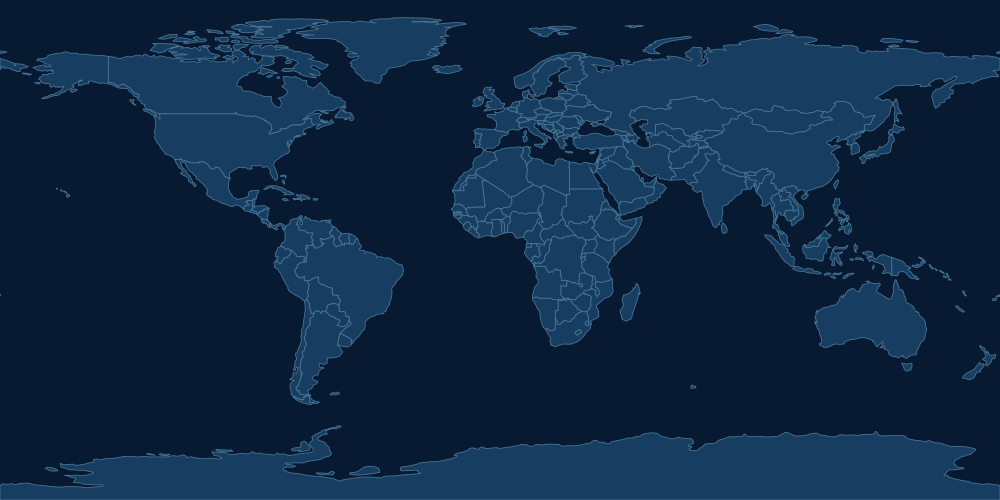
2025 production geography
Selected production points use dated USGS MCS 2026 context.
The lens describes evidence status, not confidence theatre. “Unknown” is kept unknown, and teaching schematics are not presented as direct measurements.
Tungsten (W)
Tungsten is element 74, a very dense BCC transition metal with the highest melting point of any metal. Its symbol W comes from the historical name wolfram, and its material story must distinguish tungsten metal from tungsten carbide.
Tungsten atomic number, mass, electron configuration and key properties
Tungsten: quick answers
How many protons, neutrons and electrons does tungsten have?
Tungsten’s atomic number is 74, so every tungsten atom has 74 protons, and a neutral atom also has 74 electrons. Its most common natural isotope, tungsten-184, has 110 neutrons (other isotopes have different neutron counts).
What is the symbol for tungsten?
The chemical symbol for tungsten is W.
Is tungsten a solid, liquid or gas at room temperature?
Tungsten is a solid at room temperature (about 25 °C).
What family (group) is tungsten in?
Tungsten is a transition metal, in group 6, period 6 of the periodic table.
What is the electron configuration of tungsten?
The ground-state electron configuration of tungsten is [Xe] 4f¹⁴ 5d⁴ 6s².
From atomic number to chemistry
Read these as a chain of causes, not as isolated facts. Each step links to the concept hub if you want the underlying idea explained.
74 protons define tungsten.
The reference ground-state configuration frames atomic and chemical behavior.
Periodic position organizes recurring trends without replacing element-specific evidence.
The teaching nucleus is one isotope, not the relative atomic mass.
Phase claims are evidence-labelled; unknown superheavy bulk boundaries are not fabricated.
Tungsten in its period and family
Tungsten is a Group 6, Period 6 transition metal below molybdenum. Relativistic/heavy-element effects and strong metallic bonding contribute to its distinctive refractory behavior.
Tungsten Visual Lab
Inspect 5d and 6s probability models, rotate a BCC tungsten cell, follow the unusually high melting/boiling range, then compare W metal with WC, ores such as wolframite/scheelite, and selected current production geography.
Every mark points to one exact feature
The numbered markers explain the same information system used throughout Element Lookup. Unknown or predicted fields remain visibly labelled rather than being replaced with guesses.
Tungsten in one minute
Atomic number 74 means 74 protons.
Neutral tungsten has [Xe] 4f¹⁴ 5d⁴ 6s².
Tungsten has the highest melting point of the metals: about 3687 K.
The symbol W comes from “wolfram.”
Tungsten carbide is WC, a compound; it is not the same structure or substance as elemental tungsten metal.
Shell rings organize electron counts. They are not electron trajectories or orbital shapes.
2 · 8 · 18 · 32 · 12 · 2 electrons
The 5d distributions are representative atomic probability models. They do not directly calculate the BCC metal’s electronic band structure or WC bonding.
Tungsten is BCC under ordinary conditions. The conventional-cell viewer represents metallic W; tungsten carbide (WC) is a different compound and structure.. The viewer is evidence-aware: measured structures are identified as such; unknown bulk structures stay unknown.
Teaching visualization; not a literal finite sample or thermal trajectory.What this model does—and does not—show
The 5d distributions are representative atomic probability models. They do not directly calculate the BCC metal’s electronic band structure or WC bonding.
Where do I meet tungsten?
Clickable learning cards connect the element to materials, environment, technology, biology or research - depending on what the evidence actually supports.
Refractory metal
Tungsten retains strength to high temperature and has the highest melting point among metals.
W metal ≠ tungsten carbide
Tungsten’s exceptional high-temperature metal behavior and the hardness of WC are related industrially but arise from different structures.
BCC refractory metal
Pure tungsten is a dense BCC metal with the highest melting point among metals.
Chromium, molybdenum and tungsten
Group 6 connects d-block chemistry with increasingly heavy, refractory metals.
| Period | 4 |
|---|---|
| Melt | 2180 K |
| Period | 5 |
|---|---|
| Role | refractory alloy metal |
| Period | 6 |
|---|---|
| Melt | 3687 K |
Tungsten properties: atomic, physical, thermal and chemical
Categories follow the science of this element rather than a fixed decorative template. Each row carries condition/provenance context and an evidence label; unknown values stay unknown.
| Property | Value | Context / provenance | Evidence |
|---|---|---|---|
| Atomic number | 74 | Source-reviewed; see Sources below | Evaluated |
| Relative atomic mass | 183.84 | Source-reviewed; see Sources below | Evaluated |
| Ground-state electron configuration | [Xe] 4f¹⁴ 5d⁴ 6s² | Source-reviewed; see Sources below | Evaluated |
| Group / period / block | Group 6 · Period 6 · d-block | Periodic-table placement | Evaluated |
| Electronegativity | 2.36 | Source-reviewed; see Sources below | Evaluated |
| Reference isotope | ¹⁸⁴W | Source-reviewed; see Sources below | Evaluated |
| Property | Value | Context / provenance | Evidence |
|---|---|---|---|
| State context | Dense silvery-white solid at 20 °C | Source-reviewed; see Sources below | Evaluated |
| Density | 19.3 g/cm³ | Source-reviewed; see Sources below | Evaluated |
| Material / molecular structure | Tungsten metal · body-centred cubic | Tungsten is BCC under ordinary conditions. The conventional-cell viewer represents metallic W; tungsten carbide (WC) is a different compound and structure. | Measured |
| Classification | Transition metal | Periodic-table / chemistry classification | Evaluated |
| Structure-model scope | Tungsten is BCC under ordinary conditions. The conventional-cell viewer represents metallic W; tungsten carbide (WC) is a different compound and structure. | Teaching visualization; exact crystallographic coordinates are not implied unless stated. | Reviewed |
| Property | Value | Context / provenance | Evidence |
|---|---|---|---|
| Melting / transition reference | 3687 K | Source-reviewed; see Sources below | Evaluated |
| Boiling / gas reference | 5828 K | Source-reviewed; see Sources below | Evaluated |
| Phase-path context | At approximately standard pressure, tungsten remains BCC solid to about 3687 K, then liquid to about 5828 K before becoming gaseous—an exceptionally high-temperature phase range for a metal. | Shared phase registry drives the slider, regions and markers. | Evaluated |
| Condition warning | Temperature and pressure define phase behavior; purity/allotropy may matter. | Teaching condition statement | Reviewed |
| Property | Value | Context / provenance | Evidence |
|---|---|---|---|
| Ordinary electrical behavior | Metallic conductor | Qualitative bulk behavior; exact resistivity depends on temperature, purity and alloy state. | Measured |
| Conduction model | Collective solid-state electrons | Do not interpret isolated-atom orbital clouds as literal current paths. | Reviewed |
| Surface / compound caveat | Oxides, salts and alloys can behave differently from the pure metal | Material context | Reviewed |
| Engineering values | Condition-dependent | Use condition-specific materials data for engineering calculations. | Reviewed |
| Property | Value | Context / provenance | Evidence |
|---|---|---|---|
| Common oxidation states | +6, +4 | Source-reviewed; see Sources below | Evaluated |
| Ion / common ion context | W⁶⁺ | Source-reviewed; see Sources below | Evaluated |
| Periodic chemistry context | Tungsten is a Group 6, Period 6 transition metal below molybdenum. Relativistic/heavy-element effects and strong metallic bonding contribute to its distinctive refractory behavior. | Element-specific interpretation | Reviewed |
| Chemistry caution | Elemental form, ions and compounds are distinct chemical objects. | Interpretive teaching rule | Reviewed |
| Property | Value | Context / provenance | Evidence |
|---|---|---|---|
| ¹⁸⁴W | Stable natural isotope | Reference teaching nucleus with 74 protons and 110 neutrons. | Evaluated |
| ¹⁸²W | Stable natural isotope | Important in isotope geochemistry and early Solar System chronology. | Evaluated |
| ¹⁸⁶W | Stable natural isotope | Another abundant stable natural tungsten isotope. | Evaluated |
| Teaching nucleus | ¹⁸⁴W · 74 protons + 110 neutrons | Reference isotope used in the nucleus model | Reviewed |
Is Tungsten a solid, liquid or gas? State at temperature
At approximately standard pressure, tungsten remains BCC solid to about 3687 K, then liquid to about 5828 K before becoming gaseous—an exceptionally high-temperature phase range for a metal.
Where on Earth is Tungsten found or produced?
Who discovered Tungsten, and when?
Carl Wilhelm Scheele identified a new acid from scheelite, pointing toward a new element.
Juan José and Fausto Elhuyar isolated tungsten from wolframite.
Tungsten became central to lamp filaments, hardmetals, high-temperature alloys and specialized electrodes.
China dominates mine production, while recycling and diversified supply remain strategically important.
From scheelite/wolframite to tungsten products: a high-level path
Tungsten occurs mainly in minerals such as scheelite and wolframite rather than as native metal.
Mining/beneficiation produce tungsten concentrates; deposit geology and production geography are distinct layers.
Industrial conversion produces tungsten chemicals/powders and metal under controlled high-temperature processes; no processing recipe is provided here.
Metal powder, alloys and carbides become high-temperature, cutting, wear and dense-engineering products; tungsten-bearing scrap can be recycled.
What is tungsten used for?
Hardmetals
Tungsten carbide-based materials dominate many cutting, drilling and wear-resistant tools.
High-temperature components
Elemental W and W alloys are used where extreme heat resistance matters.
Electrical applications
Tungsten appears in electrodes, contacts and legacy lamp-filament technology.
High-density parts
Dense tungsten materials are used in balancing, vibration control and other compact-mass applications.
Tungsten isotopes and natural abundance
¹⁸⁴W
Stable natural isotopeReference teaching nucleus with 74 protons and 110 neutrons.
¹⁸²W
Stable natural isotopeImportant in isotope geochemistry and early Solar System chronology.
¹⁸⁶W
Stable natural isotopeAnother abundant stable natural tungsten isotope.
Five-question Tungsten check
What is tungsten’s atomic number?
What does W stand for historically?
Which statement is correct?
What is exceptional about tungsten’s melting point?
What is the ordinary metal structure?
Tungsten questions students commonly ask
Each answer starts with the direct fact, then explains the chemistry, evidence or material context so the result is understandable rather than merely memorized.
What is tungsten’s atomic number?
Short answer: 74.
Atomic number is defined by proton count, so 74 protons are what make an atom tungsten. A neutral tungsten atom also has 74 electrons, while isotopes can have different neutron counts without changing the element.
Key point: Atomic number = proton count.
Why is tungsten’s symbol W?
Short answer: W comes from the historical name wolfram, still reflected in mineral names such as wolframite.
Tungsten is element 74, a very dense BCC transition metal with the highest melting point of any metal. Its symbol W comes from the historical name wolfram, and its material story must distinguish tungsten metal from tungsten carbide. The symbol W comes from “wolfram.”.
Key point: The mechanism matters: connect the observed behavior to electron structure, bonding, phase or the specific material form rather than memorizing the result alone.
What is tungsten used for?
Short answer: Hardmetals/carbides, high-temperature components, electrodes, dense parts and specialized alloys.
Hardmetals: Tungsten carbide-based materials dominate many cutting, drilling and wear-resistant tools. High-temperature components: Elemental W and W alloys are used where extreme heat resistance matters. “Hard tungsten” is often shorthand for tungsten carbide tools, but WC is a compound. Elemental W is exceptionally refractory and dense; carbide hardness comes from a different bonded structure.
Key point: Always distinguish the pure element from the compound, alloy, isotope or device material that actually performs the application.
Why does tungsten have such a high melting point?
Short answer: Tungsten has exceptionally strong cohesion in its metallic solid, so a large amount of thermal energy is needed to disrupt the crystal enough to melt it.
The high melting point reflects the electronic structure and bonding of a transition-metal solid, not simply “many electrons” or “large atomic mass.” Tungsten’s valence d and s electrons contribute to strong metallic bonding in its body-centered-cubic crystal. The Royal Society of Chemistry lists a melting point near 3695 K (3422 °C; compilations differ slightly by evaluation).
Key point: High melting point is a collective bonding/solid-state property; it cannot be predicted from atomic mass alone.
Is tungsten carbide the same as tungsten?
Short answer: No. WC is a compound with carbon and a different structure/properties.
“Hard tungsten” is often shorthand for tungsten carbide tools, but WC is a compound. Elemental W is exceptionally refractory and dense; carbide hardness comes from a different bonded structure. Hardmetals Tungsten carbide-based materials dominate many cutting, drilling and wear-resistant tools.
Key point: The pure element, its ions, compounds and alloys are different materials and should not be treated as interchangeable.
Is tungsten dense?
Short answer: Yes. Its density is about 19.3 g/cm³, comparable with gold.
Tungsten is element 74, a very dense BCC transition metal with the highest melting point of any metal. Its symbol W comes from the historical name wolfram, and its material story must distinguish tungsten metal from tungsten carbide. High-density parts Dense tungsten materials are used in balancing, vibration control and other compact-mass applications.
Key point: Use the direct answer together with the material, isotope and evidence context shown elsewhere on the page.
Why was tungsten used in incandescent light-bulb filaments?
Short answer: Tungsten can operate at very high temperature without melting and has sufficiently low vapor loss and useful mechanical behavior for a glowing filament.
An incandescent lamp produces visible light by heating a conductor until its thermal emission reaches the visible range. Tungsten’s exceptionally high melting point makes that possible at temperatures where many metals would melt or evaporate too rapidly. Real filaments also depend on wire geometry, microstructure and manufacturing; the element’s melting point is essential but not the entire engineering story.
Key point: Tungsten was chosen for a system-level combination of high-temperature stability, vapor behavior and manufacturability—not melting point alone.
Scientific sources for Tungsten
- Royal Society of Chemistry - Tungsten
- NIST - Atomic Data for Tungsten
- USGS - Mineral Commodity Summaries 2026
- RSC — Tungsten
Questions to ask next about Tungsten
A good element lesson should lead to the next useful question, not end after a list of facts.
Found an error, something unclear, or a missing topic?
Tell us what you noticed. Feedback goes to a private review queue and is never published automatically.